

In any relationship, conflicts are bound to arise. Whether it’s with our significant others, family members, friends, or colleagues, disagreements are a natural part of human interactions. However, how we handle these conflicts can make all the difference in the health and longevity of our relationships.
This is where the art of fair fighting comes into play.
Fair fighting involves understanding the principles and guidelines that promote healthy and constructive resolution of conflicts.
Fair fighting is not about avoiding conflicts or suppressing emotions, but rather about embracing them in a constructive and respectful manner.
It is a skill that can transform disagreements into opportunities for growth and understanding.
In this blog post, we will explore what constitutes fair fighting, why it is important in relationships, and how outlining fair fighting rules can pave the way for healthier and more fulfilling interactions.
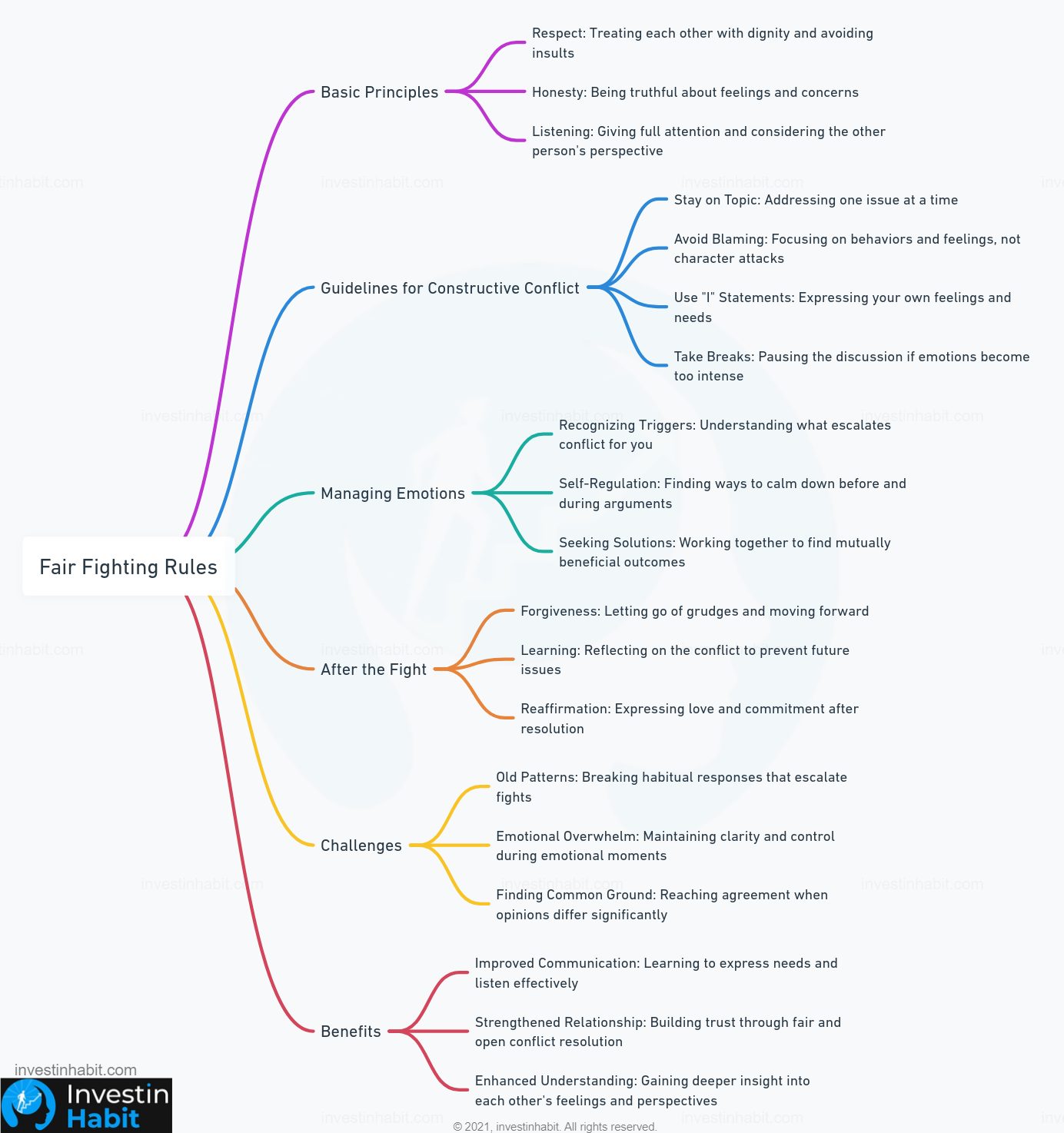
Inside this Article
Understanding Fair Fighting
In this section, we’ll dive into the nitty-gritty of what fair fighting actually means. So, grab a cup of coffee, get comfy, and let’s get started!
First things first, what exactly is fair fighting? Well, fair fighting is all about finding a healthy and constructive way to resolve conflicts. It’s not about avoiding disagreements or pretending like everything is rainbows and sunshine. Instead, it’s about embracing conflicts as an opportunity for growth and understanding.
Now, let’s talk about the difference between fighting fair and fighting dirty. When you fight fair, you approach conflicts with respect, empathy, and open-mindedness. You listen to the other person’s point of view, express your own thoughts and feelings without attacking or belittling them, and work towards finding a mutually beneficial solution. It’s like a friendly game of tennis, where both players play by the rules and strive for a fair outcome.
On the other hand, fighting dirty is when conflicts turn into a battlefield. It’s about hitting below the belt, using hurtful words, and trying to win at all costs. It’s like a wrestling match where there are no rules, and it’s every person for themselves. Needless to say, fighting dirty only leads to more pain, resentment, and damaged relationships.
Now, let’s talk about the benefits of fair fighting. When you engage in fair fighting, you create an atmosphere of trust and safety in your relationships. You allow yourself and the other person to express your thoughts and emotions without fear of judgment or retaliation. This openness fosters understanding and empathy, which are crucial for building strong and healthy connections.
Fair fighting also promotes personal growth and self-awareness. It challenges you to examine your own beliefs, biases, and triggers. It gives you an opportunity to learn from the other person’s perspective and expand your own horizons. By  practicing fair fighting, you become more skilled at managing conflicts, which can positively impact all areas of your life.
Fair fighting is a concept that embraces the inevitability and acceptability of conflicts in any form of relationship. According to McKay, Davis, and Fanning in their 1995 book “Messages: The Communication Skills Book,” this type of conflict resolution is grounded in three fundamental principles:
- Recognition of the Inevitability of Conflicts: This principle acknowledges that disagreements and conflicts are a natural part of human interactions. Instead of perceiving conflicts as something negative or harmful, fair fighting treats them as opportunities for growth and understanding. It suggests that by accepting conflict as an unavoidable element of relationships, individuals can approach disagreements with a mindset geared towards resolution and compromise rather than avoidance or victory.
- Equality of Needs: Fair fighting stresses that in any dispute, the needs, desires, and feelings of each individual involved are of equal importance. This egalitarian view rejects the idea that one person’s needs should dominate or overshadow those of the other. It encourages individuals to listen actively and empathetically to each other and to recognize that acknowledging someone else’s needs does not diminish their own.
- Mutual Victory as an Outcome: The third principle is the belief in the possibility of finding solutions where both parties come out as winners. This win-win scenario is in stark contrast to a zero-sum game where one person’s gain is the other’s loss. Fair fighting promotes the idea that through effective communication, creativity, and a willingness to compromise, it is possible to find resolutions that satisfy the core needs of both individuals. This approach fosters a spirit of collaboration and partnership, paving the way for stronger and more resilient relationships.
These principles serve as the pillars for constructive communication and problem-solving in relationships. They emphasize respect, empathy, and the pursuit of mutual satisfaction as key to resolving conflicts in a healthy and fair manner.
So, there you have it – a little sneak peek into the world of fair fighting.

Transform Your Life with InvestInHabit

Ready for real change? Join us and get over:
- 200+ Personal Development Worksheets,
- 100+ Blog Post MindMaps
for FREE! 😍 + Our newsletter offers the latest in habit formation and self-improvement, straight to your inbox.
Subscribe now and Start redefining your mindset today! Join our community committed to success!
Preparing for Fair Fighting
Now that we understand what fair fighting is all about, let’s dive deeper into the key factors that can make your discussions more productive and meaningful. Before engaging in any discussion, it’s crucial to have a strong foundation of self-awareness. This means taking the time to reflect on your own thoughts, emotions, and triggers. By understanding yourself better, you’ll be better equipped to express your needs and concerns in a calm and respectful manner.
Imagine this: you’re about to have a conversation with someone about a sensitive topic. You want to make sure that both of you are in the right headspace to have a constructive dialogue. Emotional readiness is essential for productive  discussions. It’s important to check in with yourself and ask, “Am I feeling calm and collected? Am I open to listening and understanding the other person’s perspective?”
Timing is everything when it comes to addressing issues in a relationship. Just like in comedy, timing can make or break a joke. Similarly, choosing the right moment to address concerns can greatly impact the outcome of your discussion.
If you bring up a sensitive topic when the other person is already stressed or overwhelmed, it may not be the best time to have a meaningful conversation. The same goes when they are hungry, or busy with other things.
Take a moment to consider the timing and choose a moment when both parties are more likely to be receptive and attentive.
Preparing for fair fighting is like preparing for a friendly game of tennis. You want to ensure that you have all the right equipment and mindset to play the game well. Self-awareness, emotional readiness, and timing are the essential tools that can help you navigate through conflicts with grace and understanding. By being mindful of these factors, you’ll create a space where both parties can express themselves freely and be heard without fear of judgment or retaliation.
Basic Rules of Engagement
Think of these rules as the guiding principles for a friendly game of tennis, where both players strive for a fair and mutually beneficial outcome.
Rule 1: No name-calling or derogatory language. Now, I know it can be tempting to let our emotions get the best of us and resort to hurtful words, but trust me, it won’t get us anywhere. Instead, let’s focus on respectful and constructive communication. By refraining from name-calling or using derogatory language, we create an environment where both parties feel safe and respected.
Rule 2: Stay on topic – avoid bringing up past issues. We all have a tendency to let past grievances seep into our present discussions. But here’s the thing: bringing up old wounds only muddles the conversation and detracts from finding a resolution. So, let’s stay focused on the current issue at hand. By doing so, we can address the matter at its core and work towards a solution that satisfies both of us.
Rule 3: No yelling – maintain a calm tone of voice. Remember, I mentioned earlier how timing is everything? Well, that includes our tone of voice too. Yelling or speaking in an aggressive manner only heightens tensions and closes off effective communication. Instead, let’s strive to keep our voices calm and composed. By doing so, we create a space where both parties can express themselves without fear or intimidation.
Rule 4: Listen actively and empathetically. Ah, listening – such an underrated skill! But trust me, it’s the secret ingredient to successful communication. When we actively listen to each other, we show that we value and respect the other person’s perspective. Let’s put ourselves in their shoes, try to understand where they’re coming from, and respond with empathy. By doing so, we foster a sense of understanding and create a solid foundation for finding a mutually beneficial solution.
So, there you have it – the basic rules of engagement for effective communication and conflict resolution. Remember, just like in a friendly game of tennis, these rules are meant to guide us towards a fair and positive outcome.
By adhering to these principles, we create an environment where both parties can freely express themselves and work towards finding common ground.
So, let’s grab our metaphorical rackets and get ready to ace those conversations!
Advanced Fair Fighting Techniques
We’ve covered the basic rules of engagement, but now it’s time to level up and explore some advanced fair fighting techniques. These techniques will help you navigate those tough conversations with finesse and skill. So, let’s dive right into Section 4: Advanced Fair Fighting Techniques!
Technique 1: Use “I” statements to express feelings without blaming. You know that feeling when someone starts a sentence with “You always” or “You never”? It instantly puts us on the defensive, right? Well, here’s a little secret: using “I” statements can make all the difference. Instead of saying, “You never listen to me,” try saying, “I feel unheard when I’m speaking.” By focusing on your own feelings and experiences, you create a safe space for open dialogue without pointing fingers. It’s a win-win!
I-Statements: The Key to Healthy and Effective Communication
Technique 2: Focus on finding solutions, not winning the argument. In the heat of the moment, it’s easy to get caught up in the desire to be right. But remember, the goal here is not to win the argument, but to find a solution that works for both parties. So, instead of trying to prove your point, shift your mindset to problem-solving mode. Ask yourself, “How can  we work together to find a resolution?” This collaborative approach will not only yield better results, but also strengthen your relationship in the long run.
Technique 3: Know when to take a time-out if tensions escalate. We’ve all been there – those moments when emotions run high and it feels like the conversation is spiraling out of control. That’s when it’s crucial to recognize the signs and take a time-out. Stepping away from the situation allows both parties to cool down, gather their thoughts, and come back to the conversation with a fresh perspective. Remember, it’s okay to hit the pause button when things get overwhelming. Your mental well-being and the quality of the conversation are worth it.
Technique 4: Practice reflective listening to show understanding. Ah, the power of listening! It’s not just about hearing the words, but truly understanding the other person’s perspective. Reflective listening is a technique that helps you do just that. It involves paraphrasing what the other person said and expressing it back to them. For example, you could say, “So, if I understand correctly, you’re feeling frustrated because you think I don’t appreciate your efforts.” This shows that you’re actively engaged in the conversation and genuinely trying to understand where they’re coming from. It’s a powerful tool for building empathy and finding common ground.
There you have it – four advanced fair fighting techniques to add to your communication toolkit. Remember, it’s all about creating a space where both parties can express themselves without fear or intimidation. By using “I” statements, focusing on solutions, knowing when to take a time-out, and practicing reflective listening, you’ll be well-equipped to navigate those tricky conversations with grace and effectiveness.
So, keep these techniques in mind, grab your metaphorical rackets, and let’s ace those conversations together!
- Prioritize Communication: Engage in open dialogue. Instead of saying, “You never listen,” try “I feel unheard when I talk about my day and you don’t seem engaged. What’s a good time for us both?”
- Focus on the Present Issue: Keep discussions relevant. If arguing about chores, don’t bring up past unrelated arguments. Say, “I’m feeling overwhelmed with the household tasks this week,” rather than “You always leave everything for me to do.”
- Express Emotions Clearly: Share your feelings with “I” statements. “I feel frustrated when we’re late because it makes me anxious,” is clearer and less confrontational than “You’re always dragging your feet.”
- Active Listening: Listen without interrupting. For instance, if your partner is explaining their point of view, nod and say, “I understand that you feel that way,” instead of cutting them off.
- Respect Different Perspectives: Acknowledge the other person’s feelings. You might say, “I can see why you would feel upset about that,” to show understanding without necessarily agreeing.
- Seek Win-Win Solutions: Aim for compromise. For example, if you disagree on vacation destinations, find a place that offers activities you both enjoy.
- Take Turns Talking: Ensuring each person has a chance to speak without interruption contrasts with chaotic discussions where voices are lost, promoting respectful and effective communication.
- Articulate Needs and Goals: Share your aspirations openly, like discussing financial goals with statements like, “I hope we can save up for a home together. What are your thoughts?”
- Concentrate on Shared Priorities: Let minor issues slide and focus on what truly matters to both of you. If being on time is important, focus on that rather than quibbling over wardrobe choices.
- Optimal Timing for Discussions: Choose a peaceful moment for talks, not when you’re both tired or stressed. Propose, “Can we talk about this on Saturday morning when we’re both relaxed?”
- Take Breaks to Cool Down: If emotions run high, take a timeout. “Let’s take a 20-minute break and come back to this,” can prevent saying things in the heat of the moment.
- Avoid Stonewalling: Keep the conversation going, even when it’s tough. Rather than walking away, try saying, “I need a moment to gather my thoughts.”
- Maintain Respectful Boundaries: No yelling or insults. If things escalate, remind each other of this rule: “We agreed to keep our voices down, let’s stick to that.”
- Own Your Part in Conflicts: Accept responsibility. “I realize I raised my voice, and I’m sorry,” shows willingness to acknowledge your role.
- Release Resentment: Forgive past issues. After resolving, consciously decide to move forward without holding grudges.
- Refrain from Assumptions: Verify rather than assume. Ask, “What did you mean by that?” to avoid misinterpretations.
- Focus on Reconciliation: After the argument, focus on healing and reconciliation instead of holding onto resentment or anger. This helps to build a stronger relationship moving forward.
- Move Forward Post-Resolution: Once resolved, don’t revisit the conflict. Reinforce this by saying, “We’ve worked through this, let’s focus on our next steps together.”
- Don’t Exaggerate: Exaggerating problems can escalate the disagreement and make it harder to find a resolution. Be factual and honest about the issue.
- Clarify Misunderstandings: If something is not clear, ask for clarification instead of assuming the worst. Misunderstandings can easily turn small issues into major disputes.
- Maintain Privacy: Keep your disagreements private. Discussing your private matters with friends or family can be embarrassing for your partner and may affect how others see your relationship.
- Avoid Physical Confrontation: Never let a disagreement turn physical. It is essential to respect each other’s physical space and never resort to intimidation or physical force.
- Don’t Use Sarcasm: Sarcasm can be biting and hurtful, and it often masks deeper issues. It’s better to be direct and sincere.
- Avoid Public Arguments: Having a disagreement in public not only makes the situation more stressful due to the added embarrassment but also puts undue pressure on both parties to act out of concern for public image rather than to resolve the issue.
Navigating Conflict Resolution
This is where we dive into the nitty-gritty of finding common ground, acknowledging perspectives, and reinforcing understanding and love after a fight. So, let’s get right into it!
When it comes to resolving conflicts, finding common ground and compromising are key. Remember, it’s not about  winning or losing, but about reaching a fair and mutually beneficial outcome. To do this, both parties need to be willing to listen and understand each other’s perspectives. So, take a step back, breathe, and open yourself up to truly hearing what the other person has to say. Trust me, it makes a world of difference!
Now, let’s talk about acknowledging the other person’s perspective. This is crucial in any conflict resolution process. When you acknowledge someone’s perspective, you’re showing them that you value their thoughts and feelings. It’s about saying, “Hey, I hear you, and I understand where you’re coming from.” This simple act of acknowledgement can go a long way in building empathy and finding common ground. So, don’t be afraid to put yourself in their shoes and see things from their point of view.
Once the fight is over, it’s important to take steps to reinforce understanding and love. Remember, conflicts are a part of life, but how we handle them can make all the difference. So, after the dust settles, make an effort to have an open and honest conversation with the other person. Talk about what happened, how it made you feel, and what you both can do moving forward to prevent similar conflicts. This not only helps in resolving the current issue but also strengthens your relationship by fostering understanding and love.
And there you have it! You’ve now learned some valuable techniques for navigating conflict resolution. Remember, it’s all about finding common ground, acknowledging perspectives, and reinforcing understanding and love. So, the next time you find yourself in a heated disagreement, keep these tips in mind and approach the situation with an open heart and mind. You’ve got this!
When Fair Fighting Rules Break Down
So far, we’ve covered some great techniques for resolving conflicts and finding common ground. But let’s face it – sometimes, despite our best efforts, fair fighting rules can break down. It happens to the best of us! But don’t worry, because there are still ways to navigate through these tough situations.
The first step is recognizing when professional help is needed. Sometimes, conflicts can become so complex and emotionally charged that it’s difficult to resolve them on our own. And that’s perfectly okay! Seeking the guidance of a couples therapist can be incredibly beneficial. They have the expertise and experience to help you and your partner work through your issues in a healthy and constructive way. Remember, reaching out for help is a sign of strength, not weakness. It shows that you’re committed to finding a resolution and improving your relationship.
Couples therapy plays a crucial role in teaching fair fighting skills. During these sessions, you’ll learn effective communication techniques, active listening, and how to express your emotions without attacking or criticizing each other. It’s like a crash course in healthy conflict resolution! The therapist acts as a neutral third party, guiding you through the process and helping you both understand each other’s perspectives. With their guidance, you’ll be equipped with the tools you need to navigate conflicts in a fair and respectful manner.
Now, let’s talk about strategies for rebuilding communication after a breakdown. It’s important to remember that conflicts are  a normal part of any relationship. But when they start to pile up and communication breaks down, it can feel overwhelming. The key here is to take a step back and give yourselves some space to cool down. Once you both feel calmer, it’s time to have an open and honest conversation.
Start by acknowledging the breakdown in communication and expressing how it made you feel. Use “I” statements to avoid blaming or attacking the other person. For example, say something like, “I felt hurt and misunderstood when our conversation turned into an argument.” This helps create a safe space for open dialogue and prevents the other person from becoming defensive.
Next, listen to your partner’s perspective with an open heart and mind. Really try to understand where they’re coming from and validate their feelings. Remember, empathy is key! Once you both have a better understanding of each other’s viewpoints, you can work together to find common ground and rebuild your communication.
So there you have it – some strategies for when fair fighting rules break down. Remember, conflicts are a natural part of any relationship, but how we handle them can make all the difference. If you find yourselves struggling to resolve conflicts on your own, don’t hesitate to seek professional help. And always remember to approach these situations with empathy, understanding, and a willingness to rebuild communication.
Understanding Dirty Fighting: The Antithesis of Fair Conflict Resolution
In healthy relationships, resolving conflicts fairly is vital. However, it is just as crucial to recognize and avoid the destructive tactics of “dirty fighting,” which can undermine the trust and bond between partners. Here’s a breakdown of behaviors that contrast starkly with fair fighting rules, serving as a guide for what not to do during disagreements.
The Tactics of Dirty Fighting:
- Losing Emotional Control: Allowing anxiety to govern actions, resulting in escalating arguments and potential shouting matches.
- Interrupting: Not allowing your partner to express their thoughts fully, assuming you already know what they will say, and dismissing their viewpoint.
- Disrespecting Your Partner: Using yelling, name-calling, or intimidation tactics, which degrade your partner and the relationship.
- Avoiding Conflict: Consistently dodging discussions about issues, leading to bottled-up resentment and explosive arguments later on.
- Bringing Up the Past: Rehashing old mistakes to use as ammunition in current disputes, which can make your partner feel attacked and helpless.
- Mixing Multiple Issues: Introducing unrelated grievances during an argument, diverting focus from the current problem and complicating resolution.
- Generalizing: Employing absolutes like “always” or “never,” which can distort the reality of the situation and invalidate your partner’s efforts.
- Lashing Out: Waiting until you’re extremely agitated to discuss issues, which often results in hurtful outbursts and destructive criticism.
- Failing to Seek Understanding: Not attempting to comprehend your partner’s perspective, which can lead to winning the argument but potentially losing the relationship.
- Excessive Criticism: Harshly criticizing your partner instead of focusing on constructive ways to address the issue at hand.
- Concealing Needs and Feelings: Not communicating your true needs and feelings, leading to misunderstandings and a lack of fulfillment in the relationship.
- Blaming: Pointing fingers without taking any personal responsibility, which can diminish self-esteem and intimacy.
- Threatening the Relationship: Using threats of divorce or breakup to win an argument, which can cause lasting insecurity and damage.
- Leaving Issues Unresolved: Avoiding the hard work of resolving conflicts fully, allowing them to smolder and potentially reignite later.
- Keeping Score: Competing with your partner and keeping tabs on each other’s mistakes, which can breed resentment and a sense of inequality.
- Using Children as Leverage: Involving children in adult conflicts, which can have harmful effects on their emotional well-being.
- Fighting in Front of Children: Exposing children to conflict, which can lead to feelings of instability and responsibility for the parents’ issues.
- Using Degrading Language: Resorting to insults and derogatory comments, which can cause lasting hurt and resentment.
It is important to recognize these behaviors as red flags. They serve as a reminder of what can go wrong if we lose sight of respectful, constructive communication. By avoiding these tactics, couples can work towards resolving their differences in a way that strengthens, rather than weakens, their bond.
Conclusion
In this blog post, we have explored the basic rules of engagement in a relationship and the importance of practicing fair fighting. We discussed how threatening the relationship, leaving issues unresolved, keeping score, using children as leverage, fighting in front of children, and using degrading language can all have damaging effects on a relationship. These behaviors serve as red flags, reminding us of the importance of respectful and constructive communication.
It is crucial for couples to recognize these behaviors and avoid them in order to strengthen their bond. By practicing fair fighting and resolving conflicts in a healthy manner, couples can build a stronger and more fulfilling relationship. Remember, the goal is not to win an argument, but to work towards a fair and mutually beneficial outcome.
As we conclude, I encourage all readers to reflect on these rules and practice them in their own relationships. By implementing fair fighting strategies, we can create a safe and nurturing environment for open communication and conflict resolution. Remember, constructive conflict can lead to growth and understanding, strengthening our relationships even further.
In the words of author and motivational speaker, Zig Ziglar, “Conflicts are opportunities for growth. When they arise, seize the chance to communicate, understand, and build a stronger connection.”
Now, I invite you, our readers, to share your own experiences with fair fighting. Have you encountered challenges in your relationships? How have you navigated conflicts in a constructive way? By sharing our stories, we can learn from each other and inspire one another to practice fair fighting in our relationships.
Let’s commit to fostering healthy and respectful communication, and together, we can create stronger and more fulfilling relationships.
Transform Your Habits, Transform Your Life
Are you ready to turn the page to a new chapter in your life?
Stop dreaming, start achieving. Our exclusive newsletter delivers:
- Science-backed hacks: Master the psychology of habit formation used by CEOs and Olympians.
- Actionable strategies: No fluff, just practical steps to crush procrastination and dominate your goals.
- + a FREE surprise bonus 🎁 to jumpstart your transformation!
Don’t settle for mediocre. Subscribe now!