

Reflective listening is a communication strategy that involves actively focusing on the speaker, absorbing the content of their message, and responding by mirroring and paraphrasing their sentiments and feelings back to them.
This technique allows the speaker to hear their own thoughts and emotions articulated from another person’s perspective, providing clarity, validation, and a sense of being understood.
It’s about creating a safe space for expression, ensuring the speaker truly feels heard. In doing so, it nurtures deeper connections, fostering an environment of trust and mutual understanding.
In both personal and professional realms, effective communication is the cornerstone of healthy relationships. Reflective listening plays a pivotal role in achieving this, as it goes beyond surface-level interactions, encouraging deeper understanding and empathy.
In personal relationships, it can strengthen bonds, build trust, and resolve conflicts.
Professionally, it can enhance teamwork, improve problem-solving skills, and promote a positive work environment. By prioritizing reflective listening, we open doors to more authentic and supportive interactions, regardless of the context.
Throughout this blog post, we will delve into the nuances of reflective listening, differentiating it from active listening and highlighting its key components.
We will explore the numerous benefits it brings to various types of relationships and address common challenges and misconceptions associated with it.
Practical tips and strategies for honing this vital skill will be provided, alongside examples of its application in different contexts.
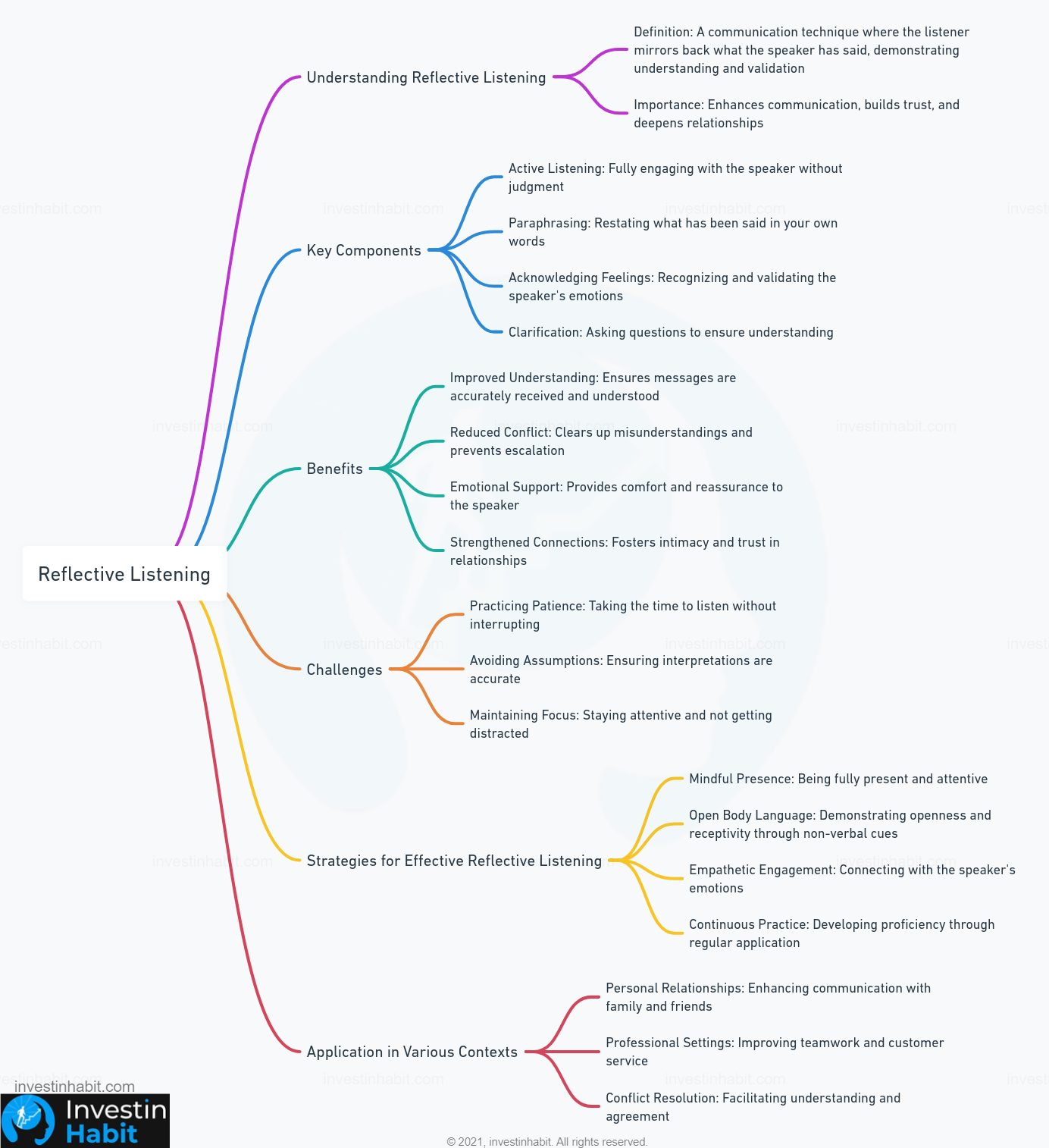
Inside this Article
The Basics of Reflective Listening
In this section, we’re going to dive into the basics of reflective listening and explore its key components. So, grab a cup of coffee, get comfy, and let’s get started!
First things first, let’s clarify the difference between active listening and reflective listening.
While active listening involves giving your full attention to the speaker and showing that you’re engaged, reflective listening takes it a step further.
It’s about not only listening but also reflecting back what the speaker is saying, both in terms of content and emotions.
It is all about helping the speaker reach their goals when they are talking. It allows the speaker to better understand their own feelings, clear up their thoughts, and figure out what to do next. The main difference between active and reflective listening lies in the aim of reflective listening, which is to foster the speaker’s self-awareness and insight.
It aims to helps the speaker learn more about themselves and see things in a new way. It’s about helping the speaker make new connections in their thoughts.
Now, let’s break down the key components of reflective listening. The first one is paying full attention. When practicing reflective listening, it’s crucial to give your undivided attention to the speaker. Put away your phone, turn off the TV, and really focus on what they’re saying.
Trust me, it makes a world of difference in the quality of your communication.
Next, we have holding back judgment. This can be a tough one, as we often have a natural tendency to jump to conclusions or form opinions while listening. But when you actively work on suspending judgment and truly understanding the speaker’s perspective, it creates a safe space for open and honest dialogue.
Another important component is reflecting the speaker’s feelings. It’s not just about understanding the words they’re saying, but also acknowledging and empathizing with their emotions. By reflecting their feelings back to them, you show that you truly care and are invested in their experience.
Last but not least, we have clarifying and summarizing. This step involves paraphrasing what the speaker has said to ensure that you’ve understood them correctly. It not only helps you clarify any misunderstandings but also shows the speaker that you’re actively listening and processing what they’re saying.
So, to recap, the basics of reflective listening involve active listening and taking it a step further by reflecting the speaker’s words and emotions. It’s about paying full attention, holding back judgment, reflecting feelings, and clarifying and summarizing.
By practicing these key components, you’ll be well on your way to becoming a skilled reflective listener.
That’s it for this section! Stay tuned for the next part of our blog post, where we’ll be exploring the benefits of reflective listening.
Remember, practice makes perfect, so start incorporating these techniques into your conversations and watch your communication skills soar. You’ve got this!

Transform Your Life with InvestInHabit

Ready for real change? Join us and get over:
- 200+ Personal Development Worksheets,
- 100+ Blog Post MindMaps
for FREE! 😍 + Our newsletter offers the latest in habit formation and self-improvement, straight to your inbox.
Subscribe now and Start redefining your mindset today! Join our community committed to success!
The Benefits of Reflective Listening
In this section, we’re going to dive into the wonderful benefits of this communication skill.
First up, let’s talk about how reflective listening builds trust and rapport. When you truly listen to someone and reflect back their thoughts and emotions, it shows that you value their perspective and care about what they have to say.
This creates a safe space for open and honest dialogue, which in turn builds trust and strengthens your connection with the speaker.
So, the next time you’re engaged in a conversation, try reflecting back what the person is saying. You’ll be amazed at how it enhances your bond!
Moving on, it also facilitates deeper understanding. By actively listening and reflecting on the speaker’s words and feelings, you’re able to gain a deeper insight into their experiences and perspectives.
This not only helps you understand them better but also allows you to see things from their point of view. It’s like putting on their shoes and walking a mile in them. Trust me, this will take your empathy and understanding to a whole new level.
If a loved one is suffering from depression and is not being honest about their feelings, using reflective listening could be an effective strategy to help them open up.
Now, let’s talk about how reflective listening helps resolve conflicts. When we’re in the midst of a disagreement or argument, it’s easy to get caught up in our own thoughts and emotions. But by practicing it, we can break through those barriers and truly hear the other person’s side of the story.
Reflecting back their feelings and thoughts not only shows them that you’re actively listening, but it also helps de-escalate the situation and find common ground.
So, the next time you find yourself in a conflict, try using this approach of thoughtful and empathetic communication. You’ll be amazed at how it can transform the outcome!
Another incredible benefit is the enhancement of emotional intelligence. By tuning in to the speaker’s emotions and reflecting them back, you’re honing your ability to understand and manage your own emotions as well.
This heightened emotional intelligence allows you to navigate complex social situations with ease and empathy. Plus, it helps you build stronger relationships and communicate more effectively.
So, if you’re looking to boost your emotional intelligence, reflective listening is the way to go!
Last but certainly not least, reflective listening promotes a supportive communication environment. When you actively listen and reflect the speaker’s words and emotions, it creates a space where they feel heard, validated, and supported.
This encourages open and honest communication, fosters collaboration, and strengthens relationships.
So, whether you’re having a heart-to-heart with a loved one or working on a team project, incorporating reflective listening into your communication style will create an environment where everyone feels valued and respected.
And there you have it, my friend! The amazing benefits of reflective listening.
By building trust and rapport, facilitating deeper understanding, resolving conflicts, enhancing emotional intelligence, and promoting a supportive communication environment, reflective listening truly has the power to transform your relationships and communication skills.
So, go ahead and start practicing these techniques in your everyday conversations. I promise you’ll see a positive difference in no time.
Common Challenges and Misconceptions
In this section, we’ll explore some common challenges and misconceptions that you might come across when practicing this communication technique. So, let’s get started!
One common misconception about reflective listening is that it’s simply parroting back what the speaker said. But let me tell you, my friend, it’s so much more than that!
Reflective listening goes beyond just repeating words. It involves truly understanding the speaker’s emotions, thoughts, and intentions. It’s about empathizing with them, connecting on a deeper level, and showing them that you genuinely care.
So, the next time you’re engaged in a conversation, remember that reflective listening is all about being present, attentive, and receptive to the speaker’s message.
Another challenge you might face when practicing reflective listening is staying neutral. It can be tough, right? We all have our own biases, opinions, and experiences that can color the way we perceive information.
But here’s the thing, my friend, staying neutral doesn’t mean suppressing your own thoughts and feelings. It means putting them aside temporarily and focusing on the speaker’s perspective.
It’s about creating a safe space where they can freely express themselves without judgment. So, take a deep breath, set your biases aside, and embrace the art of staying neutral.
Reflective listening is not just reserved for serious conversations or difficult situations. It can be applied to any conversation, whether it’s a casual chat with a friend or a brainstorming session with your colleagues.
By actively listening and reflecting the speaker’s words and emotions, you show them that their thoughts and feelings matter, regardless of the topic at hand. So, don’t limit reflective listening to serious conversations only. Embrace it in all aspects of your life, and watch how it transforms your relationships.
Ah, distractions. We all know how they can easily derail our focus during conversations. But fear not, my friend, because there are ways to overcome them. When you find your mind wandering off, gently bring your attention back to the speaker.
Practice mindfulness and be fully present in the moment. Put away your phone, turn off the TV, and create a quiet space where you can truly listen. Remember, giving someone your undivided attention is a powerful way to show them respect and build a deeper connection.
So, there you have it – some common challenges and misconceptions surrounding reflective listening. By being aware of these hurdles and consciously working to overcome them, you’ll be well on your way to becoming a master of this skill.
Practical Tips for Improving Your Reflective Listening Skills
Alright, my friend, now it’s time to dive into some practical tips that will help you become a reflective listening superstar!
You know, listening is not just about hearing the words that are being said. It’s about truly engaging with the speaker and showing them that you are fully present. So, how can you do that? Well, one way is to maintain eye contact and nod your head to show that you are actively listening. Also, subtly mirroring the speaker’s body language can further convey your attentiveness and empathy.
Take into consideration the speaker’s tone and other nonverbal cues as you formulate your reflective response to their words. Nonverbal communication is key.
Two main techniques for practicing reflective listening are mirroring and paraphrasing. These aim at getting out the speaker’s answers by rephrasing and asking questions, making it an essential communication skill. This helps the person to feel heard and understood.
Another way is to ask open-ended questions, as well as clarifying questions to make help the listener make connections. that encourage the speaker to elaborate on their thoughts and feelings. By actively participating in the conversation, you’re not only making the speaker feel heard, but you’re also gaining a deeper understanding of their perspective.
When you’re reflecting back what the speaker has said, try using “I” statements instead of “you” statements. For example, instead of saying, “You feel frustrated,” say, “I can see that you’re feeling frustrated.” By using “I” statements, you’re taking ownership of your observations and avoiding sounding judgmental. It’s a small tweak that can make a big difference in how your reflective listening is received.We all have a tendency to make assumptions based on our own experiences and beliefs. But when it comes to reflective listening, it’s important to put those assumptions aside and approach the conversation with an open mind.
I-Statements: The Key to Healthy and Effective Communication
Don’t jump to conclusions or assume you know what the speaker is going to say. Instead, let them express themselves fully and be open to new insights and perspectives.
Remember, reflective listening is about understanding the speaker’s point of view, not projecting your own onto them.
Ah, patience. It’s a virtue, my friend, especially when it comes to reflective listening techniques. Sometimes, the speaker may need a little extra time to gather their thoughts or find the right words to express themselves. And that’s okay. Be patient and give them the space and time they need.
Avoid interrupting or finishing their sentences for them. Trust me, by being patient, you’re creating a safe and supportive environment that encourages open and honest communication.
Utilizing empathetic and understanding phrases is crucial to establish a connection and show genuine interest. Here are some examples:
- “So you feel…”
- “It sounds like you…”
- “You’re wondering if…”
- “For you, it’s like…”
- “What I’m hearing is…”
- “You seem to be saying…”
- “It appears that you…”
- “From your perspective…”
- “If I understand correctly…”
- “You’re experiencing feelings of…”
- “It must be tough for you to…”
- “You’re looking for a way to…”
- “You value…”
- “You believe that…”
- “Your concern seems to be…”
- “This is important to you because…”
- “You feel conflicted about…”
- “It’s as if you…”
- “You’re hoping that…”
- “You wish that…”
Remember, the goal is not to parrot back what the speaker is saying, but to show that you are actively listening and trying to understand their experience and feelings. These phrases should be used as a starting point to guide your responses. Remember, to use verbal and nonverbal communication.
Here’s how mirroring, paraphrasing, and clarifying questions might be incorporated into reflective responses:
- Speaker: “I’ve been working overtime for weeks now, trying to get this project finished before the deadline. I’m just exhausted and I feel like I never have any time for myself anymore. It’s starting to take a toll on my health.”
- Reflective Response: “You’re working extremely hard and putting in a lot of extra hours, and it’s leaving you feeling drained and without any personal time. I can see it’s really affecting your wellbeing. [Mirroring: Exhausted facial expression] When you say it’s taking a toll on your health, can you tell me more about what you’re experiencing? [Clarifying Question]”
- Speaker: “I had a really long conversation with my sister last night. We haven’t been getting along lately, and it’s been bothering me. We talked about a lot of things, and it was emotional, but I think we made some progress. I just want us to have a good relationship.”
- Reflective Response: “It sounds like you’ve been really upset about the distance between you and your sister. [Paraphrasing] You’ve taken the step to bridge that gap, even though it was an emotional process for you. [Mirroring: Nodding and showing empathy] What does a good relationship with your sister look like to you? [Clarifying Question]”
- Speaker: “I’ve been offered a job in a different city, and it’s a great opportunity for my career. But it means I would have to move away from my family and friends. I’m torn because I want to advance in my career, but I also don’t want to leave my support network behind.”
- Reflective Response: “You’re facing a significant decision between a career opportunity in a new city and staying close to your loved ones. [Paraphrasing] I can see that you’re really torn. [Mirroring: Concerned expression] How do you think this move might impact your day-to-day life? [Clarifying Question]”
- Speaker: “Lately, I’ve been feeling like I’m just going through the motions. Every day feels the same, and I’m not really enjoying my hobbies anymore. I don’t know what’s wrong, but I just feel stuck and unmotivated.”
- Reflective Response: “It sounds like there’s a sense of monotony in your life right now, and things that used to bring you joy aren’t having the same effect. [Paraphrasing] You seem really stuck. [Mirroring: Sympathetic expression] Can you think of a time when you felt more motivated or engaged? What was different then? [Clarifying Question]”
- Speaker: “I’m finding it really hard to communicate with my team at work. Whenever I share my ideas, it feels like no one is really listening or valuing my input. I’m starting to question my own abilities and whether I belong in this role.”
- Reflective Response: “You’re feeling isolated in your team and questioning your place and value there. [Paraphrasing] I can see that this is really weighing on you. [Mirroring: Compassionate expression] When you share your ideas, how does the team usually respond? [Clarifying Question]”
In each of these examples, the reflective response incorporates mirroring through facial expressions or body language, paraphrases the speaker’s main points, and includes a clarifying question to delve deeper into the speaker’s experience and feelings.
While the previous examples covered many important aspects, including paraphrasing, mirroring, and asking clarifying questions, there are a few other elements and nuances to consider:
1. Validation:
- Acknowledging and accepting the speaker’s feelings and experiences. This helps to make the speaker feel understood and respected.
- Example: “It makes complete sense that you would feel that way given the situation.”
2. Summarizing:
- Providing a brief recap of the main points or emotions expressed by the speaker, often used to wrap up a portion of the conversation or ensure understanding.
- Example: “So, if I’m hearing you correctly, the main issues are…”
3. Empathy:
- Demonstrating that you can understand and share the feelings of the speaker. This goes beyond mere acknowledgement and shows a deeper level of connection.
- Example: “I can really feel the frustration in your words, and it must be incredibly tough for you.”
4. Silence:
- Allowing pauses and moments of silence can give the speaker time to reflect and gather their thoughts, which can be just as powerful as the words spoken.
- Example: [After the speaker shares a significant thought or feeling, pause and give them a moment before responding.]
5. Avoiding Judgment and Reassurance:
- Refraining from jumping to conclusions, giving advice, or offering reassurance too quickly, which can invalidate the speaker’s feelings or shut down the conversation.
- Example: Instead of saying “You shouldn’t feel that way,” you might say “I hear that you’re feeling that way, and I’m here to listen.”
6. Adjusting Your Nonverbal Communication:
- Ensuring that your body language, facial expressions, and tone of voice all align with your words and convey a genuine interest and empathy.
- Example: Maintaining an open and inviting posture, nodding in agreement, and using a warm tone of voice.
Reflective listening is a skill that can always be honed and improved. So, don’t be afraid to ask for feedback from the people you’re engaging in conversations with. Ask them how they felt about your reflective listening and if there’s anything you could do better.
Be open to constructive criticism and use it as an opportunity to grow. Remember, the more you practice and seek feedback, the better you’ll become at this transformative skill.
Alright, my friend, you now have some practical tips to take your reflective listening skills to the next level.
Ask clarifying questions
Asking clarifying questions is a crucial component of reflective listening, as it helps to ensure that you have correctly understood the speaker’s message and are responding appropriately. Here’s a list of examples demonstrating how this might look in practice:
- Speaker: “I’ve been feeling really overwhelmed at work lately.”
- Clarifying Question: “Can you share more about what specifically is making you feel overwhelmed?”
- Speaker: “I had a disagreement with my brother, and it’s been bothering me.”
- Question: “What was the disagreement about, and what aspect of it is troubling you the most?”
- Speaker: “I’m not sure if I should take the job offer.”
- Question: “What are the pros and cons you’re considering about the job offer?”
- Speaker: “I’m struggling with balancing my personal life and my career.”
- Question: “Can you give an example of a situation where this imbalance was particularly challenging?”
- Speaker: “I felt really disrespected during the meeting.”
- Question: “What happened during the meeting that made you feel disrespected?”
- Speaker: “I’m excited but also nervous about the upcoming move.”
- Question: “What aspects of the move are making you feel excited, and which parts are making you feel nervous?”
- Speaker: “I’ve been having a hard time getting along with my new coworker.”
- Question: “Can you describe a specific incident that illustrates the difficulties you’ve been having?”
- Speaker: “I’m not sure how to approach my friend about a sensitive topic.”
- Question: “What is the sensitive topic, and what concerns you about bringing it up with your friend?”
- Speaker: “I feel like I’m stuck in a rut with my current routine.”
- Question: “Can you identify any particular parts of your routine that you think are contributing to these feelings?”
- Speaker: “I’m finding it hard to communicate with my partner.”
- Question: “Are there specific issues or topics that you find particularly challenging to discuss?”
These questions serve to deepen your understanding of the speaker’s situation, feelings, and needs, ultimately enhancing the quality of your listening.
Reflective Listening examples in Different Contexts
Let’s move on now to some reflective listening examples in different contexts.
In Personal Relationships
Whether you’re talking to your partner, family member, or friend, applying this skill can make a world of difference.
Imagine this scenario: you’re having a conversation with your partner about a disagreement you had earlier in the day. Instead of jumping in with your own perspective or trying to fix the problem right away, you decide to use these skills.
You say, “It sounds like you felt really hurt when I forgot to pick up the groceries. Is that right?”
By doing this, you’re not only acknowledging their emotions but also giving them the space to express themselves fully. This kind of response can ultimately strengthen your relationship.
In the Workplace
Reflective listening is not only valuable in personal relationships but also in the workplace.
Whether you’re a manager, colleague, or team member, incorporating this skill can greatly improve collaboration and productivity.
When you listen attentively and reflect back what your coworkers or employees are saying, you create an environment where everyone feels heard and valued.
Let’s say you’re in a team meeting and one of your colleagues is sharing an idea. Instead of dismissing it or interrupting with your own thoughts, you practice reflective listening.
You say, “So, if I understand correctly, you’re suggesting that we implement a new marketing strategy to reach a wider audience. Is that right?”
By doing this, you not only show respect for their input but also encourage further discussion and creativity. This kind of active listening can lead to more effective problem-solving and innovation in the workplace.
In Conflict Resolution
Conflict is inevitable in any relationship, but how we handle it can make all the difference.
Reflective listening can be a powerful tool in resolving conflicts and finding common ground. By truly listening to the other person’s perspective and reflecting back what they’re saying, you can create a space for empathy and understanding.
Imagine you’re in a heated argument with a friend about a misunderstanding.
Instead of getting defensive or trying to prove your point, you decide to practice reflective listening.
You say, “It seems like you felt really hurt when I didn’t invite you to the party. Is that correct?”
By doing this, you show that you’re willing to understand their emotions and work towards a resolution. This kind of active listening can lead to a more peaceful and harmonious resolution of conflicts.
In Therapeutic or Counseling Settings
Reflective listening is a fundamental skill used in therapeutic or counseling settings.
Therapists and counselors often employ this technique to create a safe and supportive space for their clients to express their thoughts and feelings. By reflecting back what the client is saying, the therapist validates their experiences and helps them gain insight into their emotions.
Imagine you’re in a therapy session, discussing a challenging experience.
Your therapist listens attentively and reflects back what you’re saying. They say, “It sounds like you felt overwhelmed and anxious during that situation. Is that accurate?”
By doing this, they show that they understand and empathize with your emotions, allowing you to delve deeper into your thoughts and find potential solutions. This kind of active listening can lead to personal growth and healing in therapeutic or counseling settings.
It might sound easy, but using this technique effectively takes practice
In conclusion, reflective listening is a versatile skill that can be applied in various contexts. Whether it’s in personal relationships, the workplace, conflict resolution, or therapeutic settings, this transformative and effective communication skill can lead to deeper connections, improved collaboration, peaceful conflict resolution, and personal growth.
So, embrace reflective listening in different aspects of your life, and watch how it transforms your relationships and interactions.
Transform Your Habits, Transform Your Life
Are you ready to turn the page to a new chapter in your life?
Stop dreaming, start achieving. Our exclusive newsletter delivers:
- Science-backed hacks: Master the psychology of habit formation used by CEOs and Olympians.
- Actionable strategies: No fluff, just practical steps to crush procrastination and dominate your goals.
- + a FREE surprise bonus 🎁 to jumpstart your transformation!
Don’t settle for mediocre. Subscribe now!