

Inside this Article
What is mindfulness?
Mindfulness is the awareness that arises when you deliberately focus your attention on what’s happening in the present moment in a way that sets aside judgment.
No, mindfulness doesn’t mean sitting cross-legged and trying to stop your thoughts. Mindfulness isn’t a results-oriented practice.
It’s a way of living rather than a boring exercise. While mindfulness is something that we all naturally have to some degree, it becomes more available to us when we practice it.
Mindfulness is about becoming aware of the mind, body, and environment.
It’s about bringing your attention to your present experience, internal and external, and noticing whatever experience you’re having in the moment.
You basically become aware of what’s happening as it’s happening.
You step out of your mind and body and observe yourself from a third-person perspective. You’re a neutral, objective observer without mental distortions.
This gives you an outside perspective on your own experience—a meta-perspective, a perspective beyond perspectives.
You notice phenomena with detachment and equanimity.
You observe your thoughts, feelings, and activities without getting caught up in them. You observe them with detachment and, thus, remove some of the power they have over you.
You don’t identify with them. You don’t hold on to them, you don’t react to them, and you don’t judge or criticize your experience.
You let them come and go.
Basically, you witness reality as it is, rather than the way it is for you.
To describe mindfulness, Buddhists use an analogy relating to the weather. They say that the observing self is like the sky, and mental activity like thoughts and feelings are like the continually changing weather conditions.
Clouds pass by you. The sky doesn’t cling to clouds, nor does it try to change them. Despite the presence of clouds, the sky can always be accessed by rising above them.
Instead of engaging with your thoughts, you just watch them as they pass. All people have this ability and do it some of time, but mindfulness practice is about doing this more frequently and more consciously.
Another analogy that is often used to describe events in awareness is that of waves and the ocean. You’re the ocean, while phenomena like thoughts, sensations, and sights are waves.
Mindfulness is a way of relating to your experience. It’s the practice of returning your attention to your five senses and observing thoughts in such a way that you don’t get lost in their content.
Instead of avoiding one’s experience, being lost in thought, daydreaming, and thinking about the future or past, you’re in the moment. You’re present with your experience. Awake, alert, and in tune.
Mindfulness is inherently healthy, so it cannot function at any moment when the mind is under the influence of hate or greed.
When mindful, you’re cultivating an awareness even of things that you’re not focused on.
You can practice mindfulness for any length of time. It can be the duration of one breath or your whole life.
What is the point of mindfulness?
The point of mindfulness is to TRANSFORM unconsciousness, selfishness, and ignorance into self-awareness, selflessness, and understanding.
So, the purpose of mindfulness is to raise your level of consciousness.
If you have never meditated or practiced mindfulness, you will be SHOCKED by how little awareness you exhibit throughout your day.
You think that you’re aware, but, in fact, you’re not.
Most people are on autopilot. Their consciousness is asleep.
They are behaving like animals—reacting to a stimulus instead of responding to it. They get carried away in thought stories, they don’t acknowledge their feelings, they are not in touch with their senses, and they do things mechanically and unconsciously.
This is a problem that can be solved only by raising your level of consciousness and wakefulness. Awareness is the KEY to changing habits and emotions.
Research shows that mindfulness activates parts of the brain that aren’t normally activated when we’re mindlessly running on autopilot.
When you start to focus your awareness on the present moment, you’ll be using different parts of your brain than normal.
Bottom line: You will become more of a response-able conscious creator and less of a reactor (victim).
What happens when you become more mindful?
- You can have more control over your life.
- You can change the meaning that you associate with a thought.
- You can free yourself from urges.
- You can listen to your intuition and the signals of your body.
- You will be more receptive to better thoughts.
- You can stop manifesting what you don’t want.
- You can take your thinking less seriously.
- You understand others better.
- You can achieve spiritual purification.
- You improve the quality of your experience.
1. You can have more control over your life
More awareness = More self-control
You will be better able to manage your emotions and attention.
When you bring awareness to what you’re directly experiencing, you are less reactive and overwhelmed by your experience.
As a result, you stay in CONTROL of your attention, thoughts, and emotions and you STOP being controlled by your sensations, thoughts, and feelings.
We become better at regulating our emotions when we are willing to be with difficult states and become curious about them. Overwhelming emotions are better able to accept and process.
You become better at responding to emotionally charged situations.
The secret to having more control over your life is awareness. Not moralizing.
(definition of moralizing to add)
You can’t expect that you will automatically behave according to some standard that you set for yourself. If you say to yourself that you will run every day, you will still need to face yourself when you don’t want to run.
The present moment is the only moment in which you can have control over your life, and mindfulness is all about the present moment.
Also, mindfulness allows you to have more control by enabling shifts in view.
When thoughts distract you, you become less aware. You become out of control. You can’t be in control of your attention, behaviors, and emotions if you’re unaware that you’re unaware.
Unconscious – definition
We gain back our control when we REALIZE that we’re distracted, absorbed in a state of consciousness, daydreaming, or thinking about the past or future.
That’s what spiritual awakening is. It’s waking up from a dream.
Like lucid dreaming, after you realize that you’re in a dream (lost in a story), you alter the dream you’re in. When you become mindful (aware), you can shift your attention back to what you prefer.
“A situation is powerless without your reaction. When you are mindful, you stay in control.”
Another way that mindfulness will help you stay in control is by increasing your tolerance for low-stimulus environments. You’ll be able to enjoy the moment, without having to check social media, watch television, or eat unhealthy, tasty food.
2. You can change the meaning that you associate with a thought
When you become aware, you can redefine your reality in the moment.
Breaking news: Meaning is something that you create. It’s not built-in reality.
A thought has no meaning aside from the one you choose to give it.
When you become mindful, you will stop unconsciously creating meaning and start consciously creating it.
When you’re unconscious, you react to the meaning that you associate with a particular situation. You don’t react to the reality of what happened…
The meaning that you unconsciously associate with something triggers reactions like emotions, memories, fantasies, feelings, and thoughts. You react to this reaction and NOT to what actually happened.
Consequently, your perception and behavior are governed by the reaction, which heavily influences what you do next.
Mindfulness breaks this cycle and brings you back in touch with what is. When you notice and become aware of something, you can stop, breathe, and begin to let it go. You can think about how the old way of functioning is not good for all of life.
You can also think about how the new behavior is more beneficial for you.
So, mindfulness enables you to redefine your reality.
3. You can free yourself from urges
One thing that unconsciousness brings is that you imagine that the urges will only get worse. You immerse yourself in this imagined reality. You’re emotional about it. This state triggers fear…
Consequently, you act out your addiction/habit to make it go away.
Mindfulness allows you to respond differently. You stay present with the urge. You embrace it. In this way, your body learns that the craving goes away of its own accord. Mindfulness trains your brain that you don’t have to act upon the urge.
When the urge/craving arises, your physiological activity increases and then your mind becomes agitated. Mindfulness allows your physiology to settle and, consequently, your mind starts to settle.
SUGGESTED: Urge surfing
Aside from urges, your physiological activity also increases because of a stress reaction. This increases the chance of survival in dangerous and hostile situations.
In this age, however, our survival mechanisms get in the way of us thriving … mindfulness allows us to thrive by changing the flow of events that are likely to bring about automatic reactivity.
It helps us to work with negative emotions.
4. You can listen to your intuition and the signals of your body
When you’re lost in thought, you’re not in touch with what is. Notions of fairness cloud your vision (this should be this way/this shouldn’t be this way).
Mindfulness is about being in tune. When you’re present, you can notice your intuitions and what a situation is trying to tell you.
5. It will make you more receptive
What we want is not an empty mind, but one that is more receptive to better thoughts. Sometimes better can mean a negative thought. (There is nothing inherently wrong with a negative thought.)
When you’re deciding, you must be receptive to thoughts that please and displease you. When you have decided, on the other hand, you must attach yourself to either positive or negative thoughts.
Dismissing all thoughts as “just thoughts” is not ideal for your evolution. You must strike a balance between letting thoughts go and inviting thoughts in.
Some thoughts hold more truth than others. This is where introspection comes in. Mindfulness makes introspection easier. It will pave the way for developing introspective intelligence, which I’ll cover in the article below.
SUGGESTED: How to develop introspection
Introspective intelligence is being able to discern the truth from falsehood. It’s looking into yourself. For example, it’s being able to notice when your attention lost its object of attention.
6. You can stop manifesting what you don’t want
When you’re mindful, you stop giving power to what you don’t prefer. You don’t judge the negative, and you don’t see it as something less than the positive. You see negative as being equal to positive.
Basically, you stop invalidating it and, thus, you stop attracting it. When you invalidate something with judgment, you’re focusing on it. Whatever you focus on is what you end up attracting.
When something that you don’t want arises, you don’t resist it. You accept it while not necessarily liking it or agreeing with it. You can accept it while focusing on what you do prefer.
7. You can take your thinking less seriously
Mindfulness creates a space between thoughts and you. You don’t take them too personally. However, it will probably take years of practice to maintain mindfulness over thoughts.
The challenge with thoughts is that they feel like “you,” so it’s hard to have distance from them.
What will happen is that you will gradually start taking them less seriously and have more of a sense of humor about them.
8. You understand others better
Mindfulness increases your social intelligence. When you’re fully present, you can notice what others are feeling. You can notice their subtle facial expressions, and sometimes even have intuitions about what they are thinking.
9. You can achieve spiritual purification
Suffering greatly diminishes with mindfulness. This practice brings you at peace with what is happening.
On top of that, when you’re suffering, you can suffer consciously. You can grow from it, learn from it, become more selfless, and actually heal.
That is unlikely to happen when you suffer unconsciously. When you’re suffering unconsciously, your ego will actually increase and become more dysfunctional.
10. You change the quality of your experience
Every experience is accompanied by an emotional reaction. Mindfulness improves the quality of your emotional response.
The mere act of applying awareness to a situation often affects the situation or your thoughts/mood about it. The way you observe something shapes how you experience it.
What you will notice is that it’s very hard to attach to anything negative when you’re mindful. For example, let’s say someone upsets you and you want to fire back but then you watch your thoughts and emotions.
What you’ll notice is that you’ll feel completely different.
Lastly, why did I say that you CAN stay in control, that you CAN change the meaning, and that you CAN free yourself … Why didn’t I tell you that you WILL?
That’s because when you become mindful, you still have the choice to stay the same. It’s not guaranteed that you will make the choice. That’s up to you.
How to learn mindfulness
Make the distinction between thinking and awareness and the distinction between being and doing.
You learn these distinctions with awareness. You won’t make them merely by thinking or reading about them…
After reading this article, you will probably think to yourself that you understand mindfulness completely. But in practice, it will be very different. Even with a good theory, it will take you years to develop mindfulness from moment-to-moment.
Let’s go back to the first distinction.
Thinking versus awareness. This is the first distinction beginners must make. You will have to learn that there is a difference between acknowledging your feelings, thoughts, and activities and merely thinking about your experiences.
In other words, learn the difference between thinking about experience and actually experiencing experience—between conceptualizing and talking about it and actually experiencing it.
Awareness is another way of knowing. It’s a way of knowing that is experiential and non-cognitive. With practice, learning and insights come from simply observing and being with the moment as it comes and goes.
Thinking and analysis are useful, but they have their own limits. You can’t get to know the entirety of reality just by thinking about it.
Moving on, doing vs. being.

You must learn to be in the moment without doing anything. Being is a process of acknowledging and noticing. When you build your mindfulness muscle, you can just sit there, do nothing for an hour, and be completely happy. Being means being okay with what is.
On the other hand, doing is when you’re taking action—interpreting things, mindlessly running from one thing to the next, reacting, judging, criticizing, rationalizing, and actively thinking.
You can also think of doing as unconscious bondage to experience. Reality is always changing but your mind likes to attach to things and try to make them permanent. This creates suffering when you’re identified with your body/mind.
You can also think of doing as doing something that creates states of absorption.
Activities like playing games and all sorts of addictions create states of absorption. You’re getting lost in content instead of observing it mindfully, which is the point of mindfulness training. Also, notice how these activities don’t bring you a deep sense of fulfillment.
They are pleasurable experiences indeed, but they don’t contribute to your long-term happiness.
So, to learn mindfulness, you must become more familiar with being. Just sitting there and acknowledging whatever experience you’re having. Adopt a non-striving attitude.
You will get familiar with being as you immerse yourself in the process of bringing attention to what you’re experiencing. In the beginning, your attention will be very scattered—one moment here and the other moment there.
Your attention will be immersed in thought stories one moment (your mind will wander, you will randomly start thinking about your life and what happened to you and worry about the future), and then the next moment it will be directed toward a feeling in the body. The next moment it will be directed to something you hear.
As you build your mindfulness muscle, your concentration will improve. You will be able to maintain attention on a specific feeling, sight, and thought for longer.
It’s hard to acknowledge and notice anything significant when your attention is scattered.
Through practice, your attention will stabilize. Stability will lead to expansion.
Your attention will include more things. You will become aware even of the things that you’re not directly paying attention to. This is the point where you’ll discover awareness.
You will be aware of your entire body, of the multiple feelings inside it, while simultaneously being aware of thoughts and sounds.
You will become aware of awareness and discover what you are existentially. When you discover awareness, you can effortlessly tap into deep states of concentration (“pure being” or “effortless presence”).

How to start developing mindfulness
First, you must understand what to do: neutral and objective observation (not thinking of them as either pain or pleasure), noticing, recognizing, registering, acknowledging, becoming aware of things as they are, paying more attention, focusing on the experience you’re having and what is happening
Second, you must understand how to do it: non-judgmental attitude, no criticizing, no labeling, non-interfering, being non-reactive and detached. Instead of thinking about the experience, EXPERIENCE experience.
Third, if you do it correctly, you allow thoughts to come and let them pass you by.
To develop mindfulness, you will need to bring awareness to your mind, body, and environment. This includes your thoughts, feelings, activities, external sounds, thoughts, and feelings about other people.
Thoughts can be broken down into general thoughts, rationalizations, judgments, criticism, projections, gossip, negative self-talk…
Steven Pressfield, in his book The War of Art, said that rationalizations are “a series of plausible, rational justifications for why we shouldn’t do our work.”
Feelings of others can include their emotional states (noticing they’re sad, angry, or frustrated, when they’re feeling fear, happiness, surprise, disgust … noticing their suffering and the suffering you’re inflicting on them).
Let’s look at how you can develop more mindfulness in these areas.
Activities:
Bring more awareness to your activities and routines.
When you eat, notice that you’re eating. You don’t have to say anything to yourself. Just register it. Notice how the food tastes and savor it. Feel the weight and texture, notice the color and smell.
When you are walking toward your car, just notice that. Realize where you already are.
When you leave your house, notice that.
When you are overeating, notice that. Observe how it plays out.
When you are playing too many video games, notice that. When you’re binge-watching for hours, notice that. Notice when you’re overplanning, overanalyzing, overspending, oversocializing, and doing anything in excess.
When you’re procrastinating, notice that. Observe how it unfolds.
When you’re not feeling good, notice that. Notice what happens when you’re not feeling good.
When you’re not being honest, recognize that. Don’t judge it.
When you’re smoking, notice that. Witness it. Don’t criticize yourself. Notice how the smoke tastes and notice the feelings that arise in your body.
When you’re making little judgments, notice that. Notice how dirty it feels.
Notice your reactions. Notice what happens when you emotionally react to situations.
Notice how it feels when you’re looking for happiness in the future vs. enjoying the present moment as it is.
When you’re hanging around the wrong people, notice that. Notice how you’re feeling around them.
Notice when you’re engaging in negative self-talk. Notice how it makes you feel. Notice how that unfolds.
Feelings:
When your breath is long, notice that. When your breath is short, notice that.
When you’re sitting, notice the feelings under your feet and the feelings under your butt.
When you’re in nature and the birds are singing, notice that.
After you eat a meal, notice how you’re feeling.
When you’re exiting your comfort zone, notice the feelings and thoughts accompanying that.
When you’re feeling jealous, notice that. Don’t make yourself feel guilty or bad about the jealousy that you’re experiencing. Observe how it plays out. Watch it objectively without trying to interfere.
Notice how you feel when you judge and criticize.
When you’re angry, notice that. Don’t judge yourself for being angry. Just witness it. Be present with it. Let it unfold while you’re fully present with it.
Mindfulness during anger is hard because, in the moments when you’re feeling negative emotions, you’re most unconscious. Those moments are the hardest to apply mindfulness to. However, if you do, you will notice that anger will dissolve even before an outburst.
When you’re attached to people and objects, notice how that creates your own suffering.
Notice how it feels when you drop an attachment.
Notice how it feels when your mind starts to close.
Notice how it feels when your mind starts to open.
Thoughts:
Notice when you get lost in thought.
When you’re thinking, watch yourself thinking.
Watch your thoughts appear and disappear.
Notice your judgments, criticism, justifications, and negative self-talk.
Other people’s feelings:
Notice how the other person feels. Notice when they are tired. Notice if they are energized. Notice their facial expressions. Notice their vocal tone.
Mindfulness and equanimity
Mindfulness requires equanimity. Equanimity (or non-discrimination/equality) means that you’re aware of things exactly as they are. You don’t wish them to be different. You don’t make value judgments.
You don’t make one part of reality more valuable than other parts of reality. You also don’t devalue parts of reality. You see them as being of equal value.
You don’t devalue unpleasant experiences, and you don’t overvalue pleasant experiences.
You don’t take your positions too seriously. You don’t spend your time defending your positions.
Your attention is disengaged from the craving. Hate and greed are not present.
By practicing equanimity you stay stable and non-reactive. Equanimity frees you from the pull of emotions. You become undisturbed without being indifferent.
So, mindfulness works when you’re not:
– favoring or opposing.
– attracted or repulsed.
This doesn’t mean that you have no feelings and no preferences. It means you have a calm presence behind those feelings and preferences.
Being pulled by positive or negative emotions can lead to regrets. You can allow feelings to play a part in your decision-making but not the only part.
A good way to practice equanimity is to recognize the moments when you’re pulled by emotions and step back and detach yourself from them.
Mindfulness and non-judgment
Non-judgment is foundational for the practice of mindfulness. It means that you don’t label something as good or bad. As a result, you notice what is actually good and bad.
You notice when you’re feeling good and when you’re hurting yourself, as no mental distortions are present.
Judgments cloud our vision and we don’t notice as much.
When you are immersed in the content of experience, like thought stories, feelings, and activities, it feels like everything is happening to you. Your identity bonds with the content of experience. Then, you go through life judging the content as either good or bad for you. You start to take it personally.
Just like sounds, thoughts and sensations are impersonal events in awareness. These events appear and disappear spontaneously in the ocean of YOU.
Immersion is a state of high affectivity. When you’re immersed in the content of thoughts, feelings, worries, and stories, those things start to consume you.
A non-judgmental attitude allows you to step outside the content for a moment. It allows you to access the sky and neutrally observe phenomena. It allows you to orient yourself from the content to the structure in which all is happening.
There is nothing wrong with judging things as good or bad. This ensures your survival. However, it becomes problematic when you’re over-involved in the narrative of your thought stories. Mindfulness protects you from over-engagement.
A non-judgmental attitude can be seen as accepting, open, and kind curiosity toward one’s experience.
The 4 pillars of mindfulness
To be aware from moment to moment, you must practice the 4 pillars of mindfulness. These building blocks will enable you to maintain mindfulness.
Pillar #1: Openness to experience
Openness is a quality of being that helps us give space to things. Let unpleasant thoughts and feelings pass through. Be here and now as a gateway for experience to flow through. Be the spaciousness in which things can arise and pass away. Acknowledge reality for what it is instead of ignoring it. Be patient with whatever shows up and be willing to “walk with it to the other end of the tunnel.” Give space for things to be.
Pillar #2: Acceptance
Accept the moment fully, just as it is, instead of wishing it were different.
Embrace your experience. Be willing to experience it instead of avoiding it or pushing it away. You will get there by being here…
Be aware of things as they are, without resisting them. Stay with your experience, while not evaluating or focusing on problem-solving.
For example: Instead of wishing it were not raining, embrace the fact that it’s raining. Instead of wishing you had no craving, embrace the craving. Instead of verbally attacking the other person, embrace your feeling of anger. Instead of avoiding a situation that makes you anxious, embrace your anxiety.
Don’t TRY to accept it, as this often creates resistance. Instead, acknowledge that it’s already part of your experience and it’s already accepted because it is here, now.
Instead of ruminating on your injustices, pain, sadness, fear, anger, and discomfort, experience the experience that has arisen. Welcome these feelings as guests in your presence. Accept how you’re feeling and you’ll feel better.
You don’t have to accept everything. You can reject unwanted things just like toxins get rejected by the body’s auto-immune system. However, be willing to acknowledge them and listen to them regardless of your likes or dislikes.
“Consciousness gives us choice and the capacity for change not only because it permits us to pause and reflect but also because it gives us access to the source of new options.” ~ Dan Siegel
Pillar #3: Kindness
Mindfulness without kindness is boring and cold. Mindfulness is not really about evoking emotions but an attitude of kindness is sometimes necessary. During mindfulness practice, you will notice stress, frustration, anger, fear, tension, headaches … This is where the pillar of kindness shines. When you notice an unpleasant feeling, pay attention to it from your heart, not from your mind.
Notice your experience using your heart. You want to cultivate a warm, kind, and friendly awareness. Being with your experience is easy when you’re having a good time, but being with unpleasant experiences is quite challenging—unless you bring genuine kindness to it.
This attitude is crucial, so you don’t fight unpleasant experiences like anxiety—reacting to them like they are your enemy or pushing them away by trying to fix or resolve them.
When you don’t see unpleasant experiences as bad, you’ll be at peace with what is present. You’ll no longer be frustrated by unpleasant feelings. You’ll be able to get closer to them, stay open to them, and get curious about what they really feel like.
Infuse uncomfortable sensations with warmth and love. These sensations want to be met and included in the present experience. Assume that these feelings are not against you.
Pillar #4: Curiosity
When a thought or negative emotion arises, get curious about it. Curiosity involves exploring your experience with attention. It is the intense desire to explore new, challenging, or puzzling phenomena.
When someone pushes your buttons, instead of thinking about the experience as ‘How dare he/she do this to me? I’m mad. I’m going to explode,’ become curious about the experience.
You become curious about how anger is manifesting in your body. “Oh, look, a new feeling has appeared. I’m noticing a creased forehead and a tight jaw. Tension has started building up in my stomach.”
You become curious: “Where is it located? How does it feel? What is it?”
Note that you wouldn’t necessarily say these things to yourself. You would simply become curious about noticing what is actually happening.
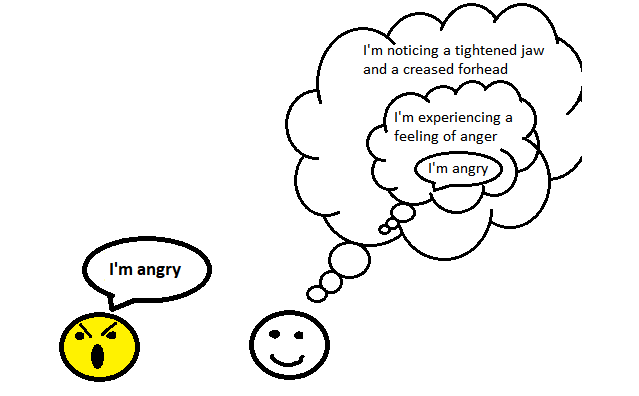
Slowing down to really notice what is going on, rather than jumping to conclusions, will deepen your self-understanding and self-awareness.
You make all sorts of assumptions about yourself when you don’t engage in this self-exploration process. (“I’m a failure…” instead of looking at the feeling that has arisen, you assume that it means something about you.)
When you’re curious, you want to find out something new. You look around to see something you haven’t seen before. You recognize and acknowledge that something is here (the object of your attention). You start exploring it, coming to fully know and experience it as it is.
When you’re genuinely curious, you’ll keep watching your thoughts, activities, and emotions until that curiosity is satisfied.

What is not mindfulness?
Mindfulness is not:
- thinking
- a habit
- doing something
- stopping thinking
- meditation
- about being calm
- about chasing states and experiences
- about reducing stress
- removing emotions
- being religious
- being complacent
- a magic pill solution
- complicated
- paying attention
As someone who has practiced mindfulness for years and has read a lot about it, I realize that there a lot of misconceptions and myths about mindfulness. Most people are misinformed about mindfulness.
- Mindfulness is not about thinking
So, it’s NOT a way of thinking. It’s not positive thinking or coming up with inspirational and creative ideas. It’s not about visualizing something, either.
- Mindfulness is not a habit
Mindfulness cannot be a habit! It’s exactly the opposite of a habit. A habit is an unconscious act, while mindfulness is deliberate conscious awareness.
Mindfulness cannot be put on autopilot. The only thing that can be put on autopilot is your mind: your thought-emotion energetic system.
We’re less likely to be mindful of habitual tasks. Practicing mindfulness means that you become more aware of your habits.
“Mindfulness transforms habits into choices.”
- Mindfulness is not about doing something
Mindfulness is not an activity. You can be aware anytime, anywhere. So, it’s not about reading inspirational content, writing in a journal, setting daily goals, or smiling in the mirror.
- Mindfulness is not about stopping thinking
Mindfulness is not about stopping thinking. It’s about becoming aware of our thoughts, without necessarily doing anything with them.
So, mindfulness is not about manipulating your experience. It’s not about doing something (pushing away thoughts). When you’re mindful, thoughts and emotions will naturally start to settle.
People with a lot of negative thoughts and emotions get attracted to mindfulness practice because they think it will help them to empty their minds. Mindfulness is not about removing negative thoughts.
The practice will empower you to handle negative thoughts and feelings when they arise. If you want to experience less mind activity, then practice mindfulness meditation.
If you have a lot of negative thoughts and emotions, you want to be more optimistic.
Becoming more optimistic is not about not having negative thoughts. Rather, it’s about being able to handle them. This is what makes you optimistic.
- Mindfulness is not meditation
Mindfulness is not meditation. While meditation requires you to be mindful, mindfulness doesn’t require meditating. So, you don’t have to focus on your breath and alter its rhythm.
Mindfulness of breath is different from deep breathing.
- Mindfulness is not about being calm
While mindfulness can lead to relaxation, and it often does, that’s not the goal. Mindfulness is not about feeling good.
With mindfulness, you’re forcing your mind to clean itself. With relaxation, tension in the body starts to dissolve.
During practice, you’ll most likely experience unpleasant thoughts and feelings. This will bring up toxic thoughts and emotions from the subconscious mind, so you can look at them and, thus, free yourself from them.
This purification process usually comes in waves. The trick is to not get triggered by this negative emotional energy. Realize that’s just part of the growth and purification process.
After each wave, you will develop more equanimity and tranquility.
- Mindfulness is not about chasing states and experiences.
It’s not like you’re achieving a detached state. Mindfulness is about embracing impermanent reality. Mindfulness is living in the moment, not for the moment.
- Mindfulness is not about reducing stress
It can help with that, but it’s not about stress reduction. It is, however, about changing our relationship to stress, so we can respond to it more healthily.
The focus is different from what people often assume. Mindfulness focuses on the RELATIONSHIP, not the outcome. When you fix the relationship, the outcome takes care of itself.
However, keep in mind that there’s nothing wrong with practicing mindfulness for stress reduction. Likewise, there’s nothing wrong with practicing mindfulness for reducing anxiety, anger, etc.
Mindfulness is not goal-oriented, but you can practice it with a specific goal in mind.
- Mindfulness is not about removing emotions
It’s about being AWARE of emotions. With mindfulness, you will experience emotions MORE, not less.
- Mindfulness is not religious
Mindfulness was indeed discovered within religious contexts, to achieve spiritual goals. However, there is nothing religious about it. You can practice mindfulness without needing to believe in anything. Millions of Christians, atheists, and Muslims practice it.
- Mindfulness is not about being complacent
Acknowledging whatever is going on does not mean agreement. Accepting something doesn’t mean that you like it. We take action when appropriate—for our well-being and the well-being of others—but we do it from a place of kindness, compassion, and understanding vs. reaction and frustration.
So, mindfulness doesn’t mean that you don’t care and are indifferent to what’s happening.
However, some people do use mindfulness meditation to escape their problems. Once they are skilled enough, they can bring themselves to a peaceful state to overlook all problems.
- Mindfulness is not a magic pill solution
Although mindfulness can help you better cope with challenges, to fully benefit from mindfulness, you will need to practice it for a long time. Mindfulness must be cultivated from moment to moment.
It’s not a quick-fix solution. It’s unlikely that behaviors and emotions that have months or even years of momentum will change overnight.
Your self-control will increase over months and years, not overnight … You can think of mindfulness as a muscle. It grows over time. You have to set your expectations right.
However, it doesn’t take years to benefit from practicing mindfulness. Research shows that it brings many mental and physical health benefits in as little as six to eight weeks. (link)
As you progress, you will feel a positive change after every session. Personally speaking, my experience throughout the day is completely different when I meditate in the morning. But it has taken me a few weeks to notice the changes that the practice brings.
- Mindfulness is not complicated
In fact, it’s so simple that your mind will try to complicate it. Watch out for thoughts like ‘I’m doing it wrong.’ As long as you keep bringing awareness to the present moment, you’re on the right path.
Yes, it sounds simple, but in actuality, it’s difficult to be mindful for longer than a few seconds at a time at first. You will keep forgetting and your mind will wander a lot.
- Mindfulness isn’t not paying attention
We are always paying attention. Our attention is always directed somewhere. Attention is the mental factor that gathers together all other mental factors and directs them to a single object. Mindfulness is paying attention in a particular way.
Mindfulness and reactivity
Emotions, thoughts, and behaviors are TRIGGERED. They’re not conscious. You’re making decisions without realizing it and then you tell yourself stories about it. That’s what I meant by you being asleep.
You must start seeing how everything you do was somehow triggered, so that you start waking up and taking more control of that vs. just projecting it out into the world.
Start noticing how something keeps happening over and over and over again. Admit to yourself that you’re being a robot there.
Mindfulness expands your perception and detaches you from the default automatic reaction and stream of thought. Adding mindfulness to your life can help you to create a more positive behavioral outcome.
The picture below offers an excellent illustration of how mindfulness can impact behavior.
Take a minute to think of an experience you’ve had in which you reacted in a way that you later regretted. Try to use the following sentence: “The stimulus was ____ and my reaction was ___.”
Now imagine how things might have unfolded differently if you had been more mindful and given a conscious response.
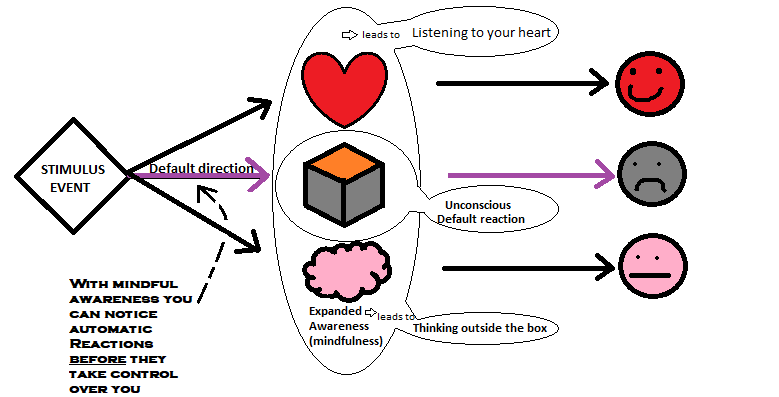
When applying awareness to your triggers, you’ll become aware of the want to act much faster than usual. You will notice automatic habitual reactions before they take control of you.
One study I read showed that we become aware of the want to act in 40-300 milliseconds. I believe that with mindfulness practice, we become aware much faster and, thus, are more likely to avoid emotional reactivity.
Let’s imagine that the reaction starts forming at t0 . It makes sense that the reaction will be bigger, have more momentum, and have more impact on our behavior if we become aware of it at 300ms in contrast to 40ms.
I already mentioned that we react to our reaction, not to the actual event. So, it makes sense that you’ll respond completely differently to that small reaction. You will naturally associate with it less weight and importance.
A reaction is initiated unconsciously but when you’re mindful, you can change the outcome of the reaction.
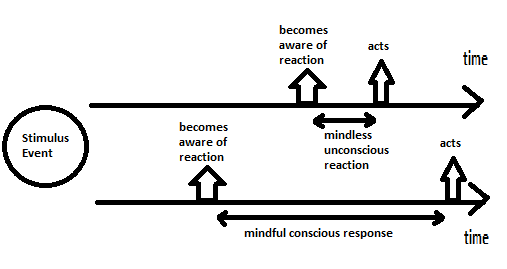
When you get lost in the content of experience, you’re subject to unconscious reactions. On the other hand, when you’re aware of the content of experience, you can stay stable and non-reactive.
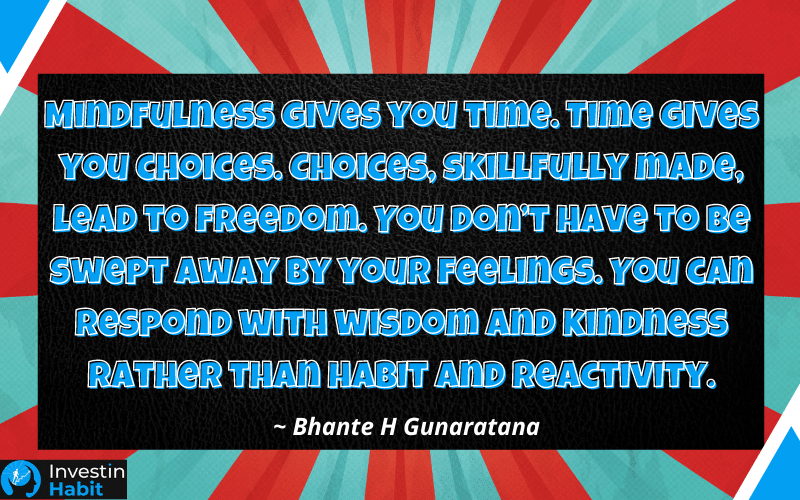
When you’re mindful, you will wait a moment before acting and therefore be able to:
- Accept
- Be open
- Be grateful
- Be patient
- Recognize what the other person is feeling
- Self-reflect
- Introspect
When you’re not mindful, you will act immediately, and therefore you will:
- Reject
- Ignore
- Assert your agenda
- Be impatient
- Show no appreciation
- Not care about how the other person feels
- Allow old behavioral patterns to control you

What is mindfulness meditation?
Mindfulness meditation combines the elements of meditation and mindfulness.
During mindfulness meditation, when your mind wanders through the content of thoughts, you gently bring it back to the present moment.
How to use mindfulness meditation to improve self-regulation
The untrained mind tends to get caught up in memories or obsessing over the future. This leads to overwhelm, anxiety, and depression.
One point of mindfulness meditation is to recognize these moments. When you recognize that you’re immersed in memories or obsessing over the future, you can switch back to the present. Just that simple recognition is enough.
Mindfulness is about recognizing and acknowledging.
Golden nugget: When you recognize the reality you’re in, you can switch your attention and tune into a different reality.
For example:
When you recognize that you’re being distracted, you can redirect your attention to the task at hand.
When your partner is talking to you and you recognize that you’re thinking about what happened yesterday, you can switch back to listening.
When you recognize your poor body language, you can correct it.
When you acknowledge that you’re feeling stressed, you can take a short break.
When you acknowledge your judgments, you can shift toward more acceptance of yourself and others.
When you acknowledge that you’re complaining about how it should be this or that way, you can face reality as it is (and come to peace with it) instead of rejecting it and suffering from it because it doesn’t match your criteria of what it should be.
Mindful awareness disrupts automatic tendencies by creating space to choose a different response.
When you practice mindfulness, you’ll have an easier time improving and correcting your behavior because you will develop the skill of acknowledging and recognizing what’s happening as it’s happening.
As a result, you will more quickly integrate what you do prefer.
Bottom line: Cultivating mindful awareness allows you to regulate and shape your attention and emotions.

Mindfulness practices
Below is a list of mindfulness practices. The best way to start with mindfulness is to just sit and do nothing. Simply sit there and acknowledge that you’re sitting. Focus your awareness on the present moment with mindfulness of the five senses. Once you’ve developed some proficiency there, you can start to expand this awareness to activities like eating, drinking tea…
Then, once you’re proficient at being aware during activities, you can start with more advanced mindfulness practices like being aware during the thought process. You want to be slowly moving from formal practices, in which you’re carving out time in your schedule to complete the practice to more informal practices, so you can be aware in daily life.
To avoid confusion, I have categorized the practices into three sections: Beginner, Intermediate, and Advanced. In this way, you will have a roadmap for maximizing your results. At the gym, you wouldn’t be bench pressing 200kg right away. Likewise, it won’t do much for you if you went immediately to the advanced-level mindfulness practices.
Mindfulness practices for beginners
The aim of beginner mindfulness practices is to familiarize yourself with the present moment. Your goal as a beginner is to develop a regular mindfulness practice.
Mindfulness of the 5 senses
This is a simple grounding technique for getting in touch with your senses.
- SEE: Notice a few things that you can see. Notice every little detail.
- FEEL: Notice a few things that you can feel throughout your body. Notice the feelings of your feet, notice the feeling of air coming through your nose, notice feelings in your chest, notice feelings in your shoulders, notice feelings in your thighs, fingers, back, stomach, ears…
- HEAR: Listen carefully. Notice things that you can hear. What can you hear?
- SMELL: Breathe deeply. Notice a few things that you can smell.
- TASTE: Notice one thing that you can taste. Even if you’re not eating, your mouth has a taste.
“Wherever you are, be there totally.” ~ Eckhart Tolle

Mindfulness of sounds
Become aware of the sounds in the environment. Watch them come and go.
Mindfulness body scan (Body awareness)
With body scans, you will bring awareness to each part of your body. Start with your feet until you reach the top of your head.
Toe s–> Feet –> Ankles –> Calves –> Knees –> Thighs –> Butt –> Stomach –> Chest –> Back –> Shoulders –> Arms –> Hands –> Neck –> Ears –> Face –> Nose –> Forehead –> Top.
Body scans encourage awareness of sensations we might otherwise ignore.
Pet your pets
Take a few minutes to pet your pet. By doing this, you will receive immediate feedback on how great it is, that you’re present with another being.
Explore nature
Exploring nature is one of the easiest ways to build mindfulness. Nature has many wonders that ground us in the present moment.
Focus on what you see and hear. Notice as much as possible.
Notice the birds singing, notice the shape of the trees, notice the rocks, notice the streams, notice small insects, notice the flowers, notice the footprints … go exploring.
Mindfulness practices for intermediates
Once you’re familiar with the present moment, you can proceed to extending this awareness to activities. This is the stage when you’ll be more actively shifting your attention toward the present moment.
Do everything 50% slower
When you stop being hyperactive, you will find it easier to be mindful.
Mindful tea drinking
Focus only on drinking tea. Stay aware of every step while doing so. As you sip your tea, savor the taste. Feel the warmth of the cup in your hands. If you notice that your mind is in thought stories, return awareness to your body. Feel the feelings. Lastly, move 50% slower for a boost in mindfulness. While you’re preparing and drinking tea, really notice every little detail of what you do and feel.
“Each one has to find his peace from within. And peace to be real must be unaffected by outside circumstances.”
~ Mahatma Gandhi

Mindful eating
Single-minded: Focus on just eating. Don’t watch TV while eating. Don’t check your social media while eating. Just eat.
What to eat: What does your body want to eat? What is it thirsty for? Pay attention and notice the sensation that gives you this information. Eat healthy foods. However, you don’t have to be anal about it. If you want a pizza, eat it without judgment.
As you go through the store, notice which foods your body really craves. (If you’re sensitive, you’ll notice that it’s not the one with high sugar, salt, and fat.) Acknowledge your likes, dislikes, and neutral reactions.
Before eating: You may notice that your body has a natural reaction to the food that you see. Bring food to your nose and smell it. Notice the color, shape, and size.
When to start eating: Eat when your body tells you to eat (i.e., low energy, hungry, thirsty). Try to eat at the same time and place.
How to eat: Slowly place the food item in your mouth, without chewing or swallowing it. Roll it around to different parts of your mouth. Notice the flavor and texture. Notice the smoothness or stickiness. Take small bites. Chew your food slowly. Savor each bite. Notice the flavor. Notice your breathing as you explore the sensations in your mouth. Notice which parts of your mouth are involved in chewing. Listen to the sounds of chewing. Notice how the texture of food changes.
When you swallow the food item, notice the path it follows and the sensations it creates. Notice the aftertaste.
Listen to your body when it tells you that it’s full.
In contrast, mindless eating is when you eat while doing other things. It’s when you ignore the signals of your body and eat until you are past full. It’s when you binge eat (eating at random times and places).
It’s when your emotions tell you to eat (i.e., bored, sad, lonely). It’s when you eat emotionally comforting foods—usually, foods that are high in sugar.
Mindful household activities
When you do the dishes, focus on the act. Don’t think about what you will do later. Notice the feeling of water on your skin. Notice how that feels. When your attention goes into thought stories, be mindful of that and gently return to cleaning your dishes.
“You’re not always in control of what happens around you, but you can ALWAYS be in control of what happens WITHIN you.”
Cold showers
Taking a cold shower is great for building mindfulness and body awareness. You can also shower in warm water, but in my opinion, cold water is better. Personally speaking, hot water makes me sleepy, which makes practicing mindfulness ineffective. On the other hand, I’ve found that cold water grounds me in the present moment. When you start showering in cold water, your mind will have a light panic reaction. Applying mindfulness to negative emotions is much harder and, thus, it builds your mindfulness. Aside from that, cold showers have many health benefits.
- Start with warm water and wash your entire body.
- Take a deep breath.
- Switch to cold water and quickly shower your entire body.
- Start breathing normally while showering with cold water for one minute.
As the cold water goes down your body, stay mindful. Notice any resistance that you might have. Notice how you’re going through that resistance with the help of mindfulness. Acknowledge your in-breath and out-breath while you’re showering. Notice how cold water makes you more grounded in the present moment. After you become better at this practice, you can skip taking a deep breath.
Mindful walking
Focus on just walking. Notice each step that you make. Notice your movements. Notice the feelings under your feet. Notice the wind blowing through your hair. Notice the cold. Notice the warmth.
Don’t listen to music or talk on your phone. Simply walk. Walk with no desire to get somewhere.
Mindful driving
Pay attention to driving. Notice your surroundings. Don’t do anything else. Don’t talk and don’t look at your phone.
Mindful transitioning
Before switching activities take a mindful moment.
When you sit in the car, take a few seconds to ground yourself in the present moment. Notice your in-breath and your out-breath. Keep in mind that it’s hard at first to just watch your breath without manipulating it. When you arrive at the destination, do the same.
Before eating, take a moment to ground yourself in the moment.
Before checking your email, take a moment to acknowledge your feelings.
Before starting work on a project, take a few moments to connect to the present moment.
“Nothing can harm you as much as your own thoughts unguarded.”
~ Buddha
Advanced mindfulness practices
Open awareness
Become aware of whatever is most prevalent in your awareness.
Mindfully accept your negative emotions
The next time you feel negative emotions (anger, frustration, sadness, worry, anxiety, overwhelm, stress…), start to notice it.
- Meet it with kindness and curiosity.
- Accept that you’re feeling this way. Avoid the temptation to escape your experience. Don’t direct your attention to something external. Focus your attention inside your body. Become curious about what’s happening inside your body.
- Add a layer of neutral observation to your emotional-thought process.
Don’t stop it. Don’t judge it. Don’t tell yourself it’s bad.
Watch it like it’s not happening to you. Watch it like it’s simply happening. Observe it in an open, accepting, and non-judgmental way.
- Become curious about where in your body you’re feeling this feeling. Locate it and bring acceptance to it.
If you get stuck in traffic and become frustrated, notice that. Notice where in the body that frustration is located. Notice how it comes and goes. Notice how you’re frustrated now, but an hour later, you are no longer frustrated. When you’re on your way to work and someone cuts you off while almost bumping into you on the road, notice your anger. Observe it in an open, accepting, and non-judgmental way.
Taking a moment to pause and breathe
When you are feeling strong negative emotions, take a three-minute pause to notice your in-breath and out-breath. Before jumping on that important meeting, pause to notice your breathing. Before engaging in an addiction, pause and breathe. You don’t have to control your breathing; you have to observe it as it is.
Mindfulness of thoughts
Notice when you’re thinking. Don’t stop thinking. Don’t change what you’re thinking about. Simply acknowledge that you’re thinking. Witness yourself thinking. Observe your thoughts in an open, accepting, and non-judgmental way.
Notice when thoughts arise and pass by you. Observe them from a distance, allowing thoughts to come and go as they please, without judging or attaching to them.
Try to see them for what they are (thoughts … and thoughts are just sounds) and not for their story.
Being aware throughout the thinking process = self-awareness.
“Don’t lose yourself in thoughts and emotions; Let them lose themselves in you.” ~ Rupert Spira
Mindful listening
Ideally, you won’t stop your mindfulness practice during social interactions. Being mindful during social interactions is harder, but important.
Practice being non-reactive when your partner, kid, friend, or coworker is trying to project their negative emotions onto you.
Don’t allow people to trigger anything in you … They might try to put you down, criticize you, judge you, but when you’re mindful, it will not bother you. You will not suffer from it.
Not reacting to them means that you don’t judge and criticize their negative internal experience. It also means that you don’t try to minimize it! Still, remember how mindfulness is non-interfering? 😉
If you react, you will add more weight to their reaction and it will get bigger. Obviously, you don’t want that.
Side Note: Know that that’s not a reflection of them, but rather a reflection of the negative emotion they’re experiencing. Basically, they became unconscious and let their emotions overpower their intelligence.
When people are experiencing negative emotions, their level of consciousness is low. They are not aware and mindful. That means they can unconsciously project their negative emotions onto you. Unconsciously, they’re calling forth a negative situation that will validate their negative internal experience.
If you react, you’ll give them the power to manifest a negative situation. However, if you stay stable and non-reactive, you will give them the space they need to face their emotions … If you react, you’re distracting them from looking inside and, thus, dissolving their emotions.
“When you understand that you can be in bliss regardless of what’s going on in the physical reality, then you will have mastered physical reality.” ~ Bashar (channeled by Daryl Anka)
Releasing tension
Notice any tension within your body and release it while breathing out.
Take the first step
Do you need to work out but feel a little lazy? That’s perfect for this mindfulness practice. Just take that first baby step. Then the second baby step. Then the third. Move through the motions as thoughtlessly as possible. Combine this practice with the mindfulness of the five senses.
Grab your shoes, t-shirt, and trousers and put them in your backpack. Don’t think, just do it. Move one leg, then the next. Open the wardrobe, grab the t-shirt, put it in your backpack … Stay mindful of any resistance or thoughts that might come up. Close your eyes and feel them. Really feel them. Where is that resistance located in your body? Acknowledge it. When you acknowledge it, it will start to dissolve.
Notice deviations from the norm
This is an advanced practice. Register how it feels to have a stable, sober, and content life. Register what you’re doing, what your energy level is, your happiness level, your thoughts, and your attitude. Then notice any deviations from that. This practice combines the elements of introspection and mindfulness.
Notice your posture
Noticing when you aren’t sitting correctly enables you to correct your posture. If you have a habit of not sitting correctly, with your feet on the ground and with your back straight, then this practice is perfect for you. Notice how you unconsciously slouched or crossed your legs, and how you awakened to that fact.
Stand up and move
When you sit for a long time, tension starts to build up. When you notice tension, take a moment to acknowledge it. Then stand up and move. When you acknowledge your feelings, you can begin to let go of them.
When you don’t acknowledge your feelings, they start to unconsciously sabotage you. You must always stay in tune with what your body is telling you. The only way to do that is to stay mindful. Taking a short break to stretch and release body tension will also make you more productive. Notice what happens when you continue to work without taking mindful breaks. Notice how that plays out.
“Feelings come and go like clouds in a windy sky. Conscious breathing is my anchor.”
~ Thich Nhat Hanh, Stepping into Freedom: Rules of Monastic Practice for Novices

Mindfulness meditation practices
How to start with mindfulness meditation
1. Sit in a comfortable position. If you’re sitting on a chair, keep your feet flat on the floor. If you’re sitting cross-legged, put a cushion under your butt, so that your knees are below your hips.
2. Straighten your upper body, so the spine is erect. Let your hands rest on your thighs. Slightly lower your jaw.
3. Set a timer for 15 minutes.
4. Close your eyes or, alternatively, keep them open but with a softened gaze. If you want the experience to be more body-based, close your eyes. If you want to feel more anchored in the space you’re in, keep them open.
5. Relax your body. As you exhale, relax each body part.
6. Become aware of your breath, body, sounds, thoughts, and feelings.
7. Develop open awareness, where you’re choicelessly aware of whatever is most prevalent in your awareness
You can start with five minutes if you find 15 minutes too difficult. As you keep meditating, gradually increase the time of your sessions until you reach one hour per day.
“Altogether, the idea of meditation is not to create states of ecstasy or absorption, but to experience being.”
~ Chögyam Trungpa

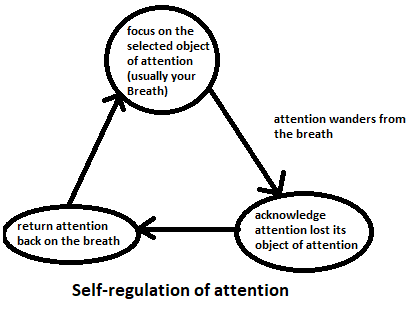
Mindful breathing
- Set a timer for at least five minutes.
- Sit with a straight back. You can sit cross-legged or on a chair with your feet on the floor.
- Focus your attention on the breath. Become aware of your breathing. Recognize the in-breath and the out-breath. Note: You don’t have to force your breathing; just allow breathing to take place.
- When your attention wanders from the breath, acknowledge this.
- Return your attention to breathing.
Focusing on your breathing will help you to still a racing mind.
Concentration
- Pick an object.
- Focus on the object.
- When you get distracted by a thought or look somewhere else, recognize the current focus of your attention.
- Return your focus to the object.
You can pick an object in your visual field and just concentrate on it. You can blink; that’s no big deal.
“Do not dwell in the past, do not dream of the future, concentrate the mind on the present moment.” ~ Buddha
Conclusion
Mindfulness changed my life and I hope it will change yours.
Your turn: Post your comments about mindfulness below.