

Do you have the proper mindset to succeed? According to world-renowned Stanford University psychologist and researcher Carol Dweck, there are two types of mindsets. In this article, we’ll explore both.
These two mindsets were discovered after two decades of research on achievement and success.
Inside this Article
What is a mindset?
A mindset is a way of thinking. It’s a view you adopt for yourself. It’s a web of beliefs, attitudes, and assumptions that form your thought process. Your mindset interprets all the information that comes your way.
What you think affects how you feel and what you do. Your beliefs shape your attitude (how you feel about something) and, in turn, your attitude shapes your beliefs.
An idea or thought becomes a belief as you build references and experiences to support that idea/thought. When a belief forms, you think it’s the truth and you start thinking that that’s reality.
An idea might be rooted in falsehood, but when it becomes a belief, we think of it as the truth.
Beliefs have a direct influence on your thought process, feeling states, choices, and behaviors. By examining your beliefs about your abilities, you can predict your success.
The two mindsets
A belief that your abilities are carved in stone leads to specific thoughts and actions. This is what Carol Dweck called the fixed mindset.
On the other hand, having a belief that your abilities can be developed leads to different thoughts and actions. Carol named this one the growth mindset.
In this article, we will explore these two basic beliefs.
Fixed mindset character traits
The fixed mindset leads to a desire to look smart and to the tendency to spend time documenting one’s intelligence and abilities and proving these things to oneself and others over and over again, avoiding all things that might make one appear incompetent… every situation is evaluated according to “Will I succeed or fail? Will I look smart or dumb? Will I be accepted or rejected? Will I feel like a winner or a loser?…”
- Abilities are fixed and cannot change.
- The inner monologue is filled with constant judging and evaluation.
- They are threatened by the success of others.
- “I always fail.”
- “I will never improve.”
- “I’m not good at this kind of stuff. It’s just not my strong suit!”
- “Why should I bother?”
- “Smart people don’t make mistakes.”
- They are highly self-critical.
- They disregard criticism.
- They resent the success of others.
- They believe that talent alone creates success—without effort.
- They lack purpose, vision, and a big-picture understanding.
- They hunger for approval.
- Inner value is derived from the external approval of others.
- They have the wrong expectations. He expects it has to be easy or too hard for him.
- Risk is a bad thing.
- Some people are naturally good at things while others are not.
- You are not in control of your abilities.
- They are end-result-oriented.
- Those who need improvement are inherently bad.
- They are not interested in improving themselves because “I’m already there.”
- Imperfections are shameful.
- They allow uncertainty to stop them from doing things.
- They are dishonest and lie to inflate their abilities so that they maintain their inner perception of themselves and look more successful.
- They expect that everything good will happen automatically.
- They focus on the negative.
- Success is about establishing their superiority, pure and simple. They want to be “somebody” who is worthier than the “nobodies.”
- Success is about being more gifted than others.
Growth mindset character traits
- “I have the capacity to learn and grow my skills.”
- They embrace any challenge.
- They never give up.
- Their inner monologue is filled with attempts to seek input that can be transformed into constructive action.
- They practice self-compassion.
- They see effort as a journey.
- They are inspired by others’ success.
- “This will take time and hard work.”
- They are inspired by others’ success.
- They operate from the big picture.
- They have a sense of purpose.
- They share their progress with others and celebrate growth.
- They don’t need approval, as they get their value from internalizing knowledge and growing.
- They take ownership of the growth mindset. They see themselves as having a growth mentality and they let it guide them through life.
- They have the right expectations. They know that it will take time and effort to learn.
- They see risk as an opportunity to expand themselves.
- They are eager to try new things.
- They are process-oriented.
- “Everybody can improve.”
- They are interested in improving themselves.
- They do something even if they’re unsure about it.
- They share vulnerabilities and how they overcame them.
- The mindset produces perseverance and resilience.
- They focus on the positive.
- They become more knowledgeable and gain new skills.

Learning:
- They learn from all criticism.
- They love learning.
- “I will keep learning.”
- “I will keep improving.”
- Learning is never finished; there is always more to learn and more to research.
- They find lessons in the successes of others.
- They try different learning tactics and find out what works best for their personality.
- They reflect back on what was learned.
- They understand that the brain can grow new neural connections every time they learn something new and step outside the comfort zone.
- They scan the environment to find opportunities to improve their skills and enhance their knowledge.
- “I can learn to do it with time and effort.”
Work:
- They reach ever-higher levels of achievement.
- After achieving a goal, they set a new one.
- They have more resilience, productivity, and motivation in business, education, and sports.
- They work smarter.
- They build skills.
- They learn from constructive criticism and feedback.
- They have improved relationships with colleagues and customers.
- They have a positive work environment.
- They praise work ethic.
Lifestyle:
- They promote a healthy lifestyle.
- They enjoy life.
- They love what they do.
- They grow in the moment! They face fears and embrace challenges. They step outside the comfort zone.
Mistakes and failure
Fixed mindset:
- Failure is something that defines you.
- Failure is something to be avoided; failure is shameful.
- They avoid making mistakes.
- They get discouraged when they make mistakes.
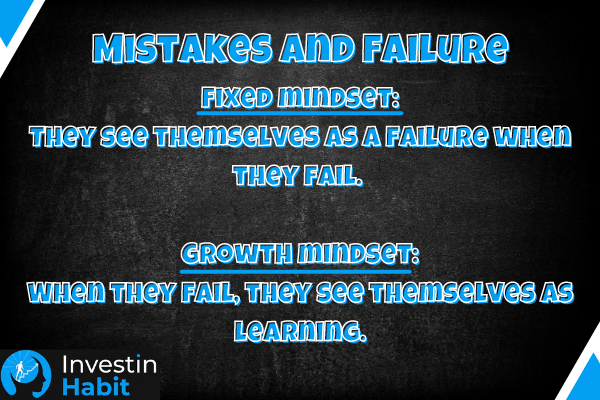
- They see themselves as a failure when they fail.
- They blame others instead of taking responsibility.
- They hide their mistakes.
Growth mindset:
- “I will learn from failure.”
- They implement what they have learned from failure.
- When they fail, they see themselves as learning.
- They learn from the mistakes of others.
- Failure can be a painful experience but it doesn’t define them. It’s just a problem to be faced, dealt with, and learned from.
- When they fail, they understand that they are not yet where they want to be. They understand they’re on a learning curve.
- They think about the root cause of the problem and how to avoid it next time.
- They share and openly discuss mistakes.
Challenges
Fixed mindset:
- They avoid taking on challenges.
- Challenges could reveal a lack of skill.
- They tend to give up or quit easily.
- They like easy challenges.
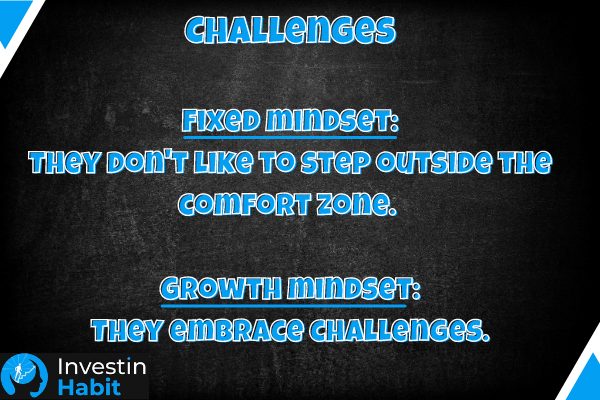
- They don’t like to step outside the comfort zone.
Growth mindset:
- They initiate challenges.
- Challenges are part of the learning process.
- They like challenging tasks.
- They use creative thinking to find a way.
- They face fears with curiosity.
- Challenges are opportunities to be free.
- Challenges are opportunities for self-improvement.
- They embrace challenges.
- They work harder and smarter.
Skills
Fixed mindset:
- They rationalize why they can’t.
- They feel stuck with no options.
Growth mindset:
- “It’s hard at first, but it’ll improve.”
- Persistence is key.
Effort
Fixed mindset:
- They see effort as a bad thing, like it’s pointless or fruitless. Effort is something that you need when you’re not that good, smart, or talented.
- “There is no point in putting effort into something that is not my strength.”
- They put in less effort.
- “It’s too hard. I can’t find a solution.”
- “The effort won’t be worth it.”
- They have a short-term focus and seek immediate gratification.
Growth mindset:
- They see effort as something that makes one smart or talented.
- “There has to be a solution.”
- They put in more effort.
- “I can find a way.”
- They seek a bigger mission and have a long-term focus.
- They see effort as the path to mastery.
- Effort is an important part of the process.
Feedback and criticism
Fixed mindset:
- They get defensive.
- They ignore criticism.
- They take it personally.
- They shut down.
- They don’t use feedback to improve their skills and knowledge.
- They give unconstructive criticism.
Growth mindset:
- Feedback is useful.
- They use it to come up with possible solutions to improve their performance.
- Feedback is something to learn from.
- They identify areas to improve.
- They give constructive criticism.
Setbacks and obstacles
Fixed mindset:
- “I’m not good enough.”
- They blame others.
- They get discouraged.
- They give up easily.
- “I am a failure.”
Growth mindset:
- They convert setbacks into future successes.
- They take responsibility.
- They are accountable for your actions.
- They reflect, review, and go again.
- They keep trying and never give up.
- They persist in the face of setbacks.

Intelligence, skills, talent, understanding, creative ability, and character
Fixed mindset:
- These are fixed and innate.
- “You either have it or you don’t.”
- Failure is proof of unintelligence.
- They have a basic assumption that all of these can’t change in any meaningful way.
- They affirm their own inherent intelligence.
- They avoid failure to maintain the identity of being smart and skilled.
Growth mindset:
- These traits can be developed through dedication and hard work.
Results
Fixed mindset:
- They plateau early and achieves less than their full potential.
Growth mindset:
- They become a better version of themselves.
Friends, family, and relationships
Fixed mindset:
- Their ideal partner sees them as perfect and glorifies them.
- Their ideal partner exhibits instant and perpetual compatibility.
- They reward traits, intelligence, or talent.
- They expect that everything good will happen automatically.
- They expect that their ideal partner will be able to read their mind.
- They expect that their ideal partner will share all of their worldviews, opinions, and preferences.
- If the relationship needs improvement, or if their partner needs improvement, there is something terribly wrong with that.
- During conflicts, they blame their partner and assign blame to a trait or character flaw. As a result, they feel disgust toward their partner and get angry. Because they attribute the conflict to a fixed trait, it can’t be solved and so they are dissatisfied with the whole relationship.
Growth mindset:
- They experience enhanced relationships.
- They encourage people to learn new things.
- They allow people to encourage you to learn new things.
- You, your partner, your friends, and the whole relationship can be developed.
- Their ideal partner acknowledges their faults and encourages them to improve, learn new things, and become a better person.
- They recognize their partners’ imperfections, without assigning blame.
- They see conflicts (in friendships, in romantic relationships, and even with their parents) as a problem of communication and not of character.
- They reward work ethic, effort, actions, focus, strategies, perseverance, and improvement, which motivates people to stick to the process and do better.
- They encourage growth over achievement.
- Their partners grow and the relationship deepens.
- They are interested in each other’s development.
Thinking
Fixed mindset:
- “I’m good at only certain things.”
- “I give up when it gets too hard.”
- “I hate challenges.”
- “I don’t like to be challenged.”
- “I take feedback and criticism personally.”
- “I don’t like doing what I don’t know.”
- “Failure is the limit of my abilities.”
- “I’m either good at it or I’m not.”
- “My abilities are unchanging.”
- “Either I can do it or I can’t.”
- “My potential is predetermined.”
- “When I’m frustrated, I give up.”
- “I stick to what I know.”
Growth mindset:
- “I can be good at anything.”
- “I try until I get the results I want.”
- “I embrace challenges.”
- “Challenges help me to grow.”
- “I welcome feedback and criticism.”
- “Feedback is useful.”
- “I like learning about things I don’t know.”
- “Failure is an opportunity to grow.”
- “I can learn to do anything I want.”
- “My effort and attitude determine my abilities.”
- “I am inspired by the success of others.”
- “I like to try new things.”

Growth mindset affirmations
- “Attitude and effort determine how much I learn.”
- “I can be brave and step out of my comfort zone.”
- “Challenges help me grow.”
- “I’ll try a different strategy.”
- “Effort makes me stronger.”
- “I welcome feedback.”
- “Getting better takes time.”
- “How can I build on my strengths?”
- “I can choose a growth mindset.”
- “Learning is a journey.”
- “I can keep an open mind.”
- “Learning is my goal… not perfection.”
- “Mistakes help me improve.”
- “New things are opportunities for me to learn.”
- “It’s ok to not know something.”
- “When I ask questions, I learn.”
- “The success of others inspires me.”
- “Plan B might work.”
- “It’s okay to take risks.”
- “I can choose to try again.”
- “Unsuccessful attempts are all part of the process.”
- “It’s okay to take risks.”
- “Valuable information can be found in every failure.”
- “What can I learn from this?”
- “XYZ didn’t work, so I’ll try ABC.”
- “I don’t know how to do this… YET!”
Identifying areas of improvement
For us to grow, we first must identify where growth is needed. Nobody has a 100% growth mindset or a 100% fixed mindset; we have a mix of both. We use different mindsets in different situations.
Where in your life do you need to switch to the growth mindset?
Is it fitness and health? Is it in relationships? Do you have poor personal boundaries? Do you eat healthy food? Are you a victim or a creator? Do you have the job that you want? Do you have healthy coping mechanisms?
Find out where you need to improve and start adopting the growth mindset.
“Why waste time proving over and over how great you are when you could be getting better? Why hide deficiencies instead of overcoming them? Why look for friends or partners who will just shore up your self-esteem instead of ones who will also challenge you to grow? And why seek out the tried and true, instead of experiences that will stretch you? The passion for stretching yourself and sticking to it, even (or especially) when it’s not going well, is the hallmark of the growth mindset. This is the mindset that allows people to thrive during some of the most challenging times in their lives.” ~ Carol Dweck
Conclusion
In this article, you learned the difference between the growth mindset and the fixed mindset. In the comments below, let me know what you think and where in your life you need to switch to the growth mindset.
If you are interested in learning more about this topic, I recommend that you buy Carol Dweck’s book, Mindset: The New Psychology of Success.