

Have you ever felt like you’re on autopilot, reacting to life’s events without fully understanding why?
This is where self-awareness comes in. It’s the ability to recognize and understand your thoughts, emotions, and behaviors. Just like a ship needs a compass to navigate effectively, we need self-awareness to navigate the complexities of life.
Strong self-awareness is crucial for emotional health and personal development. It empowers you to manage your emotions effectively, build stronger relationships, and make conscious choices aligned with your values.
But how do we cultivate this vital skill? Enter emotion-focused journaling, a powerful tool that can help you unlock a deeper understanding of yourself by exploring your personal emotions.
In this blog post, we’ll delve into the what, why, and how of emotion-focused journaling. We’ll explain what it is, explore its numerous benefits, and provide a practical guide to help you get started on your journey to greater self-awareness.


How to Practice Emotion-Focused Journaling

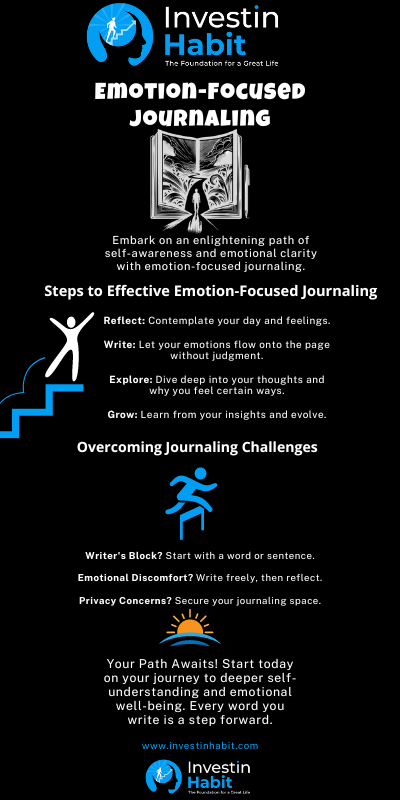
Alright, now that we’ve unpacked the why, let’s get into the how. If you’re like me, starting something new can feel like standing at the edge of a diving board for the first time—exciting yet a tad intimidating. Don’t worry; I’m here to walk you through it step by step. Let’s turn that apprehension into action and make emotion-focused journaling a rewarding part of your life.
Setting the Stage
Creating a space that invites introspection is your first step. Think of it as setting the stage for a heart-to-heart with your deepest self. Find a quiet corner where you can be undisturbed, making this spot your sanctuary. Whether it’s a cozy armchair by the window or a desk adorned with your favorite plants, what matters is that it feels safe and welcoming.
Timing is also key. Carve out a moment in your day dedicated solely to journaling. Maybe it’s the tranquility of the morning or the calm of the night—whichever works best for you. The goal is consistency, creating a ritual that signals to your mind, “It’s time to reflect.”
Getting Started
Feeling stuck staring at that blank page? You’re not alone. The trick is to begin with intention but without pressure. Start by setting a simple goal: “Today, I want to explore how I felt during a specific moment.” Remember, there’s no right or wrong way to journal. This is your space, your rules.
To break the ice, consider starting with just one sentence or even a list of words that describe your day. The important part is to start, and let the flow carry you from there.
Writing Techniques
Now, for the fun part—exploring different journaling techniques that can enrich your emotional discovery.
- Prompt-based Writing: Use questions or prompts to dive into specific emotions or experiences. “What made me happy today and why?” can unveil layers of gratitude or joy you hadn’t fully acknowledged.
- Free Writing: Let your thoughts and emotions flow without censorship. Start with a feeling or an event and write down everything that comes to mind, no matter how messy or disjointed it seems.
- Letter Writing: Address letters to yourself, your emotions, or even someone else (without the intention of sending them). This can be a powerful way to articulate feelings or unresolved conversations.
Consistency and Routine
The secret ingredient to emotion-focused journaling? Making it a habit. Like watering a plant, regular care and attention allow your emotional understanding to blossom. Aim for daily entries, but remember, flexibility is your friend. Some days might be a deep dive, others a quick check-in, and that’s perfectly okay.
Incorporating journaling into your daily life doesn’t have to be a chore. Link it with another habit, like your morning coffee or bedtime routine, to help it naturally become part of your day.
Tip: Schedule regular reflection sessions. Maybe it’s once a week or once a month, but make it a ritual. Use highlighters or notes to mark significant entries.
Journaling is a journey, not a destination. It’s about growing, learning, and discovering yourself layer by layer. And remember, I’m right here with you, pen in hand, ready to explore the vast landscape of our emotions together. Let’s embrace this adventure with an open heart and an eager spirit. The page is waiting.
Tips for Effective Emotion-Focused Journaling

Navigating the waters of emotion-focused journaling can be both exhilarating and daunting. I get it. Pouring your heart onto a page, facing those swirling thoughts and feelings head-on—it’s no small feat. But you’re not alone in this journey. Let’s walk through some gentle yet powerful strategies to make your journaling practice not just a habit, but a haven.
Embrace Honesty with Open Arms
First off, let’s talk about being honest in your journal. It sounds straightforward, right? But when it comes down to confronting our true feelings, many of us tend to hold back, even in the privacy of our own journals. The key here is to remember that your journal is a judgment-free zone. It’s your safe space, where every thought and emotion is valid and nothing is too trivial or too overwhelming to be acknowledged.
Tip: Start by writing down whatever comes to mind, without worrying about coherence or grammar. Think of it as a stream of consciousness where the only goal is to let your inner voice be heard, loud and clear.
Unraveling the Complex Emotions
Emotions can be complex, tangled webs that are hard to decipher. Identifying and exploring these emotions through journaling allows you to untangle and understand them better. Sometimes, you might start writing about one thing, only to discover another, deeper emotion lurking beneath the surface.
Tip: When you stumble upon a strong emotion, pause and probe a little deeper. Ask yourself, “Why do I feel this way?” or “What’s really bothering me?” This approach can unearth underlying emotions you weren’t initially aware of, fostering deeper self-understanding.
Navigating Through Emotional Challenges and Triggers
Life throws curveballs, and sometimes our journals catch the brunt of our emotional responses. Journaling can be a powerful tool to work through these challenges and triggers. By laying out your experiences and emotions on paper, you’re able to view them from a distance, which can provide new perspectives and insights.
Tip: When you encounter a trigger or challenge, dedicate a journal entry to it. Describe the situation, how it made you feel, and why you think it affected you so deeply. Then, brainstorm possible ways to cope or address the issue moving forward. This method not only helps in processing your emotions but also empowers you to take constructive action.
Remember, journaling is a personal and unique journey. There’s no “right” way to do it, only your way. And while it might feel overwhelming at times, the insight and clarity you gain about yourself are invaluable. So, keep that pen moving. Be kind to yourself, and know that with each word you write, you’re taking steps toward healing, understanding, and growth.
I’m here cheering you on, every step of the way. Your journey through emotion-focused journaling is a brave one, filled with potential for profound personal insight and transformation. Let’s keep the conversation going. What strategies have you found helpful in your journaling practice?
Overcoming Common Challenges in Emotion-Focused Journaling

Embarking on a journey of emotion-focused journaling is like setting sail on vast seas. Sometimes, the waters are calm, and the writing flows effortlessly. Other times, you might hit a rough patch where the waves of writer’s block, emotional discomfort, or concerns about privacy seem insurmountable. But guess what? You’re the captain of this ship, and I’m here to navigate through these challenges with you.
Conquering Writer’s Block
It’s frustrating, isn’t it? Sitting down to journal and… nothing. Just remember, writer’s block is a temporary fog on your journaling journey.
Solution: Try setting a timer for five minutes and write anything that comes to mind, no matter how disjointed. It’s not about creating a masterpiece; it’s about kickstarting your brain. Another trick is to start with a prompt, a quote, or even a single word. Sometimes, the smallest spark can reignite your writing fire.
Navigating Emotional Discomfort
Journaling about deep, personal emotions can sometimes feel like sailing through stormy weather. It’s natural to want to steer clear of the turbulence.
Solution: Approach your feelings with curiosity instead of judgment. When you encounter an emotion that’s hard to face, gently ask yourself, “What’s this really about?” Remember, your journal is a safe space. There’s no rush. Take it one word at a time. And if it gets too overwhelming, it’s okay to close the journal and return when you feel ready. You’re in control.
Maintaining Privacy
Your journal is a treasure trove of your innermost thoughts and feelings. Keeping it safe from prying eyes is a legitimate concern.
Solution: Digital journaling with password protection is one way to ensure privacy. If you prefer pen and paper, consider keeping your journal in a locked drawer or invest in a journal with a lock. Remember, this is your personal sanctuary. Protecting it helps maintain that sense of safety where you can express yourself freely.
Keep Sailing Forward
Every writer, every journaler, faces these challenges at some point. It’s all part of the journey. The key is to keep moving forward, pen in hand. Your journaling practice is a powerful tool for self-discovery and emotional growth. Each word you write, every challenge you overcome, adds to your strength and resilience.
So, take a deep breath, pick up your pen, and let your words flow once more. Remember, the sea of self-exploration is vast and full of potential. You’ve got this, and I’m cheering you on every step of the way.
And remember, I’d love to hear from you. What challenges have you faced in your journaling practice, and how have you navigated through them? Your stories are a beacon of inspiration for fellow travelers on this journey.
Integrating Journaling Insights into Personal Growth

You’ve been journaling for a while now, pouring your heart and soul onto the page. But what comes next? How do you turn these reflections into stepping stones for personal growth? Let’s explore how to weave the golden threads of journaling insights into the fabric of your daily life.
Analyzing and Reflecting for Deeper Insights
First things first: take a moment to look back on your entries. This isn’t just a casual glance; it’s about delving into the patterns, emotions, and thoughts that have surfaced over time. Notice any recurring themes? Perhaps certain situations trigger anxiety more than others, or maybe joy comes from places you hadn’t expected.
Reflection is key. Ask yourself, “What have I learned about my feelings and reactions?” Don’t rush this process. It’s like sipping a fine tea, savoring each insight. This reflective practice illuminates your inner world, offering a map to navigate your emotions more skillfully.
Tip: Create a “lessons learned” section in your journal. Summarize the insights you’ve gained and brainstorm practical ways to apply them in your life. This section becomes a quick-reference guide for your personal growth journey.
Applying Insights for Improved Self-Awareness and Emotional Regulation
Now, armed with these insights, how do you use them? It’s about bringing this awareness into your daily interactions and inner dialogues. For instance, if you’ve noticed you feel particularly stressed on busy mornings, you might implement a new morning routine to foster calm.
Emotional regulation comes into play here, too. Recognizing your emotional triggers allows you to prepare and respond rather than react. It’s like having a secret weapon; knowing your patterns gives you the power to change the narrative in real time.
Setting Personal Goals and Making Meaningful Changes
Journaling insights are goldmines for goal setting. They help you identify not just what you want to change, but why. Maybe you’ve discovered a deep-seated need for creativity that’s gone unmet. Your goal could then be to integrate creative expression into your weekly routine.
When setting these goals, ensure they’re aligned with your true self, not the version of you that feels compelled to meet everyone else’s expectations. This authenticity makes your goals more resonant and achievable.
And remember, change doesn’t happen overnight. It’s a journey, with each step informed by the insights gleaned from your journal. Celebrate the small victories, the subtle shifts in perspective, and the gradual changes in your emotional landscape. These are the markers of true growth.
Tip: Start small but dream big. Set achievable goals based on your insights, but don’t be afraid to stretch yourself. Want to become more assertive? Set a goal to express your opinion openly in the next team meeting. Each small victory builds the foundation for profound, lasting change.
Closing Thoughts
Your journal is more than just a collection of entries; it’s a compass guiding you toward a more mindful, aware, and fulfilled life. The insights you uncover are the stars by which you navigate, illuminating the path to personal growth and emotional wellbeing.
So, keep journaling, keep reflecting, and keep growing. The journey of self-discovery is endless, and each page you fill is a step forward on this beautiful path. Remember, I’m cheering for you every step of the way. Here’s to the insights yet to come and the growth they’ll inspire. Let’s continue this adventure together, with open hearts and open journals.
FAQ Section
-
What is Emotion-Focused Journaling?
Emotion-focused journaling is a reflective practice aimed at understanding your emotions, enhancing emotional intelligence and self-awareness.
-
How does Emotion-Focused Journaling benefit mental health?
It helps in processing emotions, reducing stress, and improving mood and mental well-being.
-
Can Emotion-Focused Journaling improve relationships?
Yes, by understanding your emotions better, you can communicate more effectively and build stronger relationships.
-
What do you write in an Emotion-Focused Journal?
Write about your feelings, why you feel that way, and how it affects your thoughts and actions.
-
How often should you practice Emotion-Focused Journaling?
Regular practice is recommended, but even a few times a week can offer significant benefits.
Conclusion

We’ve journeyed together through the realms of emotion-focused journaling, uncovering the profound impact it can have on our lives. From understanding its essence to integrating insights into personal growth, each step has revealed the power of this simple yet transformative practice. Emotion-focused journaling is more than just writing; it’s a gateway to deeper self-awareness, a tool for navigating the complexities of our emotions, and a path to enriching our personal development.
The Heart of the Matter
At its core, emotion-focused journaling helps us connect with our innermost feelings, offering a clearer understanding of who we are and how we react to the world around us. It’s a practice that encourages reflection, fosters emotional intelligence, and cultivates a stronger, more resilient self. Through consistent journaling, we’ve seen how it’s possible to reduce stress, enhance mood, improve relationships, and even benefit our physical health.
Your Journey Awaits
If you’re on the cusp of beginning or are already walking this path, know that the journey of emotion-focused journaling is endlessly rewarding. Each page turned is a step towards personal enlightenment, each word written a bridge to a more mindful existence. The transformative potential of this practice is boundless, limited only by the depth of your exploration and the openness of your heart.
Join the Conversation
I invite you to share your own experiences and insights gained from emotion-focused journaling. Your story is a unique piece of the larger mosaic of personal growth, and by sharing it, we foster a community of like-minded individuals, all on their own paths to self-discovery. Whether you’re a seasoned journaler or just starting out, your journey is an inspiration.
Call to Action
Why wait for tomorrow when the journey to self-awareness can begin today? Grab a journal and let your first entry be a declaration of your commitment to self-discovery. Remember, there’s no “right” way to start, only your way. And if you’re looking for more inspiration, guidance, or simply a place to share your journey, consider subscribing to the blog or following us on social media. Together, we’ll explore the vast landscapes of personal development and emotional well-being.
Your journey is yours to shape, but you don’t have to walk it alone. Let’s embark on this adventure of emotion-focused journaling together, and see where the path leads us. Here’s to the first step, the next page, and the endless discoveries that await.

Transform Your Habits, Transform Your Life

Are you ready to turn the page to a new chapter in your life?
Stop dreaming, start achieving. Our exclusive newsletter delivers:
- Science-backed hacks: Master the psychology of habit formation used by CEOs and Olympians.
- Actionable strategies: No fluff, just practical steps to crush procrastination and dominate your goals.
- + a FREE surprise bonus 🎁 to jumpstart your transformation!
Don’t settle for mediocre. Subscribe now!