

Imagine standing at the edge of a cliff, looking back at your life, and seeing a series of “what ifs” that could have made all the difference.
We’ve all experienced moments of regret, that lingering feeling of disappointment when we realize we made the wrong choice or missed a golden opportunity. Regret is an all-too-familiar emotion, and while it serves as a learning experience, it can also be a heavy burden.
In life and business, decision-making is crucial, as it can propel us to new heights or send us spiraling into despair. The stakes are high, and the choices we make often have far-reaching consequences.
But what if there was a way to make better decisions by minimizing potential regret?
Enter the Regret Minimization Framework (RMF), a powerful decision-making tool that can help you navigate the complex landscape of choices and opportunities, ensuring that you lead a life with fewer regrets and more fulfillment.
In this blog post, we will delve into the world of the Bezos Regret Minimization Framework, exploring its origin and core principles, and demonstrating its applicability in various aspects of life and business. Our journey begins by understanding the nature of regret and the importance of making sound decisions.
So strap in, as we embark on an adventure that could change the way you approach decision-making forever.

Transform Your Life with InvestInHabit

Ready for real change? Join us and get over:
- 200+ Personal Development Worksheets,
- 100+ Blog Post MindMaps
for FREE! 😍 + Our newsletter offers the latest in habit formation and self-improvement, straight to your inbox.
Subscribe now and Start redefining your mindset today! Join our community committed to success!
Inside this Article
Understanding the Regret Minimization Framework
You might be wondering where the concept of the Regret Minimization Framework came from.
Well, it all started with a man who is no stranger to making bold decisions: Jeff Bezos, the founder and former CEO of Amazon. In the early 1990s, Bezos was a successful Wall Street executive, but he couldn’t shake the feeling that there was something more out there for him.
That’s when he came up with the Regret Minimization Framework to help him decide whether to leave his lucrative career and start an online bookstore, which would later become the e-commerce giant we know today as Amazon. He needed a mental model that would allow him to come to the right answer.
A mental model is a simplified cognitive framework that individuals rely on to understand and navigate the world. These internal representations help us make decisions and predictions by breaking down complex concepts into manageable, actionable insights, allowing us to minimize potential regrets, as exemplified by Jeff Bezos’s approach
He made the decision incredibly easy.
He said “I knew that when I was 80 I was not going to regret having tried this. I was not going to regret trying to participate in this thing called the Internet that I thought was going to be a really big deal. I knew that if I failed I wouldn’t regret that, but I knew the one thing I might regret is not ever having tried. I knew that that would haunt me every day, and so, when I thought about it that way it was an incredibly easy decision. So I wanted to project myself forward to age 80 and say okay now I’m looking back on my life I want to have minimized the number of regrets I have.”.

And this is how he started Amazon and selling books online. It was a tough decision, so he searched for theories and recommendations on how to make that kind of big decision. And then he came up with this mental model.
The RMF can be a useful decision-making tool, as it encourages you to focus on the long-term consequences of your choices, rather than the short-term rewards or costs.
For example: Imagine yourself at age 80, reflecting on your life. Will you regret not starting your own business and playing it safe with a stable job? Will you regret not taking investment risks or saving diligently for your goals?
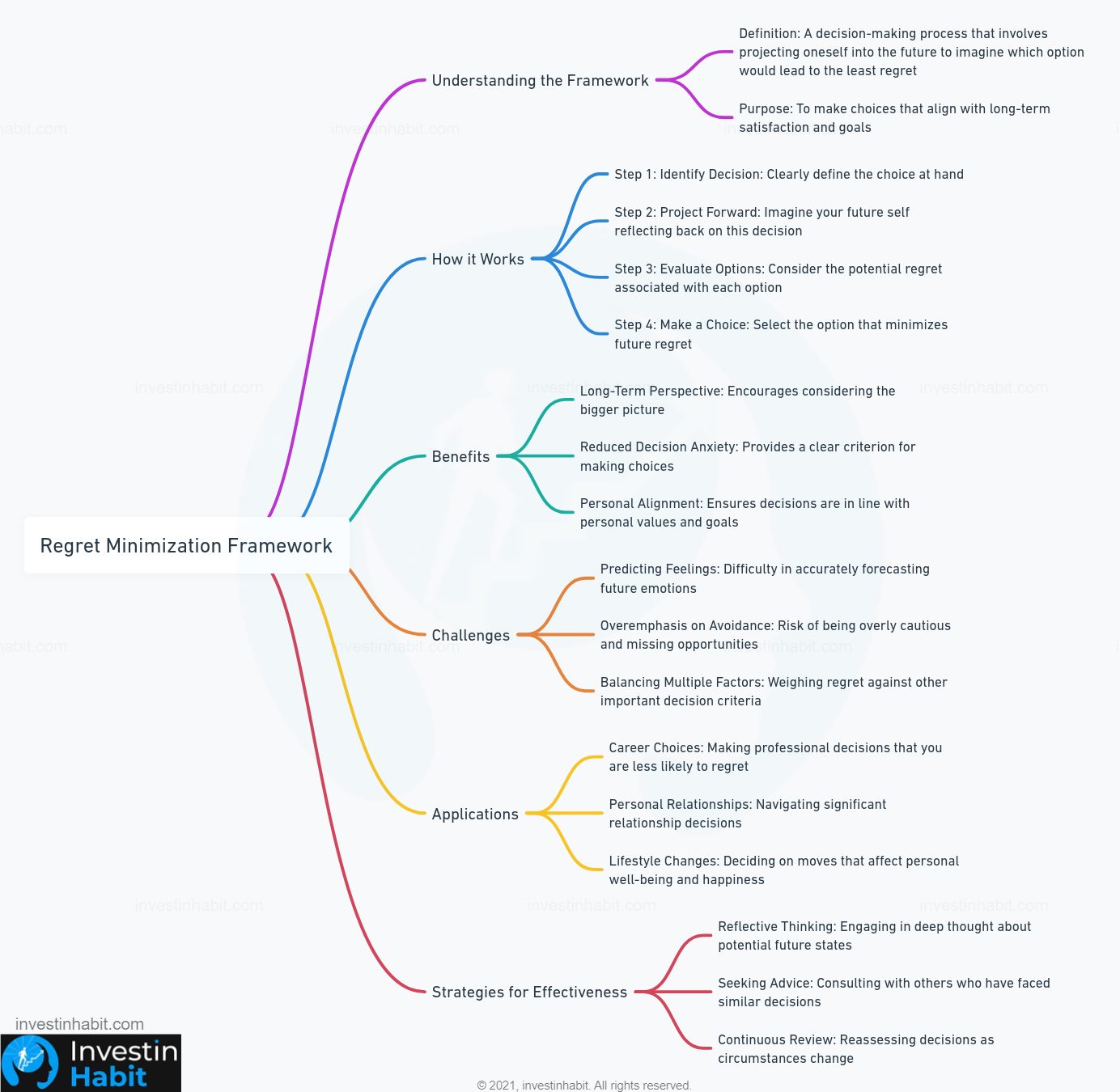
The Regret Minimization Framework is built on three core principles that can guide you in making decisions that you won’t regret later in life. Let’s take a closer look at these principles:
- Long-term perspective: When faced with a decision, it’s easy to get caught up in the short-term consequences. However, the RMF encourages you to think long-term, envisioning how your choices will impact your life in 5, 10, or even 20 years down the road. By adopting this forward-thinking mindset, you can prioritize what truly matters in the grand scheme of things and avoid getting bogged down by temporary setbacks or challenges.
- Focusing on key decisions: In life, there are countless decisions to make, but not all of them carry the same weight. The RMF teaches you to identify the key decisions that have the potential to shape your life or business in significant ways. By concentrating your efforts on these pivotal choices, you can ensure that you’re investing your time and energy where it matters most.
- Evaluating potential regret: Lastly, the RMF asks you to consider the potential regret associated with each option before making a decision. Imagine yourself in the future, looking back at the choice you’re about to make.Which option would leave you with the least amount of regret?By weighing the potential regret against the potential rewards, you can make more informed decisions that align with your long-term goals and values.

As you can see, the Regret Minimization Framework is more than just a decision-making tool; it’s a way of approaching life that helps you focus on what truly matters while minimizing the chances of looking back with disappointment.
By embracing these principles, you’ll be well on your way to living a life filled with purpose, fulfillment, and fewer regrets.
Benefits of using RMF in decision-making
Now that you have a better understanding of the Regret Minimization Framework, you might be wondering, “What’s in it for me?” Well, I’m glad you asked!
There are several benefits to using the RMF in your decision-making process, and I’m excited to share them with you. First and foremost, the RMF helps you gain clarity in your decision-making.
By focusing on long-term goals and evaluating potential regret, you’ll find it easier to identify the path that aligns with your values and aspirations. We all know how confusing and overwhelming it can be when you’re trying to make a crucial decision, but the RMF can help you cut through the noise and see the bigger picture.
Secondly, using the RMF can lead to increased confidence in your choices.
When you’ve taken the time to thoroughly analyze your options and consider the potential regret associated with each one, you’ll feel more assured that you’re making the right decision. This confidence can also help you stay committed to your choices, even when faced with obstacles or challenges.
You’ll know deep down that you’ve made the best possible decision for your long-term happiness and success.

Finally, the RMF encourages personal growth and self-awareness.
By regularly reflecting on your decisions and their long-term consequences, you’ll become more attuned to your values, priorities, and goals. This increased self-awareness can lead to a deeper understanding of yourself, which in turn can help you make even better decisions in the future.
So, my friend, as you can see, the Regret Minimization Framework is not only a practical tool for making better decisions, but it can also play a significant role in your personal development.
By incorporating the RMF into your decision-making process, you’ll set yourself on a path towards a more fulfilling, purpose-driven life with fewer regrets along the way.
Applying the Regret Minimization Framework in Life
Personal relationships
Now that we’ve covered the basics of the Regret Minimization Framework, let’s dive into some real-life examples of how you can apply it to your personal relationships.
After all, our connections with others are a huge part of what makes life meaningful, and we certainly don’t want to be weighed down by regret in this area. So, let’s explore how the RMF can help you make better decisions when it comes to friendships, romantic relationships, and family.
- Friendships: Have you ever found yourself in a situation where you had to choose between spending time with different friends, or maybe even questioning whether a particular friendship was still healthy and positive for you? The RMF can guide you in these situations by encouraging you to consider the long-term impact of your choices. For example, which friendships will be most valuable and supportive in the years to come? By focusing on the potential regret of maintaining or letting go of certain friendships, you can make more intentional choices about the people you surround yourself with.
- Romantic relationships: Navigating the world of love and romance can be tricky, to say the least.
- The RMF can help you make clearer, more thoughtful decisions in your romantic life, whether you’re deciding whether to pursue a new relationship, wondering if it’s time to take the next step with your partner, or even considering ending a relationship that no longer serves you. By evaluating the potential regret associated with each option and reflecting on the long-term consequences, you’ll be better equipped to make decisions that align with your values and contribute to your overall happiness.
- Family: Our relationships with our family members can be some of the most rewarding, but also the most challenging.When faced with decisions related to family, such as how to handle conflicts, set boundaries, or allocate time between different family members, the RMF can provide valuable guidance. By keeping the long-term impact of your choices in mind and considering the potential regret associated with each option, you’ll be able to make decisions that nurture and support your family relationships, ensuring that you create lasting, cherished memories with your loved ones.
As you can see, the Regret Minimization Framework is a versatile tool that can be applied to various aspects of your personal relationships.
By using the RMF to guide your decision-making, you’ll be well on your way to building stronger, more fulfilling connections with the people who matter most in your life.
Career choices
Career choices are another crucial aspect of life where the Regret Minimization Framework can come in handy.
After all, we spend a significant portion of our lives at work, so it’s important to make choices that will bring us satisfaction and fulfillment. Let’s take a closer look at how you can apply the RMF to some common career-related decisions.
- Pursuing passion versus stability: Ah, the age-old debate of following your dreams or playing it safe with a stable, well-paying job.This is a decision many of us grapple with at some point in our lives, and the RMF can help you navigate this tricky terrain. By considering the long-term consequences and potential regret of each option, you can make a more informed decision about what path to take.Remember, it’s not just about immediate financial gain; think about the long-term happiness and sense of purpose that each choice could bring you.
- Job changes and promotions: Deciding whether to change jobs or accept a promotion can be a difficult decision, particularly when there are factors like increased responsibility, relocation, or a change in work culture to consider.Using the RMF, you can weigh the potential regret associated with each choice and consider the long-term impact on your career trajectory and personal growth. By focusing on what matters most to you in the long run, you’ll be better equipped to make decisions that align with your values and goals.
- Work-life balance: Striking the right balance between work and personal life can be challenging, especially when it feels like there are never enough hours in the day.The RMF can help you make decisions about how to allocate your time and energy, whether it’s deciding to take on additional work projects, opting for a flexible work schedule, or setting boundaries with your employer.By evaluating the potential regret of each choice and its long-term impact on your overall well-being, you can make more intentional decisions that support a healthy work-life balance.
As you can see, the Regret Minimization Framework can be a valuable tool for guiding your career choices and helping you create a more fulfilling professional life.
By applying the RMF to these decisions, you’ll be better equipped to navigate the complex world of work and build a career that aligns with your values, passions, and long-term goals.
Health and wellness
Health and wellness is another area where the Regret Minimization Framework can help you make more informed decisions.
After all, our physical and mental well-being is the foundation for everything else in life, so it’s crucial to prioritize self-care. Let’s explore how you can apply the RMF to various aspects of your health and wellness journey.
- Exercise and diet choices: We all know that eating well and staying active are essential for maintaining good health, but sometimes it can be challenging to make the right choices in these areas.The RMF can help you evaluate the long-term consequences and potential regret associated with different exercise routines or diet plans. By considering how your choices will impact your health and well-being in the years to come, you’ll be more likely to make decisions that support a sustainable, healthy lifestyle.
- Seeking professional help: Whether it’s visiting a doctor for a check-up, consulting with a nutritionist, or starting therapy, seeking professional help for your health can sometimes feel daunting.The RMF can guide you in making these decisions by encouraging you to weigh the potential regret of not addressing your health concerns against the benefits of seeking expert advice. Remember, taking care of your health is an investment in your future self – one that you’re unlikely to regret.
- Taking care of mental health: Just as important as physical health is the well-being of our minds.The RMF can be a valuable tool in making decisions related to mental health, such as finding stress-reduction techniques, setting aside time for self-care, or deciding to seek therapy.By considering the long-term impact and potential regret of each choice, you can make more intentional decisions that support your mental well-being and overall happiness.
So, my friend, as you can see, the Regret Minimization Framework can be a powerful ally in your journey towards better health and wellness.
By applying the RMF to your decision-making process, you’ll be better equipped to make choices that support your physical and mental well-being, leading to a healthier, happier, and more balanced life.
Implementing the Regret Minimization Framework in Business
Strategic decision-making
The Regret Minimization Framework isn’t just helpful in our personal lives – it can also be a powerful tool for making decisions in the business world.
In a landscape filled with uncertainty and fierce competition, having a solid decision-making framework can make all the difference.
Let’s take a look at how you can implement the RMF in your business, focusing on strategic decision-making in areas like entering new markets, mergers and acquisitions, and product development and innovation.
- Entering new markets: When considering expanding your business into new markets, it’s essential to weigh the potential risks and rewards.The RMF can help you evaluate these opportunities by encouraging you to think about the long-term consequences and potential regret associated with each option. By focusing on the big picture and considering how these choices will impact your business in the long run, you’ll be better prepared to make well-informed decisions that drive growth and success.
- Mergers and acquisitions: Mergers and acquisitions can be high-stakes endeavors, with the potential for both significant rewards and considerable challenges.By using the RMF, you can weigh the potential regret of going forward with a merger or acquisition against the potential benefits and risks.By considering the long-term impact on your company’s financial health, culture, and market position, you’ll be better equipped to make decisions that align with your strategic goals and vision.
- Product development and innovation: In today’s fast-paced business world, innovation is the key to staying ahead of the competition.The RMF can guide you in making decisions related to product development and innovation, such as determining which projects to invest in or which technologies to adopt.By evaluating the potential regret associated with each choice and considering the long-term consequences for your business, you can make more strategic decisions that foster innovation and help your company thrive.
As you can see, the Regret Minimization Framework can be a valuable asset in the world of business, helping you make strategic decisions that lead to success and growth.
By implementing the RMF in your business decision-making process, you’ll be better equipped to navigate the complexities of the corporate landscape and steer your company toward a bright and prosperous future.
Operational decision-making
In addition to strategic decision-making, the Regret Minimization Framework can also be applied to operational decisions that impact the day-to-day functioning of your business.
After all, the success of your company often depends on the quality of these choices, so let’s explore how you can use the RMF to make better decisions in areas like hiring and talent management, supply chain and logistics, and marketing and sales strategies.
- Hiring and talent management: Your employees are the backbone of your business, so making the right hiring and talent management decisions is crucial.The RMF can help you evaluate potential candidates and make informed choices by considering the long-term consequences and potential regret associated with each hiring decision.By focusing on how each candidate will contribute to the company’s growth and culture, you’ll be better equipped to build a strong and talented team that drives success.
- Supply chain and logistics: Managing your supply chain and logistics efficiently can be a complex task, but it’s essential for keeping your business running smoothly.The RMF can guide you in making decisions related to procurement, inventory management, and transportation by encouraging you to weigh the potential regret of each option against the long-term impact on your company’s operations.By prioritizing choices that minimize risk and optimize efficiency, you can create a more resilient and agile supply chain.
- Marketing and sales strategies: In a world where customers have countless options at their fingertips, developing effective marketing and sales strategies is more important than ever.The RMF can help you make data-driven decisions in areas like advertising, pricing, and promotions by considering the potential regret and long-term consequences of each choice. By focusing on strategies that align with your target audience and business goals, you can drive growth and boost your company’s bottom line.
As you can see, the Regret Minimization Framework can be a powerful tool for making operational decisions that contribute to the overall success of your business.
By incorporating the RMF into your decision-making process, you’ll be better equipped to manage the day-to-day challenges of running a company and set the stage for long-term growth and success.
Organizational culture and values
Organizational culture and values play a significant role in the success and long-term sustainability of a company.
The Regret Minimization Framework can not only help you make better decisions, but it can also be a powerful tool for shaping the culture and values of your organization. Let’s explore how you can promote the RMF among employees and balance risk-taking with stability while keeping ethical considerations and long-term impact in mind.
- Encouraging RMF among employees: As a leader, you have the power to influence your team’s decision-making approach by encouraging the use of the RMF throughout the organization. By promoting a culture of long-term thinking and minimizing regret, you can help employees make better choices that contribute to the overall success of the company. Consider offering training or workshops on the RMF, sharing examples of how it has been applied effectively, and celebrating the positive outcomes that result from this approach.
- Balancing risk-taking and stability: A successful organization needs to strike a balance between taking risks and maintaining stability. The RMF can help you and your team navigate this delicate balance by evaluating the potential regret associated with each decision, along with its long-term consequences. By fostering a culture that values both innovation and stability, you can create an environment where employees feel empowered to take calculated risks while keeping the company’s long-term goals in mind.
- Ethical considerations and long-term impact: The Regret Minimization Framework isn’t just about maximizing profits or growth; it’s also about considering the ethical implications of your decisions and their long-term impact on stakeholders like employees, customers, and the environment. By promoting a culture that values ethical decision-making and long-term thinking, you can ensure that your organization is not only successful but also a responsible corporate citizen. Encourage employees to consider the ethical aspects of their choices and to weigh the potential regret of pursuing short-term gains at the expense of long-term consequences.
As you can see, the Regret Minimization Framework can be a valuable tool for shaping your organization’s culture and values.
By promoting the use of the RMF among your employees and fostering a culture that balances risk-taking with stability and ethical considerations, you can build a strong, resilient company that’s well-positioned for long-term success.
Common Pitfalls and Challenges in Applying RMF
While the Regret Minimization Framework can be a powerful decision-making tool, it’s essential to be aware of some common pitfalls and challenges that may arise when applying it.
By recognizing and addressing these issues, you can make the most of the RMF and use it effectively to guide your choices. Let’s discuss some of these challenges and how you can overcome them.
Overcoming analysis paralysis:
When using the RMF, it’s possible to get caught up in analyzing every potential outcome and regret, leading to analysis paralysis. To overcome this, try to focus on the most critical decisions with the highest potential for regret.
Remember that it’s impossible to predict every outcome, and sometimes it’s better to make a decision with the available information than to remain stuck in indecision.
Trust your instincts and remember that you can always adjust your course as new information becomes available.
Balancing short-term and long-term considerations:
Another challenge when using the RMF is balancing short-term needs with long-term goals.
It’s essential to keep the big picture in mind while addressing immediate concerns. One way to do this is by prioritizing decisions that align with your long-term objectives and values, even if they may require short-term sacrifices.
By focusing on what truly matters in the long run, you’ll be better equipped to make decisions that serve both your immediate and long-term interests.
Dealing with uncertainty and incomplete information:
Life and business are full of uncertainties, and we often have to make decisions with incomplete information.
The RMF can help you navigate this uncertainty by encouraging you to consider the potential regret associated with each option. However, it’s essential to accept that you may not have all the answers and be willing to adapt and learn as new information becomes available.
Embrace the unknown, trust your judgment, and remember that you can always adjust your decisions as you gain more insight.
By keeping these common pitfalls and challenges in mind, you can use the Regret Minimization Framework more effectively to guide your decision-making process.
Remember that the RMF is not about predicting the future with perfect accuracy but about minimizing regret and making the best possible choices with the information available to you. Embrace the journey, and you’ll be well on your way to a life filled with fewer regrets and more success.
Conclusion
As we come to the end of our exploration of the Regret Minimization Framework, let’s take a moment to recap what we’ve learned.
The RMF is a powerful decision-making tool that encourages us to consider the long-term consequences and potential regret associated with our choices. By applying the RMF in various aspects of our lives, from personal relationships to business decisions, we can make more informed choices that lead to fewer regrets and greater success.
I hope that our discussion of the Regret Minimization Framework has inspired you to consider applying it to your own decision-making process. By adopting a long-term perspective and evaluating the potential regret of your choices, you’ll be better equipped to make decisions that serve your best interests and align with your values.
Remember that no decision-making framework is perfect, but the RMF can be an invaluable tool for navigating the complexities of life and business.
Finally, I’d like to invite you to share your experiences with the Regret Minimization Framework.
Have you tried using it in your personal or professional life? How has it helped you make better decisions or overcome challenges?
By sharing your stories and insights, we can all learn from one another and continue to grow on our journey towards a life with fewer regrets. Thank you for joining me on this exploration of the Regret Minimization Framework, and I wish you the best of luck in applying it to your own decision-making process.
Here’s to a life filled with purpose, success, and, most importantly, minimal regrets!
Call-to-Action
As we continue our journey towards personal growth and better decision-making, I invite you to stay connected and engaged with our community:
Subscribe to the blog for more insights: Don’t miss out on future posts that delve into personal growth, decision-making, and other essential topics. By subscribing to the blog, you’ll receive the latest updates and valuable insights straight to your inbox.
Together, we’ll continue exploring new ideas and strategies to help you lead a more fulfilling and regret-free life.
Share the post on social media: If you found this discussion on the Regret Minimization Framework helpful, please consider sharing it with your friends and followers on social media.
By spreading the word, you’ll help others discover the power of the RMF and potentially transform their decision-making process for the better.
Leave a comment with your thoughts and experiences on RMF: I’d love to hear your thoughts on the Regret Minimization Framework and how it has impacted your life.
Have you used it to make a tough decision or experienced a moment of clarity by applying its principles?
Please share your experiences and insights in the comments section below. Your input is invaluable to our community as we learn from one another and continue to grow together.
Thank you for your support, and I look forward to continuing this journey towards personal growth and better decision-making with you.
Transform Your Habits, Transform Your Life
Are you ready to turn the page to a new chapter in your life?
Stop dreaming, start achieving. Our exclusive newsletter delivers:
- Science-backed hacks: Master the psychology of habit formation used by CEOs and Olympians.
- Actionable strategies: No fluff, just practical steps to crush procrastination and dominate your goals.
- + a FREE surprise bonus 🎁 to jumpstart your transformation!
Don’t settle for mediocre. Subscribe now!