

Understanding the Neural Pathways and Behavioral Psychology Behind It
Are you struggling to break a bad habit?
You’re not alone. Habits are hard to change because they’re deeply ingrained in our neural pathways.
But don’t worry, it’s not impossible. In this blog post, we’ll explore the science behind why bad habits are so difficult to break and offer strategies to help you overcome them.
We’ll delve into the different types of learning, including operant conditioning and classical conditioning, that contribute to habit formation.
We’ll also discuss how the reward pathway in our brains plays a role in the pleasurable nature of bad habits, making them harder to weaken compared to strengthening “good” habits.
But it’s not just science that’s at play here.
We’ll also explore the psychological and emotional factors that make breaking bad habits challenging. From our negative motivations to our sense of identity, changing a habit can feel like a threat to who we are.
So, if you’re ready to learn how to break your bad habits and form new, healthier ones, keep reading.
We’ll offer practical tips on how to leverage the structure of habits to your advantage, how to replace old habits with new ones, and how to navigate the environmental triggers that can make habit change difficult.

Inside this Article
How Operant Conditioning Makes Changing Habits Challenging
Operant conditioning is a psychological principle that describes how we learn through rewards and punishments.
When we engage in behavior that leads to a desirable outcome, we are more likely to repeat that behavior in the future. On the other hand, when we engage in behavior that leads to an undesirable outcome, we are less likely to repeat that behavior in the future.
This principle can make changing habits difficult because habits are behaviors that have been repeatedly reinforced through rewards or avoidance of punishment.
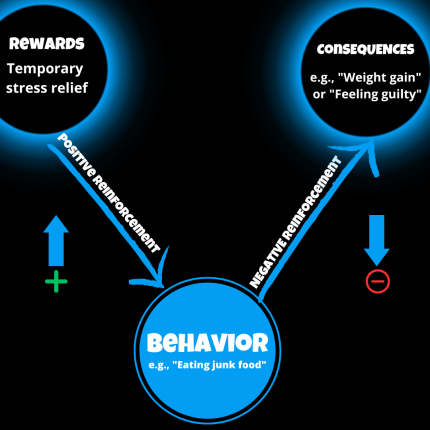
For example, if we have a habit of eating junk food when we feel stressed, the act of eating junk food may provide temporary relief from stress, reinforcing the behavior. This makes it more difficult to break the habit of reaching for junk food in times of stress because the behavior has been reinforced through positive reinforcement.
Additionally, operant conditioning can make it difficult to adopt new habits because the brain’s rewards associated with the new behavior may not be immediate or tangible.
For example, if we want to start a habit of exercising regularly, the benefits of exercise may not be immediately noticeable. This lack of immediate reward can make it more difficult to stick to the new habit, especially if the old habit provided a more immediate reward.

Transform Your Life with InvestInHabit

Ready for real change? Join us and get over:
- 200+ Personal Development Worksheets,
- 100+ Blog Post MindMaps
for FREE! 😍 + Our newsletter offers the latest in habit formation and self-improvement, straight to your inbox.
Subscribe now and Start redefining your mindset today! Join our community committed to success!
How Classical Conditioning Makes it Hard to Change
Classical conditioning is another aspect of learning that can make changing habits challenging.
It involves pairing a neutral stimulus with an automatic response to create a learned association. Over time, the neutral stimulus alone can elicit the same response.
This type of learning is what makes it difficult to break habits that are associated with particular triggers or cues.
For example, if a person has developed a habit of snacking while watching TV, the TV becomes the cue that triggers the snacking behavior.
The person has learned to associate the TV with snacking through classical conditioning. Even if they are not hungry, when they see the TV, they may feel compelled to eat.
Breaking this habit involves breaking the association between TV and snacking.
The strength of the learned association also contributes to the difficulty of breaking habits.
The more times the behavior has been repeated in the presence of the cue, the stronger the association will be, making it harder to resist the urge to engage in the behavior when the cue is present.
To overcome habits formed through classical conditioning, identify the triggers and work on breaking the associations by consciously resisting the urge to engage in the behavior when the cue is present. Consistency is key to weakening the habit’s hold.
Why Behavioral Psychology Makes Breaking Habits a Challenge
Behavioral psychology, or the study of how behavior is shaped by environmental factors, is closely related to operant and classical conditioning.
When it comes to habit formation, behavioral psychology highlights the role of environmental cues in triggering automatic behaviors. These cues can be anything from a particular time of day to a specific location, and they can activate the habit even when we’re not consciously aware of it.
The problem with these automatic behaviors is that they’re hard to change.
Even if we’re aware of the habit and understand why we want to change it, the environmental cues can override our intentions and make us act habitually. For example, if we’re used to snacking while watching TV in the evening, we may find it difficult to resist the urge to snack even if we’re not hungry.
Additionally, behavioral psychology suggests that behaviors are reinforced by their consequences.
If a behavior leads to a positive outcome, we’re more likely to repeat it in the future. This is why bad habits can be so hard to break – they’re often reinforced by some sort of reward, even if that reward is short-lived or ultimately harmful.
For example, smoking may be reinforced by the feeling of relaxation or stress relief, even though the long-term consequences are detrimental to health.
Overall, behavioral psychology emphasizes the importance of changing the environment and the consequences of behavior in order to change habits.
This can involve removing environmental cues that trigger the habit, creating new cues that promote healthier behaviors, and finding alternative rewards that can replace the positive reinforcement associated with the bad habit.
To break bad habits and form new ones, identify and modify environmental cues, find alternative rewards, and keep the long-term consequences in mind, all while maintaining consistency in your actions.
How Memory Plays a Key Role in Habit Formation and Change
Memory is another important factor that contributes to habit formation and can make changing habits difficult.
When we repeatedly perform a behavior in a specific context, it becomes associated with that context in our memory. The next time we encounter that context, our memory automatically retrieves the associated behavior, and we perform it without consciously thinking about it.
By “context,” I mean the specific situations or environments where a behavior takes place, such as physical surroundings, emotional states, or times of the day.
This is known as “automaticity,” and it’s how habits become ingrained in our daily lives.
This automaticity can make breaking a habit difficult because our memory is constantly reminding us of the habit every time we encounter the associated context.
Even if we consciously try to resist the habit, our memory is working against us by automatically triggering the behavior. This can create a sense of frustration and a feeling of being out of control, which can make changing the habit seem like an insurmountable challenge.
In addition, memory can also make forming new habits challenging because it requires repetition and consistency.
In order to create a new habit, we need to repeat the desired behavior in the same context over and over again until it becomes automatic. This can take time and effort, and if we miss a few repetitions, our memory may not be able to form the necessary associations to create the habit.
Overall, memory plays a significant role in habit formation and can make changing habits hard.
It’s important to understand how our memory works and how it contributes to the formation and maintenance of habits so that we can develop effective strategies for breaking old habits and forming new ones.
To build lasting habits, simply repeat your desired actions in the same situations. The stronger the link between context and behavior, the more likely your new habit will stick like glue!
Why Addiction Makes Changing Habits So Challenging
Addiction is a tough cookie to crack when it comes to changing habits.
When we engage in addictive behaviors, our brain releases a chemical called dopamine, which gives us a warm and fuzzy feeling of pleasure and reward.
But, the more we indulge in these behaviors, the more our brains become wired to associate them with pleasure, which leads to a strong desire to continue.
This creates a feedback loop in which the behavior is reinforced by the release of dopamine, making it more likely that we will continue to engage in the behavior in the future and increasingly difficult to break free from the behavior.
Breaking a bad habit becomes a challenge as the brain associates it with pleasure and reward.
Addiction can also lead to physical dependence, which means that when we try to break the addiction, we can experience withdrawal symptoms like discomfort, anxiety, and pain.
These symptoms can be emotional and physical, making it incredibly difficult to break free from addictive behaviors and form new, healthier habits. Overall, addiction can be a significant hurdle to overcome when trying to change habits.
It creates a strong reward system that reinforces addictive behaviors and can also lead to physical dependence that makes it challenging to stop engaging in those behaviors.
By understanding the impact of addiction on habit formation, you can better navigate the challenges of breaking bad habits and forming new, healthier ones.
Breaking habits tied to addiction requires understanding the powerful reward system created by dopamine and acknowledging the potential physical dependence. Seek support, be patient, and explore healthier alternatives to replace the addictive behavior, making the process of change more manageable.
The Marshmallow Test and Bad Habits
How the Marshmallow Experiment Sheds Light on the Challenge of Changing Habits
The Marshmallow Experiment is a famous study conducted in the late 1960s that tested the ability of children to delay gratification.
In the study, children were offered a choice between one small reward (like a single marshmallow) immediately or two small rewards if they waited for a short period of time. The experiment showed that children who were able to delay gratification and wait for the larger reward tended to have better life outcomes later on, such as higher academic achievement and better social skills.
The Marshmallow Experiment highlights a key factor in changing habits: the ability to delay gratification.
Changing habits often involves short-term sacrifices for long-term gains, and it can be difficult to resist the immediate rewards of continuing a bad habit in favor of the delayed rewards of forming a new, healthier habit.
Furthermore, the Marshmallow Experiment demonstrates that delaying gratification is a skill that can be learned and developed over time.
Similarly, changing habits requires practice and consistency over time in order to form new associations and neural pathways in the brain.
Overall, the Marshmallow Experiment helps us understand why changing habits is hard by showing that it requires the ability to delay gratification and develop new patterns of behavior over time.
By practicing delayed gratification and consistently working towards forming new, healthier habits, you can increase your chances of successfully breaking bad habits and forming new ones.
Immediate rewards can help reinforce new habits, while the ability to delay gratification helps in resisting the temptations of old habits or short-term rewards that might interfere with your progress and long-term goals.
Why Negative Emotions Drive Bad Habits
and How to Break the Cycle
It’s no secret that negative emotions can be powerful motivators.
When we’re feeling stressed, anxious, or overwhelmed, it’s easy to turn to bad habits as a way to cope. Whether it’s overeating, smoking, or drinking too much, these behaviors can provide a temporary escape from our negative emotions.
Unfortunately, relying on bad habits to cope with negative emotions can become a vicious cycle.
The short-term relief they provide can quickly turn into a long-term problem, as we become dependent on these behaviors to feel better. This can make it incredibly difficult to break free from bad habits, as they become deeply ingrained in our daily routines.
To make matters worse, our negative emotions can also contribute to a sense of hopelessness and defeatism.
When we’re feeling down, it can be hard to see the point in making an effort to change our habits. This can create a self-perpetuating cycle, in which our negative emotions lead to bad habits, which in turn lead to more negative emotions.
However, it’s important to remember that there are other, healthier ways to cope with negative emotions.
Exercise, meditation, and talking to a trusted friend or therapist are all effective ways to manage stress and anxiety. By focusing on building healthy habits, we can break free from the cycle of negative emotions and bad habits, and create a happier, healthier life for ourselves.
To tackle negative emotions driving bad habits, remember this tip: “Replace, don’t suppress.” Instead of trying to suppress negative emotions or cope with them through unhealthy habits, replace those habits with healthier alternatives like exercise, meditation, or seeking support from a trusted friend or therapist. This way, you break the vicious cycle and pave the way for a happier, healthier life.
Breaking Habits: The Power of Focusing on One at a Time
Changing a habit can be a challenging endeavor.
Many people make the mistake of trying to change too much all at once, which can quickly lead to feelings of overwhelm and frustration. When we try to tackle multiple habits simultaneously, we are spreading ourselves too thin and not giving ourselves the time and energy needed to focus on one habit at a time.
Focusing on one habit at a time allows us to channel our energy and resources into making lasting changes.
It also allows us to build momentum and confidence as we start to see progress and success in changing our habits. By starting small and working our way up, we can create lasting change in our habits and achieve our goals.
Remember, changing a habit is a process that takes time and patience.
It’s important to set realistic expectations and not get discouraged by setbacks or slow progress. Celebrate the small victories along the way and keep moving forward, one step at a time.
In the end, trying to change too much all at once can be counterproductive.
Focusing on one habit at a time allows us to be more successful in creating lasting change and achieving our goals. So take it slow, be patient, and remember that change is a process, not a quick fix.
Focus on changing one habit at a time to effectively channel your energy. Patience and celebrating small victories will keep you moving forward in the process.
Patience Needed: Changing Habits Takes Time
Breaking bad habits is not easy, and one of the main reasons why people struggle is that they forget that it is a process that takes time. We often expect to see immediate results and get frustrated when we don’t. But changing a habit is like a journey, and it requires patience, persistence, and commitment.
It’s important to remember that habits are ingrained patterns of behavior that have been reinforced over time. So breaking them will not happen overnight. It can take weeks, months, or even years to change a habit. But with consistent effort and small steps, you can make progress and eventually break the habit.
Another reason why we forget that breaking habits is a process is that we tend to focus too much on the end goal. We want to be healthier, fitter, or more productive, and we want it now. But focusing on the end goal can be overwhelming and discouraging, especially if we don’t see results right away. Instead, it’s essential to focus on the process, the small steps that will lead us to our goal.
In summary, forgetting that breaking habits is a process and takes time is a common reason why people struggle to change bad habits. It’s important to be patient, persistent, and committed to the journey.
By focusing on the process, celebrating small victories, and taking small steps, we can eventually break the habit and achieve our goals.
Changing Habits Can Feel Like a Threat to Who We Are
Our habits are often tied to our identity and sense of self. When we engage in a habit repeatedly over time, it can become part of who we are and how we see ourselves. As a result, changing a habit can feel like a threat to our very sense of self.
This can create a powerful emotional attachment to our habits, making it difficult to break free from them. When we attempt to change a habit, we may experience feelings of discomfort or anxiety as we confront the idea of letting go of a part of ourselves.
It’s important to recognize this emotional attachment and give ourselves time and space to process these feelings.
By acknowledging the role our habits play in our sense of self, we can begin to shift our perspective and see changing our habits as a positive step towards personal growth and development.
As we successfully transform our habits, we can reshape our identity and evolve into the person we aspire to be, embracing the new and improved version of ourselves.
Remember, it’s okay to feel uncomfortable or uncertain when changing a habit – it’s all part of the process.
Why Bad Habits Are Easy to Form and Hard to Break
While Good Habits Are Hard to Form and Easy to Break
One reason why bad habits are often easier to form and harder to break is that they are often reinforced more quickly and immediately than good habits.
When we engage in a bad habit, such as smoking or overeating, we may experience an immediate sense of pleasure or relief, which reinforces the behavior and makes it more likely that we will do it again in the future.
In contrast, good habits, such as exercising or eating healthy, may not provide an immediate sense of reward, making it more difficult to stick with them in the long run.
Another reason why bad habits are often easier to form is that they can be tied to strong emotional experiences or stress.
For example, when we are feeling anxious or stressed, we may turn to comfort foods or other unhealthy coping mechanisms, which can quickly become habits. On the other hand, forming good habits often requires sustained effort and motivation, which can be difficult to maintain over time.
Breaking bad habits can also be difficult because they can be tied to our sense of identity and self-worth.
If we have been engaging in a bad habit for a long time, it can become a part of our sense of self, making it feel like a threat to our identity to try to change it. In contrast, good habits may not be as closely tied to our sense of self, making them easier to let go of if we slip up or face obstacles.
Overall, the process of forming and breaking habits is complex and multifaceted, but understanding the factors that contribute to the ease or difficulty of these processes can help you better navigate the challenges of habit change.
Strategies for Breaking Bad Habits: Tips and Techniques
Breaking bad habits can be a challenging process, and it can be easy to feel overwhelmed or discouraged. However, with the right strategies and mindset, it is possible to break even the most ingrained bad habits.
In this section, we will explore some effective strategies for breaking bad habits and replacing them with healthier, more positive behaviors.
First, we will discuss how understanding the structure of habits can be a useful tool for breaking them. By leveraging the way that habits are formed and reinforced, we can develop effective strategies for changing our behavior.
Next, we will explore the role of rapid reinforcement in the formation and maintenance of bad habits. By recognizing how quickly and powerfully bad habits can be reinforced, we can take steps to interrupt those patterns and create new, healthier habits instead.
For some particularly stubborn habits, a more extreme approach may be necessary. We will discuss when and how to take more drastic measures to break deeply ingrained habits and create lasting change.
We will also delve into strategies for breaking habits that are triggered by environmental cues or contexts. By learning to recognize and manage those triggers, we can create a healthier, more supportive environment for ourselves and make it easier to break bad habits.
Finally, we will discuss the importance of substituting new, positive behaviors for old, negative habits. By developing new habits that serve the same needs as our old habits, we can create a foundation for lasting change and build a happier, healthier life.
Unlocking the Secret Structure of Habits to Change Them
Understanding the structure of habits is crucial to breaking them. Habits are formed through a process of repetition in a consistent context and become more automatic over time.
This means that breaking a habit requires inhibiting an established behavioral response when a cue is encountered, or planning ahead to avoid the cue.
Leveraging this structure can be done by identifying the cues and rewards associated with the habit and making changes to the environment to remove or replace them. For example, if the cue for a bad habit is a certain time of day, changing up the routine during that time can disrupt the habit loop and make it easier to break.
By understanding the structure of habits and the role of cues and rewards, we can create new and healthier habits more effectively. It’s important to remember that forming a new habit takes time and effort, but with awareness and persistence, we can create lasting change in our lives.
Recognizing and Overcoming Rapid Reinforcement of Bad Habits
Bad habits are often formed quickly because they are rapidly reinforced, which means that when we engage in a certain behavior, we receive an immediate reward or benefit.
This creates a strong association between the behavior and the reward, making it more likely that we will continue to engage in the behavior in the future.
The rapid reinforcement of bad habits can make them incredibly difficult to break, as our brains have become wired to associate those habits with reward and pleasure.
This can make it hard to resist the urge to engage in the behavior, even when we know it is not in our best interest.
To break this cycle, it’s important to recognize the patterns of behavior that lead to the reward or benefit.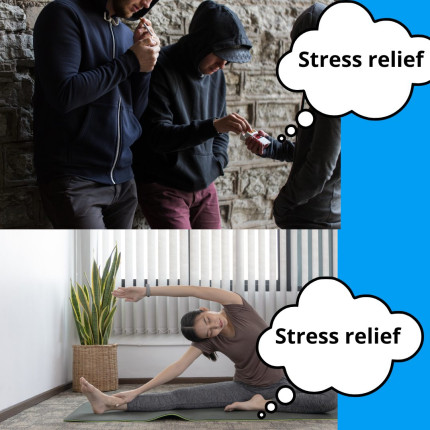
This means paying attention to the triggers or cues that precede the behavior, as well as the thoughts and emotions that follow. For example, someone who eats junk food when they’re bored may need to find alternative ways to occupy their time, while someone who smokes to relieve stress may need to find healthier ways to cope with difficult emotions.
Once we understand what triggers the behavior, we can work to avoid those triggers or replace the behavior with a healthier alternative.
This may involve making changes to our environment, such as removing junk food from the house or finding new ways to cope with stress, such as practicing mindfulness or going for a walk.
It may also involve finding healthier ways to satisfy the underlying need that the behavior is fulfilling, such as finding healthier snacks to eat when we’re hungry or learning new stress management techniques.
It’s also helpful to focus on the long-term benefits of breaking the habit, rather than the immediate rewards of continuing it.
By understanding the rapid reinforcement of bad habits and actively working to break the cycle, we can create lasting change in our behavior and improve our overall well-being.
Breaking Bad Habits: When Extreme Measures are Necessary
Sometimes breaking a bad habit requires more than just willpower and small changes.
In some cases, a more extreme approach may be necessary. This is especially true for habits that are deeply ingrained and tied to our sense of identity.
For example, quitting smoking may require not just cutting back gradually, but quitting cold turkey and making significant lifestyle changes. Similarly, overcoming addiction may require seeking professional help and support.
It’s important to recognize when a habit requires a more extreme approach and to seek the necessary help and resources to make a significant change. This can be difficult, as it requires confronting the habit and its underlying causes, but it can lead to lasting and positive change in the long run.
Remember, changing a habit is a process that requires patience, self-awareness, and sometimes, more extreme measures. Don’t be afraid to seek help and support when necessary and to approach the process with a growth mindset and determination to succeed.
Breaking Habits Triggered by Environment: Strategies to Succeed
Breaking habits that are triggered by environmental contexts can be especially challenging. However, there are a few strategies that can help. One approach is to avoid the environment altogether, if possible.
For example, if you have a habit of snacking while watching TV, try not to keep any snacks in the house, or watch TV in a different room.
Another approach is to stop yourself from acting on the triggered habit. This can be done by using a cue to remind yourself to pause and reflect on your behavior before acting on the habit.
For example, if you have a habit of checking your phone every time it buzzes, you can place your phone out of reach and remind yourself to take a few deep breaths before responding.
Lastly, trying to unlearn the activated associations can also be an effective strategy. This involves intentionally breaking the connection between the environmental trigger and the habitual behavior.
For example, if you have a habit of smoking when you take a break from work, you could try taking a walk instead, to create a new association between taking a break and engaging in a healthier behavior.
By employing these strategies, you can begin to break the connection between the environmental context and the habit, making it easier to change the behavior over time.
Remember, changing habits is a process that requires patience and persistence, but with the right strategies and mindset, it is possible to create lasting change.
The Power of Substituting Old Behaviors with New Ones
Breaking a bad habit requires more than just stopping the behavior – it requires replacing it with a new, healthier habit. Substituting a new behavior in place of a habitual response can be a powerful way to break old patterns and establish new ones.
When choosing a new behavior to replace the old habit, it’s important to choose something that is satisfying and rewarding, but also aligned with your goals and values. This can help to reinforce the new behavior and make it more likely that you will continue to engage in it over time.
One effective strategy for substituting a new behavior is to use a cue and reward system. This involves identifying a specific trigger or cue that prompts the old habit, and then replacing the old behavior with a new one that provides a similar reward or benefit.
Over time, this can help to rewire the brain and establish a new, healthier habit.
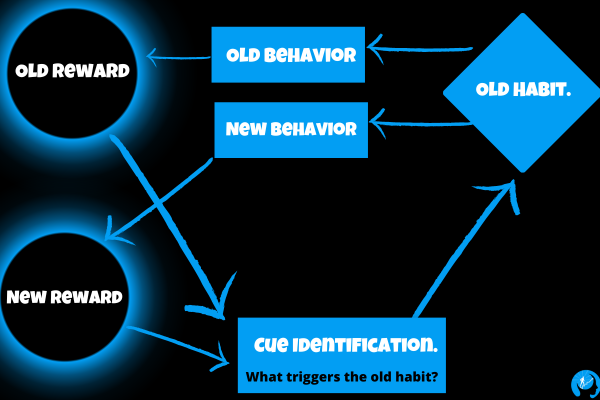
Example habit: Checking social media frequently during work hours
Cue Identification: Feeling bored or overwhelmed at work Old Habit: Reaching for the phone and opening a social media app Old Behavior: Scrolling through social media feeds, leading to decreased productivity Old Reward: Temporary relief from boredom or work stress
New Behavior: Taking a short walk or doing a quick stretching exercise instead of checking social media New Reward: Refreshed mind, increased focus, and reduced stress while maintaining productivity
In this example, the process of identifying the cue, old habit, old behavior, new behavior, and the old and new rewards are as follows:
- Cue Identification: Recognizing that the trigger for checking social media is feeling bored or overwhelmed at work.
- Old Habit: The automatic response of reaching for the phone and opening a social media app when experiencing the cue.
- Old Behavior: Scrolling through social media feeds, leading to decreased productivity.
- Old Reward: Experiencing temporary relief from boredom or work stress, but at the cost of productivity.
- New Behavior: Choosing to take a short walk or do a quick stretching exercise instead of checking social media when feeling bored or overwhelmed at work.
- New Reward: Feeling refreshed and more focused, with reduced stress and maintained productivity. (a similar reward)

Here are some examples of how this strategy can be used for breaking common bad habits:
- Smoking: Many people smoke as a way to relieve stress or anxiety. To replace this habit, you could try deep breathing exercises, meditation, or taking a quick walk when you feel stressed or anxious.
- Overeating: Overeating can be a way to cope with emotions, boredom, or other triggers. To replace this habit, you could try engaging in a fun activity when you feel bored, talking to a friend or therapist when you feel emotional, or finding healthier snacks to eat when you have the urge to snack.
- Procrastination: Procrastination can be a way to avoid uncomfortable tasks or to find more enjoyable activities. To replace this habit, you could try breaking down large tasks into smaller, more manageable ones, using a timer to work in short bursts, or finding ways to make the task more enjoyable, such as listening to music while you work.
- Nail-biting: Nail-biting can be a way to cope with anxiety or stress. To replace this habit, you could try chewing gum or sucking on a piece of hard candy, using fidget toys or stress balls, or practicing relaxation techniques like deep breathing or meditation.
Remember, breaking a bad habit and establishing a new one takes time, patience, and persistence. By substituting a new behavior in place of a habitual response, we can create lasting change and achieve our goals.
Changing Habits: Strategies and Final Thoughts
In conclusion, breaking bad habits can be a challenging and daunting task, but it is possible with the right mindset and strategies.
The science behind habits, including operant and classical conditioning and behavioral psychology, contributes to why breaking bad habits is so difficult. Additionally, addiction, negative emotions, and habits tied to identity and sense of self can make it hard to change habits.
However, there are effective strategies for breaking bad habits, such as understanding the structure of habits and recognizing the rapid reinforcement of bad habits. Furthermore, the need for more extreme approaches to some habits and the importance of substituting a new behavior in place of a habitual response can also aid in breaking bad habits.
It’s important to remember that breaking bad habits is a process that takes time and patience. It’s essential to set realistic expectations and celebrate small victories along the way.
Understanding the process of breaking habits and implementing effective strategies can help you achieve your goals and create lasting change. Overall, breaking bad habits is a challenging but worthwhile endeavor.
By using the strategies outlined in this article and persevering through the process, you can successfully break bad habits and establish healthier ones.
Transform Your Habits, Transform Your Life
Are you ready to turn the page to a new chapter in your life?
Stop dreaming, start achieving. Our exclusive newsletter delivers:
- Science-backed hacks: Master the psychology of habit formation used by CEOs and Olympians.
- Actionable strategies: No fluff, just practical steps to crush procrastination and dominate your goals.
- + a FREE surprise bonus 🎁 to jumpstart your transformation!
Don’t settle for mediocre. Subscribe now!