

Habits play a significant role in our lives, influencing our behavior, thoughts, and ultimately, our success.
Building good habits and breaking bad ones is crucial for personal growth and development. But how do we develop habits that stick?
In this blog post, we’ll explore the “three Rs” of habit formation, a framework that can help you create lasting, positive changes in your life.
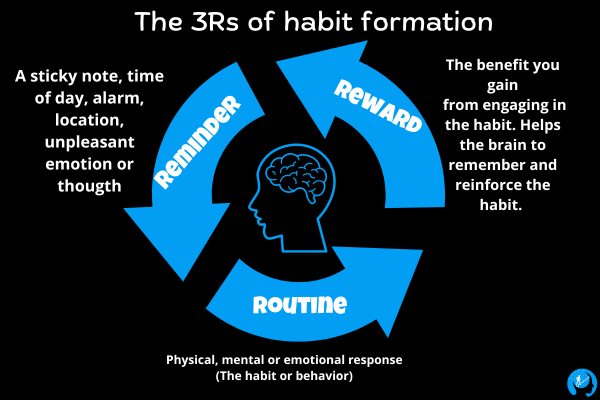
The “three Rs” of habit formation are Reminder, Routine, and Reward. In general, you’ll find that these three steps fit almost any habit. Understanding this framework helps to break down a typical habit.
By utilizing this framework, you can develop new habits and make them a permanent part of your daily routine.
New Habits: The Three Rs of Habit Formation
Every year, many write up goals and resolutions that they want to achieve, but often end up breaking them not too long after. What is the reason behind this?
The answer is simple – habits. Your life today is essentially the sum of your habits.
Habits are actions that are performed repeatedly and automatically, without requiring much thought. Creating different patterns isn’t always easy, but with the help of the Three Rs, it is possible to create and maintain habits that make our lives better.
Reminder: The First R
The first “R” in the three Rs is the Reminder.
This is the reminder that initiates the behavior.
The reminder is the trigger that prompts a specific behavior. It’s an essential aspect of the process of habit formation because it initiates the habit loop, the cycle that triggers and reinforces the habit.
A good reminder makes it easy to start by encoding your new behavior in something that you already do.
The reminder could be anything that prompts you to engage in a particular behavior, such as an alarm, a specific time of day, a location, or a particular event. For example, setting an alarm to remind you to meditate every morning or leaving your running shoes by the door to remind you to go for a run.
To create a reminder, you need to make the behavior visible and easy to implement. You could use a post-it note, a reminder app on your phone, or even a string around your finger. The key is to make the reminder something that you cannot ignore or forget.
Routine: The Second R
The second “R” in the three Rs is Routine.
Routine is the behavior or action you want to establish as a habit.
An important part of forming new habits is starting small and building up gradually. For example, if you want to start a daily exercise routine, start with a few minutes of stretching or light exercises and gradually increase the duration and intensity over time.
The key is to make the routine something that you can sustain and that doesn’t feel overwhelming. To establish a routine, create a plan that outlines what you’ll do and when you’ll do it.
For example, if you want to establish a daily meditation routine, create a plan that outlines what time of day you’ll meditate and for how long. Having a plan will help you stay on track and establish the habit.
Reward: The Third R
The third and final “R” in the three Rs is Reward.
The reward is the positive consequence that follows the behavior, and it reinforces the habit. The reward is what makes us want to keep doing the behavior.
It’s the benefit / reward for completing the habit.
The reward could be anything that provides a positive consequence for the behavior, such as a sense of accomplishment, increased energy levels, or improved mood.
For example, if you establish a daily exercise routine, the reward could be the release of endorphins that comes with exercise, or the sense of pride and accomplishment that comes from sticking to your routine.
To establish a reward, identify something that provides a positive consequence for the behavior and make it something that you look forward to. For example, if you establish a daily exercise routine, treat yourself to a healthy snack or a relaxing bath after your workout.
The reward should be something that you enjoy and that reinforces the habit. In conclusion, the “three Rs” are a powerful framework that has been proven by behavioral psychology researchers.
So, there is a lot of science behind the process of habit building. You can be relatively confident that your habits follow the same cycle I just described.
By understanding this framework you can improve your health and life in general because your life is ultimatelly the product of daily habits.
Start by encoding your new behavior with a reminder, make the new habit so easy that you can’t say no, and reinforce the positive behavior with a reward. With enough repetition, you can create, maintain, and stick to any new habit you want.
Lasting change is a product of consistent everyday habits rather than isolated, monumental transformations.
Remember to start small, stay consistent, and celebrate your progress along the way.

Transform Your Life with InvestInHabit

Ready for real change? Join us and get over:
- 200+ Personal Development Worksheets,
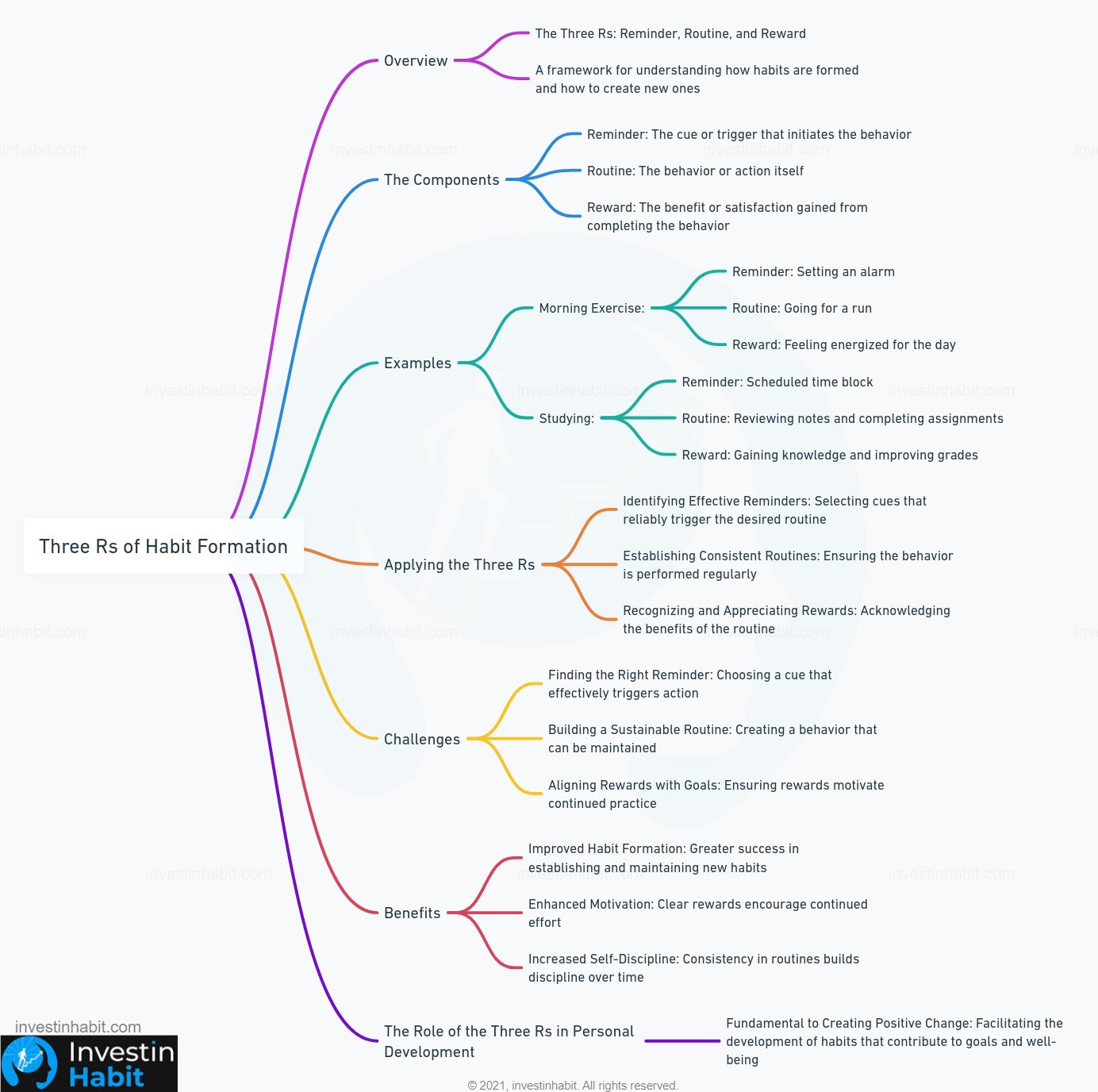
- 100+ Blog Post MindMaps
for FREE! 😍 + Our newsletter offers the latest in habit formation and self-improvement, straight to your inbox.
Subscribe now and Start redefining your mindset today! Join our community committed to success!
FAQ Section
How Do Habits Work?
Habits function as automatic behavioral patterns ingrained in our brains through repetition, allowing us to carry out tasks with minimal conscious effort. They are formed when the brain connects a specific cue or trigger with a particular action, creating a habit loop that drives our behavior.
What is Habit Change?
Habit change refers to the process of replacing an old habit with a new one. It’s much easier to change a habit than to try to break an old bad habit, especially if you’re replacing it with a similar one. That’s where the Three Rs come in handy.
What is the Habit Loop and How Does it Work?
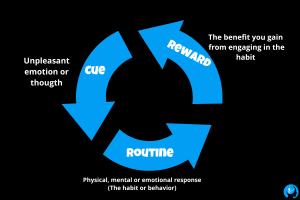 The Habit Loop is the framework behind the process of building habits. The 3Rs are components of the habit loop. Every habit follows the same basic structure: Cue, Routine, and Reward. The Cue initiates the behavior, the Routine is the actual behavior, and the Reward is the benefit gained from completing the habit. Cue=Reminder.
When repeated enough times, the habit becomes automatic and easier to stick to.
Suggested: What is the habit loop? The ultimate answer
What are the Three Rs of Habit Development?
The “three Rs” are Reminder, Routine, and Reward.
What is the Cue in Habit Formation?
The Cue is the first step in understanding how habits form. With any new habit, start by encoding your new behavior with a reminder. A reminder could be anything – a time of day, a location, a sound, or even an emotion.
How Can You Form New Habits?
When trying to form new habits, it’s important to start with baby steps. James Clear, the author of Atomic Habits, suggests making the new behavior so easy that you can’t say no. He calls it the two-minute rule: focus on doing the new habit for just two minutes each time.
Once the habit becomes easy, gradually increase the duration or difficulty.
How Can You Actually Stick to Your New Habits?
To actually stick to your new habits, make them enjoyable and start with small, manageable steps. Additionally, set up consistent reminders and make your habits part of your daily routine.
How Many Times Do You Need to Repeat a New Behaviour to Make it Stick?
There is no set number of times required to repeat a new habit to make it stick. It varies from person to person, and the nature of the habit. However, studies have shown that it typically takes at least 21 days to form a new habit, a safer bet would be 66 days.
What is the Reward for Creating and Sticking to New Habits?
The reward for creating and sticking to a new habit is the positive impact it has on our lives. Small, consistent positive changes add up over time and lead to significant improvements in our overall well-being.
Transform Your Habits, Transform Your Life
Are you ready to turn the page to a new chapter in your life?
Stop dreaming, start achieving. Our exclusive newsletter delivers:
- Science-backed hacks: Master the psychology of habit formation used by CEOs and Olympians.
- Actionable strategies: No fluff, just practical steps to crush procrastination and dominate your goals.
- + a FREE surprise bonus 🎁 to jumpstart your transformation!
Don’t settle for mediocre. Subscribe now!