

Have you ever wondered why some habits seem to stick, while others fade away?
Why can some people easily develop healthy routines, while others struggle to make lasting changes? The answer lies in the fascinating world of habit formation psychology.
In this article, we’ll dive deep into the psychological mechanisms behind habits, exploring the intricate interplay between our thoughts, emotions, and behaviors. By understanding the psychology of habits, you’ll be better equipped to create lasting, positive changes in your life and overcome the barriers that have held you back in the past.
So, get ready to unlock the secrets of habit formation and transform your daily routines for the better!
Inside this Article
The Psychology of Habit Formation
Picture this: You’re sitting at home, trying to decide whether to hit the gym or binge-watch your favorite show.
Why is it that sometimes the gym wins, while other times the couch calls your name? The answer lies in the captivating realm of the psychology.
In this section, we’ll explore the fascinating processes that govern our habits, shedding light on the forces that shape our decisions and behaviors. By delving into the mysteries of the mind, we’ll uncover the secrets to forming powerful, lasting habits that can transform your life.
So, buckle up and get ready for an intriguing journey into the inner workings of the human psyche!
The habit loop: cue, routine, and reward
Picture yourself waking up in the morning, smelling the aroma of freshly brewed coffee, and savoring that first delightful sip.
This seemingly simple routine is actually a perfect illustration of the habit loop at work. The habit loop, a cornerstone of habit formation psychology, consists of three essential components: cue, routine, and reward.
By understanding how these elements interact, we can unlock the secrets to creating and changing our habits.
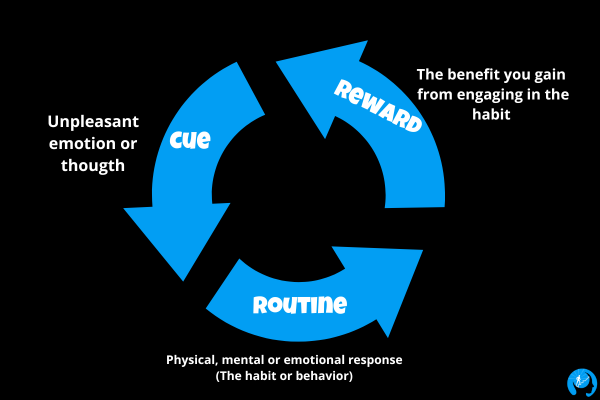
First up is the cue, the trigger that initiates the habit.
In our coffee example, the cue might be the irresistible smell of the coffee or the sound of the brewing machine. Cues can come in various forms, such as sights, sounds, or even emotions.
The key is that they signal to our brains that it’s time to engage in a specific routine.
The routine is the actual behavior or action we perform in response to the cue.
In the case of our coffee habit, the routine would be pouring a cup and taking that first delicious sip. Routines can be simple, like grabbing a coffee, or more complex, like exercising or meditating.
What makes a routine a habit is its automatic nature, often performed without conscious thought. As the habit develops and strengthens, the process of automaticity increases, allowing the behavior to occur with minimal cognitive effort.
Lastly, we have the reward, which is the positive reinforcement that comes from engaging in the routine.
The reward can be a feeling of satisfaction, pleasure, or relief, and it’s what makes the habit loop so powerful. For the coffee drinker, the reward might be the energy boost from the caffeine or the comfort of a warm drink.
The reward strengthens the association between the cue and the routine, increasing habit strength and creating a cycle that reinforces the habit over time.
By understanding the habit loop and its components, we can better identify the cues, routines, and rewards that drive our behaviors. This knowledge helps us see how habits guide behavior, influencing our actions and decision-making throughout the day.
This insight enables us to harness the power of psychology to create positive habits and replace less desirable ones, ultimately helping us to lead more fulfilling lives.
Charles Duhigg, a journalist and author, popularized the concepts of cue, routine, and reward in habit formation in his book “The Power of Habit: Why We Do What We Do in Life and Business” published in 2012.
However, these concepts were derived from various research studies and findings in the fields of psychology and neuroscience that explored habit formation and behavior modification. Duhigg synthesized this information to present the habit loop framework in his book.

Transform Your Life with InvestInHabit

Ready for real change? Join us and get over:
- 200+ Personal Development Worksheets,
- 100+ Blog Post MindMaps
for FREE! 😍 + Our newsletter offers the latest in habit formation and self-improvement, straight to your inbox.
Subscribe now and Start redefining your mindset today! Join our community committed to success!
The role of motivation behind habit formation
Ah, motivation!
It’s the fuel that sets us in motion and keeps us going as we work towards our goals. But when it comes to habit formation, motivation plays a key role that goes beyond just getting us started.
Think of motivation as the spark that ignites the engine of habit formation.
Without it, the whole process of developing a new habit can feel like an uphill battle. But when we have that initial motivation, it’s like riding a bike with the wind at our back, making the journey smoother and more enjoyable.

I remember when I first decided to start running every morning.
In the beginning, it was my motivation – the desire to improve my fitness and have more energy throughout the day – that got me out of bed and into my running shoes. But as the days went by, I realized that motivation alone wouldn’t be enough to sustain this new habit.
Some days I would wake up feeling less than enthusiastic about hitting the pavement, and that’s when the power of habit formation really came into play.
In those moments, I relied on the consistency I had built over time.
My running routine had become so ingrained in my daily life that it was almost like brushing my teeth – something I did without even thinking about it. Motivation had provided the initial push, but it was the habit I had formed that kept me going, even on those less-than-perfect days.
You see, motivation and habit formation work hand-in-hand like the gears of a well-oiled machine.
Motivation helps us take that first step, while habit formation ensures that we continue moving forward, even when the initial excitement starts to fade. And the more we practice a habit, the stronger and more automatic it becomes, turning what once required conscious effort into something that feels as natural as breathing.
 So, when embarking on the journey of habit formation, remember the importance of motivation as the spark that gets you going.
But don’t forget that it’s the steady, consistent practice that will ultimately help you turn your goals into reality. Like a gardener tending to their plants, it’s the combination of motivation and habit formation that will help you cultivate a flourishing and fulfilling life.
The power of belief and mindset in habit development
Belief and mindset are the unsung heroes in the world of habit development.
They’re the invisible forces that can either propel us towards success or hold us back, depending on how we harness their power. The impact of our beliefs and mindset on habit formation is not to be underestimated, as they can make all the difference between flourishing and floundering.
I recall a time when I decided to learn a new language.
At first, I was excited about the challenge and eager to immerse myself in this new linguistic adventure. But soon, self-doubt began to creep in, and I found myself thinking, “Can I really do this?
What if I’m not cut out for learning a new language?” It was then that I realized the power of belief and mindset in shaping my progress.
Our beliefs and mindset act like a pair of glasses through which we see the world.

If we wear glasses that are tinted with doubt and negativity, the world appears to be a much more difficult and daunting place. But if we swap those glasses for ones that are colored with confidence and optimism, suddenly, the challenges we face seem much more manageable and surmountable.
Once I acknowledged the power of my mindset, I decided to change my perspective.
I chose to believe in my ability to learn a new language and embraced a positive, can-do attitude. And just like that, my journey towards language mastery became an exciting and enjoyable experience.
My newfound belief in myself empowered me to persevere through the inevitable challenges and setbacks that came my way, and eventually, I found myself speaking and understanding the language with ease.
It’s important to remember that our beliefs and mindset are like the soil in which our habits grow.
When we cultivate a fertile mindset – one that is rich in self-belief, optimism, and determination – we create the perfect environment for our habits to take root and thrive. In contrast, a mindset mired in doubt and negativity is like barren soil, where even the most promising seeds of habit struggle to grow.
So, as you embark on your own habit development journey, be mindful of the power that lies in your beliefs and mindset.
Tend to them with care, and watch as your habits blossom and flourish in the fertile ground of your positive outlook.
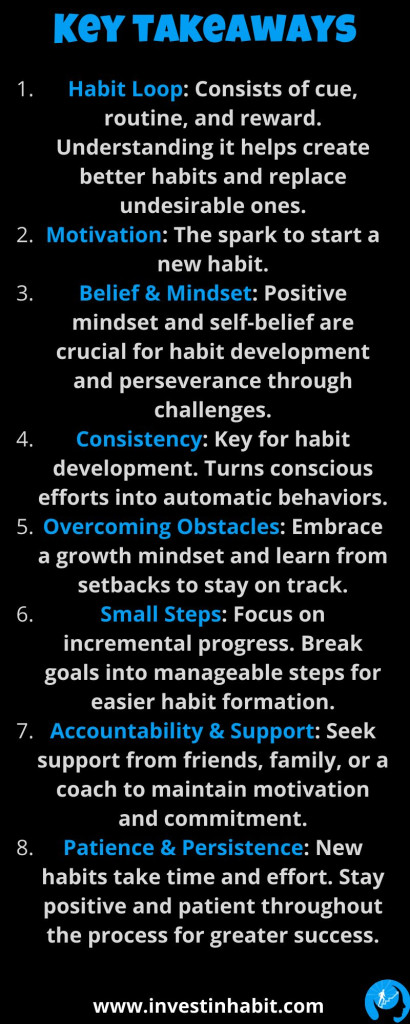
 Key takeaways from the Psychology of Habit Formation:
- The “habit loop”: The habit loop consists of three components – cue, routine, and reward. Understanding the habit loop helps us identify the triggers and rewards associated with our habits, enabling us to build better habits and replace undesirable ones.
- The role of motivation: Motivation is the initial spark that helps us start forming a new habit. However, it’s the consistent practice and reinforcement that strengthens the habit and makes it more automatic over time.
- The power of belief and mindset: Our beliefs and mindset can either propel us towards success or hold us back. Cultivating a positive mindset and self-belief is crucial for developing and maintaining healthy habits, as it helps us persevere through challenges and setbacks.
- Consistency is key: To develop and strengthen a habit, it’s essential to maintain consistency in practicing the routine. Consistency helps turn conscious efforts into automatic behaviors, making it easier to sustain the habit over time.
- Overcoming obstacles: It’s normal to face obstacles and setbacks during the habit formation process. Embracing a growth mindset and learning from these experiences can help you stay on track and continue making progress.
- Small steps and gradual progress: When forming new habits, it’s important to start small and focus on making incremental progress. Breaking down goals into manageable steps can make creating habits less overwhelming and more achievable.
- Accountability and support: Having a support system, such as friends, family, or a coach, can be beneficial in maintaining motivation and staying accountable during the habit formation process. Sharing your goals and progress with others can provide encouragement and help you stay committed to your new habits.
- Patience and persistence: Developing new habits takes time, effort, and patience. It’s essential to be persistent and understand that progress may not always be linear. Maintaining a positive attitude and being patient with yourself during the habit formation process will increase the likelihood of success.
Habit Formation Theories
Welcome to the thrilling world of habit formation theories!
Yes, you heard that right – thrilling. While the topic might sound like something you’d encounter in a dusty old psychology textbook, it’s actually a fascinating subject that holds the key to unlocking the secrets behind our daily behaviors.
So, buckle up as we delve into the captivating world of habit formation theories, shedding light on the psychological mechanisms that guide our actions and help us navigate the complexities of life. Prepare to have your mind blown as we explore the theories that underpin the way habits are formed, and perhaps even gain some invaluable insights to apply in your own life.
Get ready for a rollercoaster ride through the fascinating landscape of the human mind!
Classical conditioning
Imagine the delightful sound of an ice cream truck, jingling its way through your neighborhood on a hot summer day.
As soon as you hear that familiar tune, your mouth begins to water, and you find yourself craving a sweet, icy treat. What you’re experiencing is a perfect example of classical conditioning.

Classical conditioning is a learning process discovered by Russian psychologist Ivan Pavlov in the early 20th century.
Pavlov noticed that his dogs would begin to salivate whenever they saw the lab assistant who fed them, even if the assistant wasn’t carrying any food. Intrigued by this observation, he set up a now-famous experiment in which he rang a bell before feeding the dogs.
Over time, the dogs associated the sound of the bell with the arrival of food and began to salivate at the sound alone.
Before diving deeper into the concept of classical conditioning, it’s important to understand the key terms involved in this psychological process.
By familiarizing ourselves with these definitions, we can better grasp the mechanics of classical conditioning and how it influences habit formation. Here is a list of essential terms and their definitions:
Neutral stimulus: A neutral stimulus is a stimulus that, initially, does not elicit any specific response or emotional reaction from an individual. It is a stimulus that has no particular meaning or significance before it becomes associated with an unconditioned stimulus.
Conditioned stimulus: A conditioned stimulus is a previously neutral stimulus that, after being repeatedly paired with an unconditioned stimulus, acquires the ability to elicit a conditioned response from an individual. In other words, it is a neutral stimulus that becomes meaningful and triggers a specific response due to its association with another stimulus.
Unconditioned stimulus: An unconditioned stimulus is a stimulus that naturally and automatically elicits a response or emotional reaction from an individual without any prior learning or conditioning. It is a stimulus that has an innate, built-in meaning or significance.
Conditioned response: A conditioned response is a learned response or emotional reaction that an individual exhibits in response to a conditioned stimulus. It typically resembles the original unconditioned response, but it occurs as a result of the association between the conditioned stimulus and the unconditioned stimulus.
Unconditioned response: An unconditioned response is a natural, automatic response or emotional reaction that an individual exhibits in response to an unconditioned stimulus. It is a response that occurs instinctively and without any prior learning or conditioning.
In classical conditioning, we start with two main elements: a neutral stimulus and an unconditioned stimulus.
Let’s break it down using Pavlov’s experiment as an example.
First, we have the neutral stimulus, which is something that doesn’t naturally cause a specific response.
In Pavlov’s case, this was the sound of the bell. When the dogs first heard the bell, they didn’t associate it with food, and therefore, it didn’t cause them to salivate.
The second element is the unconditioned stimulus, which naturally triggers a particular response. In this experiment, the unconditioned stimulus was the food, and the response it naturally elicited was salivation.
This response is called the unconditioned response, as it happens automatically, without any prior learning.
Now, here’s where the magic of classical conditioning takes place.
Pavlov repeatedly paired the neutral stimulus (the bell) with the unconditioned stimulus (the food), making the dogs hear the bell right before they received their meal. Over time, the dogs started to make a mental connection between the sound of the bell and the arrival of food.
After several instances of pairing the bell and the food, something interesting happened. The neutral stimulus (the bell) was transformed into a conditioned stimulus, meaning it now had the power to elicit a response on its own.
In other words, the sound of the bell alone was enough to make the dogs salivate, even when no food was presented. This new response, triggered by the conditioned stimulus, is called the conditioned response.
Imagine you’re living in a peaceful village near a dense forest.

Every day, you venture into the woods to collect firewood for your home. At first, the sound of the rustling leaves was just a neutral stimulus—it had no particular meaning or effect on you.
However, one day, while you were gathering wood, you encountered a friendly deer who always seemed to appear when the leaves rustled.
Over time, the sound of the rustling leaves became associated with the deer’s presence.
The deer (an unconditioned stimulus) naturally brought you feelings of joy and excitement (an unconditioned response) whenever it appeared.
As you continued to hear the rustling leaves and see the deer, you began to experience joy and excitement (now a conditioned response) just by hearing the leaves rustle (now a conditioned stimulus), even if the deer didn’t appear.
In this metaphor, the rustling leaves represent the neutral stimulus that eventually becomes a conditioned stimulus, and the friendly deer symbolizes the unconditioned stimulus that leads to the conditioned response.
The story illustrates the process of classical conditioning, where a neutral stimulus transforms into a conditioned stimulus through repeated pairing with an unconditioned stimulus, ultimately evoking a response similar to the original unconditioned response.

This type of learning plays a role in habit formation by creating associations between environmental cues and our automatic responses to them.
For example, if you always eat a snack while watching TV, you might find yourself reaching for a treat every time you sit down in front of the screen, even if you’re not hungry. By understanding how classical conditioning works, you can better recognize the cues and associations that drive your habits and make conscious efforts to break or modify them.
Imagine a world where understanding the science behind our habits could help us break free from the chains of unhealthy behaviors.
This is the story of Tom, a man who struggled with a bad habit of smoking and how his friend Lucy, a psychologist, used the principles of classical conditioning to help him overcome his addiction. In this tale, you’ll discover the power of classical conditioning in shaping our habits and how, with persistence and the right strategies, we can change them for the better.
So, sit back, relax, and join us as we explore the fascinating world of habit formation through the eyes of Tom and Lucy.
Once upon a time, in a quaint little town, there lived a man named Tom.
Tom was well-liked by his neighbors, but he had one bad habit – smoking. Despite his numerous attempts to quit, he found himself helplessly reaching for a cigarette whenever he stepped out onto his porch.

One day, Tom’s friend, a psychologist named Lucy, decided to help him quit smoking by explaining classical conditioning.
She began by observing Tom’s smoking habit and noticed that every time Tom sat on his porch swing, he would light a cigarette without even realizing it.
Lucy explained to Tom that his smoking habit had become a conditioned response to the action of sitting on his porch swing.
In this case, the porch swing was a neutral stimulus that became associated with the unconditioned stimulus – the act of smoking. The unconditioned response was the satisfaction and relaxation Tom felt when he smoked.
Over time, the porch swing (neutral stimulus) transformed into a conditioned stimulus, making Tom crave a cigarette whenever he sat on it, resulting in a conditioned response of smoking.
To help Tom quit smoking, Lucy suggested that they try to break this association using the principles of classical conditioning.
She proposed that Tom replace the cigarette with a healthier alternative, such as chewing gum, whenever he sat on the porch swing. This way, Tom would still experience satisfaction and relaxation (the unconditioned response) but without the harmful effects of smoking.
With Lucy’s guidance, Tom diligently practiced this new routine every day.
Gradually, he began to associate the porch swing with chewing gum instead of smoking. Over time, the conditioned response of reaching for a cigarette when sitting on the porch swing was replaced by the healthier habit of chewing gum.
Through understanding classical conditioning and its role in habit formation, Tom was able to successfully break his smoking habit and replace it with a healthier alternative.
This story demonstrates the power of classical conditioning in shaping our habits and how, with persistence and the right strategies, we can change them for the better.
Operant conditioning
Imagine you’re learning to play the guitar, and every time you successfully strum a chord, someone gives you a piece of chocolate.
Over time, you’d likely become more motivated to practice your chords to receive that sweet treat. This is an example of operant conditioning, a powerful psychological concept that helps us understand how habits can be formed and changed.
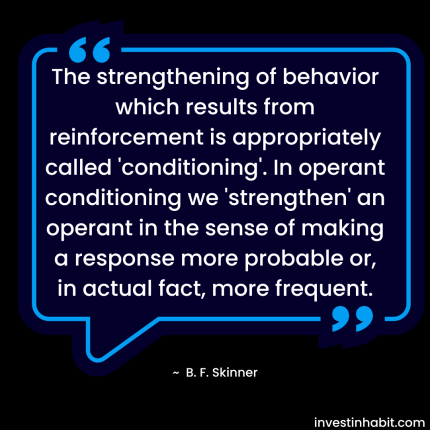
Operant conditioning, developed by psychologist B.F. Skinner, is a learning process in which an individual’s behavior is shaped through consequences, such as rewards or punishments.
It’s based on the principle that actions followed by positive outcomes are more likely to be repeated, while actions followed by negative outcomes are less likely to be repeated.
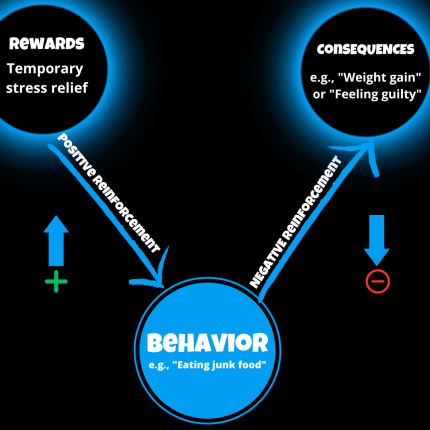 In operant conditioning, there are four primary components: positive reinforcement, negative reinforcement, positive punishment, and negative punishment.
Let’s break down each one:
Positive reinforcement: This occurs when a desirable consequence (like our chocolate reward) follows a behavior, increasing the likelihood that the behavior will be repeated. In our guitar example, the positive reinforcement of receiving chocolate makes practicing chords more appealing.
Imagine a child who receives praise and encouragement from their parents every time they put away their toys. The praise serves as a positive reinforcement, increasing the likelihood that the child will continue to clean up after themselves in the future.
Negative reinforcement: This is the removal of an unpleasant stimulus following a behavior, also increasing the likelihood of the behavior being repeated. For example, if you practice your chords and your guitar teacher stops criticizing your technique, that’s negative reinforcement. The removal of criticism encourages you to keep practicing.
Consider a driver who hears a loud, annoying beeping noise every time they forget to fasten their seatbelt.
When they buckle up, the noise stops. In this case, the removal of the annoying sound acts as negative reinforcement, encouraging the driver to consistently fasten their seatbelt.
Positive punishment: This involves introducing an unpleasant consequence after an undesirable behavior, decreasing the likelihood that the behavior will be repeated. For instance, if you play a wrong chord and your guitar teacher scolds you, that’s positive punishment. The scolding serves as a deterrent, discouraging you from making the same mistake again.
Let’s say a teenager stays out past their curfew, and as a consequence, their parents ground them for a week. This punishment serves as a deterrent, discouraging the teenager from breaking their curfew again.
Negative punishment: This is the removal of a desirable stimulus following an undesirable behavior, also decreasing the likelihood of the behavior being repeated. If you consistently play the wrong chords and your guitar teacher takes away your chocolate reward, that’s negative punishment. The loss of the reward serves as a deterrent, discouraging the undesirable behavior.
Suppose an employee is often late to work, and as a result, they are denied their annual bonus.
The removal of the bonus acts as negative punishment, discouraging the employee from continuing their tardy behavior.
Through a deeper understanding of operant conditioning and its core components, we can gain valuable insights into the ways in which our habits are shaped and maintained.
By applying the principles of operant conditioning to our daily lives, we can strategically use reinforcements and punishments to alter our behavior and foster healthier, more productive habits.
By taking a closer look at the reinforcements and punishments that influence our actions, we can begin to modify our behaviors and create positive change in our lives.
Whether it’s breaking a bad habit, forming a new routine, or achieving a specific goal, operant conditioning can be a powerful tool for behavioral change.
From the workplace to the home, operant conditioning can be applied to a wide range of everyday situations.
By identifying the factors that influence our habits and behaviors, we can make conscious efforts to modify or reinforce certain actions, ultimately leading to a happier, healthier, and more productive life.
Overall, understanding the principles of operant conditioning is an essential step towards achieving our personal and professional goals.
By harnessing the power of positive reinforcement and carefully managing punishments, we can shape our habits and behaviors in a way that serves our best interests and leads to long-term success.
Here are some examples of how you can apply operant conditioning to change your habits:
Positive reinforcement: If you want to start exercising regularly, you could treat yourself to a small reward each time you complete a workout.
This could be something like watching an episode of your favorite show or enjoying a healthy snack. By consistently rewarding yourself, you’re more likely to stick to your exercise routine.
Negative reinforcement: Let’s say you have a habit of staying up late watching TV, and you want to start waking up earlier in the morning.
You could set up a system where you give yourself a small reward, like a piece of your favorite candy or a few minutes of free time, every time you manage to wake up at the desired time. By doing this, you are using negative reinforcement because you are removing the aversive stimulus of having to wake up early in exchange for a reward.
Over time, this can help motivate you to continue waking up early and form a new habit.
Positive punishment: To break the habit of hitting the snooze button, you could place your alarm clock across the room, forcing you to get out of bed to turn it off.
This adds a minor inconvenience to the act of snoozing, which can help deter you from continuing this habit.
Negative punishment: If you’re trying to cut down on unhealthy snacking, you could implement a rule that for each unhealthy snack you eat, you must remove a designated “fun” activity from your daily routine (e.g., browsing social media or playing video games).
This will create a consequence for indulging in unhealthy snacking and help you change this habit.
By understanding and applying the principles of operant conditioning, you can create a system of rewards and consequences tailored to your individual needs and preferences. This approach can help you modify your habits more effectively and sustainably, leading to long-lasting changes in your behavior.
Observational learning and social influence
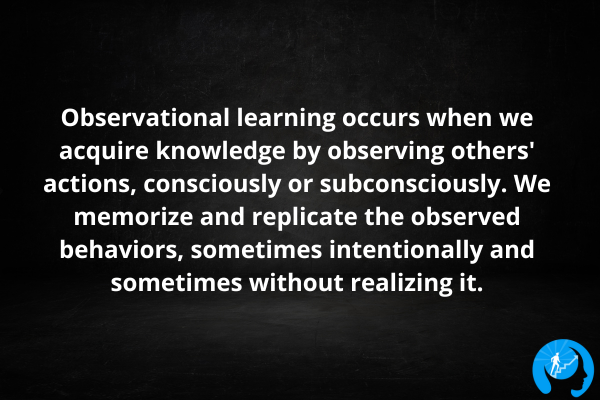
Observational learning, also known as social learning, is another crucial aspect of habit formation.
This type of learning occurs when we watch and imitate the behaviors of others around us, absorbing and adopting their habits as our own. The power of social influence should not be underestimated when it comes to understanding how we develop and maintain our habits.
Imagine you’re new to a workplace, and you notice that everyone takes a break at 3 pm to gather around the coffee machine and chat.
After observing this routine for a few days, you might find yourself naturally joining in on these coffee breaks without even thinking about it. This is a prime example of observational learning, where you pick up on the habits of your peers and integrate them into your own behavior.
The people we surround ourselves with can have a significant impact on our habits.
If your social circle consists of individuals who exercise regularly, eat healthily, and engage in positive behaviors, you’re more likely to adopt these habits yourself. Conversely, if you spend time with people who have unhealthy habits, such as smoking, overeating, or procrastinating, these behaviors may rub off on you as well.
We can also use the power of social influence to our advantage when trying to change our habits.
By surrounding ourselves with positive role models or joining support groups, we can draw inspiration and motivation from others who have successfully changed their habits. For instance, if you’re trying to quit smoking, attending a support group with others who have successfully quit can provide invaluable encouragement and guidance.
Observational learning can be both conscious and subconscious. Sometimes, people intentionally observe and learn from others’ actions, while in other cases, they may pick up on behaviors and habits subconsciously without even realizing it.
In summary, observational learning and social influence play a significant role in the formation and reinforcement of our habits.
By being mindful of the people and environments we expose ourselves to, we can better understand and leverage the power of social influence to create positive and lasting changes in our habits.
Cognitive Processes in Habit Formation
Welcome to the fascinating world of cognitive processes and their role in habit formation!
In this riveting section, we’ll dive into the mysterious inner workings of the mind and explore how our thoughts, beliefs, and mental strategies contribute to the habits we create and maintain. Ready to embark on a thought-provoking journey into the depths of your own cognitive processes?
Strap in, and let’s get started on this captivating exploration that will undoubtedly leave you with a deeper understanding of your own habits and the power of the mind.

Cognitive dissonance and habit change
Imagine you’re an environmentalist who is deeply passionate about reducing plastic waste, yet you find yourself frequently using plastic water bottles.
You know it’s harmful to the environment, but the convenience is too hard to resist. This internal struggle creates a psychological discomfort known as cognitive dissonance.
Picture cognitive dissonance as an itchy sweater; it’s uncomfortable and you can’t ignore it. The more you wear it, the more it bothers you, urging you to do something about it.
Cognitive dissonance is a powerful force that can drive us to change our habits.
In our example, the discomfort of holding conflicting beliefs – being an environmentalist and using plastic water bottles – could push you to seek a resolution. You might decide to invest in a reusable water bottle or look for alternative ways to reduce your environmental impact.
The magic of cognitive dissonance lies in its ability to turn the discomfort into a catalyst for change.
Recognizing and embracing this discomfort can be a game-changer when it comes to breaking old habits and forming new ones. If we can acknowledge the inconsistency between our actions and beliefs, we can harness that energy to make positive changes in our lives.
For instance, a person who is trying to eat healthily but still indulges in junk food might feel cognitive dissonance as well.
To resolve this inconsistency, they could choose to replace their unhealthy snacks with healthier options or set specific goals for their diet.
In summary, cognitive dissonance is like a mental alarm that sounds when our actions are not aligned with our beliefs. By paying attention to this alarm and using it to fuel positive change, we can transform our habits and ultimately live a more authentic and fulfilling life.
Goal setting and intentionality
Picture yourself standing at the bottom of a mountain, gazing up at the peak you’ve always dreamed of conquering.
You know it’s going to be a long, challenging journey, but you’re determined to make it to the top. To get there, you’ll need to break down your ultimate goal into smaller, manageable steps.
This process of goal setting and intentionality is an essential part of habit formation, guiding us through the twists and turns of our personal growth journey.
When I first decided to start running regularly, I knew I couldn’t jump straight into running a marathon.
I set smaller, achievable goals for myself, like running a mile without stopping or increasing my weekly mileage. By focusing on these incremental steps, I could measure my progress and celebrate my successes along the way.
The satisfaction I felt each time I accomplished a goal fueled my motivation to keep going, and soon, running became a natural and enjoyable part of my daily routine.
Goal setting is like having a roadmap for your journey up the mountain.
You need to establish checkpoints that guide you along the way and help you stay focused on your ultimate destination. Intentionality is the compass that keeps you on track, ensuring that your daily actions are aligned with your goals.
When forming new habits, it’s crucial to be specific and intentional about your goals.

Instead of vaguely aspiring to “eat healthier,” set a clear goal like “incorporate more vegetables into my meals” or “drink a green smoothie every morning.” By setting specific, achievable goals, you create a concrete path to follow, making it much easier to stay committed and motivated.
In conclusion, goal setting and intentionality are powerful tools that can transform your journey of habit formation into a successful and enjoyable experience.
Like a skilled mountaineer, equip yourself with a roadmap and a compass to guide you toward your personal summit, and you’ll find that forming new habits can be both rewarding and fulfilling.
The role of self-efficacy in habit formation
Imagine you’re setting out to learn a new skill or form a healthy habit.
You might be excited at first, but soon enough, you’re faced with obstacles and challenges. It’s at this point that your belief in your ability to succeed becomes a crucial factor in your journey.
This belief is called self-efficacy, and it plays a pivotal role in habit formation.
Self-efficacy is the confidence we have in our ability to accomplish a specific task or achieve a particular goal.
It’s like the fuel that keeps us moving forward, even when the road gets bumpy. When we believe in ourselves, we’re more likely to invest time and effort in our goals, face challenges head-on, and persist through setbacks.
Think of it as the inner cheerleader that keeps you going when the going gets tough.
For instance, let’s say you’ve decided to take up jogging to improve your fitness. At first, it might be difficult to run even a short distance, and you might feel discouraged.
But if you have a strong sense of self-efficacy, you’ll be more likely to push through the discomfort and keep working towards your goal.
On the other hand, if you doubt your capabilities, you might give up at the first sign of difficulty, convincing yourself that you just can’t do it.
A low sense of self-efficacy can prevent you from even trying in the first place, making it nearly impossible to form new habits or achieve your goals.
To boost your self-efficacy and set yourself up for success in habit formation, start by setting realistic and achievable goals.
Break your larger goal down into smaller, manageable steps, and celebrate each milestone along the way. Surround yourself with supportive people who believe in you and encourage your efforts.
And most importantly, don’t forget to believe in yourself, because when you have faith in your abilities, you’re more likely to turn your dreams into reality.
Emotional Aspects of Habit Formation
Get ready to dive into the fascinating world of emotions and their powerful influence on our habits!
You might be surprised to learn just how deeply our feelings are intertwined with the actions we take every day. Emotions have the power to nudge us into forming habits, and understanding their role can unlock the secrets to successfully adopting new behaviors or breaking free from old, unwanted patterns.
So, fasten your seatbelts and join us on this emotional rollercoaster ride as we explore the captivating realm of habit formation and the psychology of emotions!
The role of emotions in habit formation
Think of our emotions as the wind that propels the sailboat of our habits.

They can either push us towards positive, life-enhancing behaviors or drag us into negative, self-destructive patterns. Whether we realize it or not, our emotions are often the driving force behind our actions and play a pivotal role in habit formation.
Imagine your daily commute to work.
You’ve found that listening to upbeat music makes you feel happy and energized, so you start doing it every day. Over time, this emotional connection to the music transforms your morning routine into a pleasant, almost automatic habit.
You’ve harnessed the power of positive emotions to create a habit that makes your daily journey more enjoyable.
On the flip side, consider the habit of emotional eating.
Let’s say you had a particularly rough day at work, and you’re feeling down. You reach for your favorite comfort food – a tub of ice cream – and devour it while watching TV.
The immediate satisfaction and relief it provides creates a strong emotional connection, and soon enough, you find yourself turning to ice cream as a way to cope with stress. In this case, your emotions have nudged you into forming a habit that might not be the healthiest choice.
The key takeaway here is that our emotions have a powerful influence on our habits, whether positive or negative.
By becoming more aware of the role our emotions play in shaping our behaviors, we can better harness their power and channel it towards forming habits that serve us well.
So, let your emotions be the gentle breeze that guides you towards the shores of positive habit formation, and steer clear of the stormy seas of unhealthy patterns.
Emotional regulation and habit development
Imagine your emotions are like a river, sometimes calm and serene, and other times wild and tumultuous.
When we learn to navigate these emotional currents skillfully, we can use them to our advantage in the development of healthy habits.
One day, I found myself caught in a cycle of procrastination.
I was swamped with work, yet every time I thought about tackling my to-do list, I’d feel anxious and overwhelmed. Instead of addressing my tasks, I’d escape into mindless social media scrolling.
This only made me feel more stressed, as I was fully aware that I was falling behind on my work. To break this cycle, I decided to practice emotional regulation.
First, I took a moment to acknowledge and accept my feelings of anxiety.
Rather than trying to suppress them, I allowed myself to sit with those emotions, observing them without judgment. Once I had identified the root cause of my procrastination – fear of failure – I took small, manageable steps to tackle my work.
I set a timer for 25 minutes and focused solely on one task, followed by a short break. This technique, known as the Pomodoro Method, helped me transform my anxiety into a driving force for productivity.
The key to emotional regulation is recognizing that our emotions are like the weather – ever-changing and temporary.
When we learn to observe and accept our emotions without being swept away by them, we can create an environment conducive to habit development. It’s like learning to sail through the choppy waters of our emotional landscape, adjusting our sails as needed to harness the winds of change and steer ourselves towards the desired destination – a life filled with healthy, empowering habits.
The impact of stress on habit formation
Imagine stress as a storm cloud that looms over us, sometimes releasing torrents of rain and harsh winds that can throw us off course.
When we’re under stress, our ability to form and maintain healthy habits can be seriously challenged.
I recall a period in my life when I was juggling multiple responsibilities – work, family, and personal commitments.
The constant demands on my time and energy left me feeling frazzled and overwhelmed. I noticed that during this stressful phase, my exercise routine took a back seat, and my diet began to suffer.
It seemed like stress was acting like a wrecking ball, tearing down the healthy habits I had worked so hard to establish.
To regain control, I decided to confront the stress head-on.
I began by identifying the primary stressors in my life and looked for ways to manage or eliminate them. For instance, I started delegating tasks at work and set clear boundaries for my personal time.
I also made it a point to prioritize self-care activities such as meditation, exercise, and spending quality time with loved ones.
As I addressed the stressors in my life, I noticed the storm cloud of stress began to dissipate, allowing the sunlight of my healthy habits to shine through once more.
By acknowledging the impact of stress on habit formation and taking proactive steps to manage it, we can create a more balanced, nourishing environment in which our habits can thrive. Just like a gardener who protects their delicate plants from harsh weather conditions, we too can safeguard our habits by cultivating resilience in the face of life’s inevitable stressors.
Strategies for Creating and Maintaining Positive Habits
As we embark on this path towards creating and maintaining positive habits, it’s essential to recognize that our daily actions and choices are the building blocks of a fulfilling and successful life.
Our habits, both big and small, ultimately shape who we are and who we aspire to become. In this section, we will explore a treasure trove of strategies that will empower you to cultivate healthy habits and set the stage for lasting behavior change.
So, gear up and get ready to unleash your full potential as we dive into the world of positive habit formation and maintenance. The journey ahead is sure to be inspiring, enlightening, and life-changing!
Implementing the psychology of habit formation
Picture yourself as a skilled gardener, preparing to cultivate a lush and thriving garden filled with positive habits.
The psychology of habit formation is like the rich soil that nourishes the seeds of change, providing them with the right environment to grow and flourish. By harnessing the power of psychological principles, you can effectively sow the seeds of new habits and nurture them until they become strong and resilient plants.
Think back to when I first learned about the habit loop, with its three key components: cue, routine, and reward.
This understanding was a game-changer for me. I had been struggling to establish a consistent exercise routine for years.
By identifying the cue (setting out my workout clothes the night before), creating a specific routine (a 30-minute workout every morning), and rewarding myself afterward (with a delicious and healthy breakfast), I finally managed to make exercise an integral part of my daily life. Now, every morning feels like a celebration of my commitment to health and wellness.
As you embark on your own journey of habit formation, consider the metaphor of a sculptor carefully chiseling away at a block of marble.
With each stroke, the sculptor reveals the masterpiece hidden within. Similarly, when you implement the psychology of habit formation, you gradually chip away at the obstacles standing between you and your best self.
By employing strategies like classical conditioning, operant conditioning, and observational learning, you can patiently and persistently shape your behaviors and choices, revealing the remarkable person you were always meant to be.
Remember, you are the master of your destiny, and the psychology of habit formation is the toolkit that empowers you to create a life filled with purpose, happiness, and success.
Embrace the process, celebrate your progress, and never stop learning, growing, and evolving.
Overcoming obstacles and challenges in habit development
Picture yourself as a seasoned hiker, embarking on a challenging trek to reach the summit of a majestic mountain.

This journey represents your path to developing new habits, and along the way, you’ll undoubtedly encounter obstacles and challenges. Much like the hiker who persists in the face of adversity, you, too, can overcome these obstacles and ultimately achieve your goals.
I remember when I tried to establish a habit of daily meditation.
At first, it seemed like an impossible task, with countless distractions vying for my attention. It felt like trying to navigate a dense, thorny forest with no clear path in sight.
But I knew that if I could just push through the initial resistance and discomfort, I’d eventually reach the peaceful meadow of a calm and focused mind.
To overcome the challenges I faced, I employed various strategies such as setting realistic goals, finding an accountability partner, and reflecting on my progress regularly. 
I soon realized that developing a habit is like building a bridge across a turbulent river. The process requires patience, persistence, and continuous reinforcement of the structure.
Each day, as I meditated, I added another plank to my bridge, strengthening my commitment and making it easier to stay on track.
When it comes to habit development, remember that obstacles and challenges are inevitable, but they are also valuable opportunities for growth and self-discovery.
Embrace the lessons they offer and use them to refine your approach. Like the hiker who finally reaches the summit, your dedication and perseverance will lead you to the breathtaking view of your desired outcome.
So, lace up your metaphorical hiking boots, and remember: the journey of habit development is one of courage, determination, and self-belief.
With each step you take, you’ll grow stronger and more capable, ultimately conquering the mountain of change and reaping the rewards of your hard work.
The power of social support and accountability
Imagine embarking on a challenging journey to explore a vast, uncharted territory.
While it’s possible to go it alone, having a trusty companion by your side can make the experience infinitely more enjoyable and rewarding. The same holds true for habit formation: having a support system and a sense of accountability can greatly enhance your chances of success.
Think back to a time when you set out to accomplish a goal, perhaps training for a marathon or learning a new language.
At first, the excitement and novelty may have carried you through the initial stages, but as the novelty wore off and challenges arose, it likely became increasingly difficult to stay on track. This is where the power of social support and accountability can make all the difference.
Having a friend, family member, or even an online community to share your journey with can provide much-needed encouragement, motivation, and a sense of camaraderie.
It’s like having a cheerleading squad by your side, rooting for your success and helping you back up when you stumble. This support network can also act as a sounding board for ideas, strategies, and insights, allowing you to learn from the experiences of others and fine-tune your approach.
Accountability plays a crucial role in habit formation, too.
When we make a commitment to someone else, we’re more likely to follow through on our promises. It’s like having a friendly, yet firm, coach who keeps us on our toes and helps us stay focused on our goals.
Knowing that someone else is invested in our success can provide an extra boost of motivation to keep pushing forward, even when the going gets tough.
So, as you work on creating and maintaining positive habits, remember the power of social support and accountability.
By engaging with others and holding yourself accountable, you’ll be setting yourself up for success, fostering a sense of community, and making the journey toward lasting change all the more enjoyable and fulfilling.

Breaking and Replacing Unwanted Habits
Imagine standing at the foot of a towering wall that seems to block your path to a happier, healthier life.
This wall represents the unwanted habits that have taken root in your life, and it can feel incredibly daunting to even think about scaling it. But fear not!
With the right knowledge, tools, and mindset, you can dismantle that wall brick by brick, replacing those unwanted habits with positive, life-enhancing ones.
In this section, we’ll explore the inspiring journey of breaking and replacing unwanted habits, empowering you to create lasting change and reach new heights in your personal development.
So, let’s take that first courageous step and start chipping away at the wall together!
Understanding the habit loop and its role in habit change
When embarking on the adventure of habit change, it’s important to know the lay of the land.
The habit loop is a map that can guide us through the complex terrain of our habitual behaviors. It consists of three key components: the cue, the routine, and the reward.
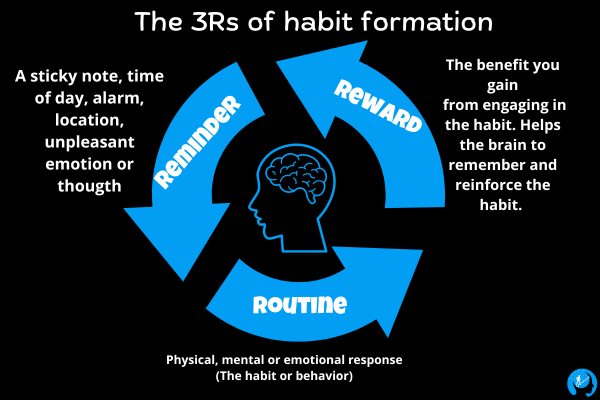
By identifying the cues and rewards that trigger and reinforce our habits, we can take control of our behaviors and make positive changes in our lives.
By understanding these elements, we can better navigate our way towards lasting change.
Picture this: every time you get home from work, you’re greeted by the enticing aroma of freshly brewed coffee from your local cafe (cue).
You find yourself stopping by for a cup of coffee (routine) and relishing the warm, satisfying taste that provides a much-needed energy boost (reward). This simple loop has become ingrained in your daily routine.
Now, let’s say you want to change this habit to save money and cut back on caffeine.
Armed with an understanding of the habit loop, you can devise a plan of action. Begin by identifying the cue, which is the aroma of coffee.
Next, focus on replacing the routine, perhaps by brewing a cup of herbal tea at home instead. Finally, ensure that the new routine provides a comparable reward, such as a soothing and comforting taste that still gives you a sense of relaxation.
By dissecting the habit loop, we’re better equipped to make informed decisions about how to change our habits.
It’s like solving a puzzle: once we see how the pieces fit together, we can swap out the unwanted pieces for new ones that align with our goals. This process of understanding and modifying the habit loop can be a powerful ally in creating lasting, positive changes in our lives.
So, grab your map and compass, and let the habit loop guide you on your journey to a better, healthier you!
Strategies for interrupting and replacing unwanted habits
Imagine your life as a bustling city, with roads representing your habits.
Some roads are frequently used, leading you to undesirable destinations like procrastination or unhealthy snacking. Others, less traveled, could guide you towards more positive outcomes.
The key to changing your habits lies in interrupting the old routes and constructing new, more desirable paths.
Let’s say your daily commute takes you past a bakery, where the aroma of fresh pastries (cue) lures you in for a treat (routine), and the delicious taste leaves you satisfied (reward).
Over time, this route becomes an ingrained habit, as automatic as turning on your blinker at an intersection. To change this habit, you’ll need to employ some clever strategies.
First, try altering the route you take to work.
By avoiding the bakery altogether, you can prevent the cue from activating your habitual response. This is like constructing a detour in your city, steering you away from the temptation of the pastries.
Next, find a healthier alternative to satisfy the craving for a treat.
Maybe you could pack a nutritious snack that still feels indulgent, like a piece of dark chocolate or a handful of nuts. This new reward helps solidify the new habit, like building a new road that leads to a beautiful park.
Lastly, enlist the help of friends or coworkers to keep you accountable.
Share your goal with them, and ask them to check in on your progress. Their support can act as a roadblock, making it more difficult to slip back into old habits.
By employing these strategies, you can effectively interrupt and replace unwanted habits, constructing a new, more efficient network of roads in your mental city, ultimately leading to the formation of better habits for a healthier and more successful life.
Remember, it takes time and effort to build new paths, but with perseverance, you’ll soon find yourself effortlessly cruising towards a healthier and happier lifestyle.
The role of mindfulness and self-awareness in habit change
Imagine your mind as a vast, open sky, with thoughts and emotions passing through like clouds.
Some clouds are big and dark, signaling unwanted habits, while others are small and fluffy, representing positive changes. Mindfulness and self-awareness are like the radar system that helps you identify and track the clouds, allowing you to navigate your mental landscape more effectively.
Picture this: one day, you notice that whenever you’re feeling stressed, you reach for a bag of chips.
You munch away, and the crunching sound temporarily soothes your nerves. Through mindfulness, you become aware of this pattern – the stress cloud appears, and the habitual response follows.
Instead of getting lost in the storm, you learn to observe the cloud from a distance and recognize the connection between your emotions and your actions.
Now that you’ve identified the pattern, you can take steps to change it.
When stress arises, pause for a moment and take a few deep breaths. This simple act of mindfulness can create a gap between the cue (stress) and the routine (eating chips), allowing you to choose a different response.
Perhaps you could take a short walk or do some deep breathing exercises to calm your nerves. This new action acts like a gust of wind, gently steering the dark cloud away from the well-worn path and towards a more desirable destination.
As you practice mindfulness and self-awareness, you’ll become more adept at spotting the cues and patterns that drive your habits.
Each time you choose a healthier response, you’re rewiring your brain and changing the course of the clouds. Before long, the once-stormy sky will clear, revealing a brighter, more intentional landscape of positive habits and improved well-being.
Conclusion on The Psychology of how Habits are formed
In conclusion, understanding the psychology of habit formation is a powerful tool for personal growth and self-improvement.
Recognizing that habit formation is the process through which our behaviors become automatic, will help you effectively harness this knowledge for positive change in your life.
Through exploring concepts like the habit loop, classical and operant conditioning, cognitive processes, emotional aspects, and various strategies for creating and maintaining positive habits, I have uncovered the intricacies of how habits are formed and changed.
The journey through the realms of habit formation psychology has demonstrated that with awareness and intention, we can break the chains of unwanted habits and build new, positive ones.
By utilizing this knowledge, you hold the key to unlocking your full potential and taking charge of your life.
Studying and modeling habit formation in successful individuals offers insights into creating and maintaining our own positive habits in daily life.
As you venture forth, remember that transforming your habits is a continuous process that requires dedication and persistence.
The science of habit is a fascinating field that delves into the intricacies of how our behaviors become habits, and how certain habits can shape our lives. Every habit we develop is formed through a process of repetition and reinforcement, eventually allowing our brain to go into automatic mode when performing the behavior.
Research has shown that, it takes an average of 66 days for a behavior to become a habit. However, the time required for a habit to form can vary depending on the complexity of the behavior and the individual’s level of commitment.
Habits are often formed when a behavior is performed frequently and consistently, eventually leading to the development of automaticity, where actions are carried out with little or no thought.
The psychology behind habit formation is closely linked to the concept of self-control. Interestingly, individuals with high self-control may not necessarily have an innate ability to resist temptation; rather, they have developed habits around avoiding temptations in the first place.
This insight can be helpful when working towards creating the habits you want in your life.
Habit learning can be a powerful tool for personal growth and self-improvement. By understanding the factors that predict which behaviors will become habits, we can tailor our approach to habit formation more effectively.
For example, by focusing on small, achievable goals, we can increase the likelihood that our desired behaviors will become habits over time.
In conclusion, the science of habit offers valuable insights into how habits are formed and how they govern our lives.
By understanding the principles of habit formation, such as the importance of repetition and the development of automaticity, we can take control of our lives and create lasting, positive change.
You have the power to shape your life and improve your well-being through the choices you make each day.
So, let the insights gained from understanding the psychology of habits be your guiding light, leading you toward a brighter, healthier, and more fulfilling future.
Transform Your Habits, Transform Your Life
Are you ready to turn the page to a new chapter in your life?
Stop dreaming, start achieving. Our exclusive newsletter delivers:
- Science-backed hacks: Master the psychology of habit formation used by CEOs and Olympians.
- Actionable strategies: No fluff, just practical steps to crush procrastination and dominate your goals.
- + a FREE surprise bonus 🎁 to jumpstart your transformation!
Don’t settle for mediocre. Subscribe now!